Officials from the Ministry of Culture, Tourism and Citizens, the Ministry of Home Affairs, and the Ministry of Finance have expressed ignorance about the financial collection being made in the name of Ramgram.
We use Google Cloud Translation Services. Google requires we provide the following disclaimer relating to use of this service:
This service may contain translations powered by Google. Google disclaims all warranties related to the translations, expressed or implied, including any warranties of accuracy, reliability, and any implied warranties of merchantability, fitness for a particular purpose, and noninfringement.
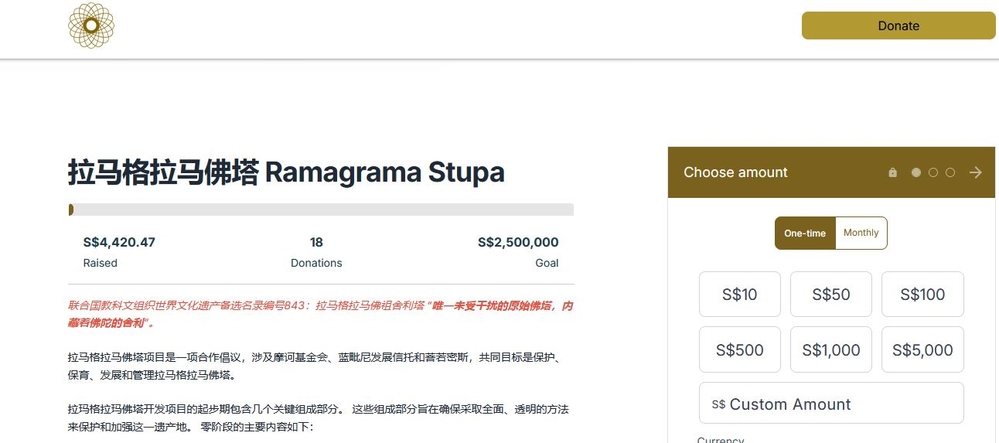
A foreign organization is illegally collecting donations in the name of development, conservation and management of the Ramgram area of Nawalparasi, where the ashes of Gautam Buddha are enshrined. The Moksha Foundation, which has an office in Singapore, is collecting funds illegally in collaboration with The Promised Land, headed by Nikesh Adhikari. The executive director of the Moksha Foundation is James Seng.
The foundation has set a target of collecting 2.5 million Singapore dollars for the ‘conservation, promotion, development and management of the Ramgram Stupa and its relics’. The foundation’s website states that 4,420.47 dollars have been raised from 18 donors. However, the government has not approved the financial collection and construction of the structure. Officials from the Ministry of Culture, Tourism and Civil Affairs, the Ministry of Home Affairs and the Ministry of Finance have expressed ignorance about the financial collection being carried out in the name of Ramgram.
Nikesh, the head of ‘The Promised Land’, is the son of controversial businessman Sharda Prasad Adhikari. He is also the former housewife of former Prime Minister Pushpa Kamal Dahal. Two years ago, when Dahal was the Prime Minister, preparations were made to lease about 120 bighas of land in the Ramgram area to Moksha Foundation and ‘The Promised Land’ for 99 years.
Without taking approval from the Ministry of Culture, Tourism and Civil Aviation and the Ministry of Finance, the Vice-Chairman of the Trust, Lharkyal Lama, had unilaterally decided to hand over the Ramgram area to ‘The Promised Land’ and the Moksha Foundation. The ‘Ramangram Area Master Plan’, which was taken forward based on the decision of the Vice-Chairman of the Trust, was laid by the then Prime Minister Dahal on 26 Mangsir 2080.
The Trust had entered into an agreement to lease out about 116 bighas of land belonging to locals, 75 kattas of the Trust and 10 kattas of the Department of Archaeology. On 15 Magh 2080, Kantipur published news about the collusion in which the land was secretly leased out for the purpose of excavating the Buddha’s ash-metal tomb and constructing structures. It was soon revealed that none of the Department of Archaeology, the Ministry of Culture, Tourism and Civil Aviation, the Ministry of Finance and the Council of Ministers had given approval to the Foundation for the lease and heritage excavation.
An investigation by the Public Accounts Committee of the House of Representatives and the Ministry of Culture found that the decision to lease out the historical heritage site was made in bad faith. The Accounts Committee instructed the government to cancel the process on 29 Magh 2080. The next day, on 1 Falgun 2080, the ministry canceled all the processes. However, the Moksha Foundation and ‘The Promised Land’ have started collecting funds in the name of the canceled project.
The Moksha Foundation’s Executive Director James Seng is described on the website as a ‘visionary and has spent 3 decades in the technology industry’. Song Suang Ping is shown as the director of the Ramgram Stupa program on behalf of the foundation. Kay Ti Tan is called the project advisor.
It was Seng, the Executive Director of the Foundation, who worked with ‘The Promised Land’ to raise the main investment for the master plan. An agreement was reached between Seng, Nikesh, the head of ‘The Promised Land’, and Lama, the vice-chairman of the trust, to proceed with the project without the government’s approval. ‘The Promised Land’ was shown as the manager of the structure to be built in Ramgram.
Hari Prasad Mainali, Secretary of the Ministry of Culture, Tourism and Civil Aviation, said that the government has not given permission to anyone for the excavation of heritage sites, construction of structures, and other works in the Ramgram area. ‘The ministry has not given permission to anyone to collect donations related to this,’ he told Kantipur, ‘You cannot collect support against the law.’
Lama, the vice-chairman of the Lumbini Development Trust, said that the larger project related to Ramgram has been stopped. ‘We are not doing that project, it was made controversial for no reason,’ he said, ‘We have not talked about donations from our side.’
Madhav Poudel, a former minister and former secretary of the Ministry of Law, says that collecting financial support without the government’s approval is punishable. ‘The Donation Act itself has made it clear that donations can or cannot be collected, and government approval is mandatory for this,’ he says. ‘Furthermore, if someone raises funds without permission by showing off heritage of national pride, it is also a crime of fraud, and the government’s attention should be drawn to this immediately.’
Former Secretary of the Ministry of Finance Krishnahari Baskota also says that it is punishable for foreign organizations to illegally collect donations by invoking the name of historical and archaeological heritage. ‘There are various forms of collecting donations, donations, and endowments. Some people help by saying that the bell in a temple is broken. Some people raise funds to support orphans. Some people call for help to build government/public structures through collective initiatives and labor donations, the government itself calls for donations to rebuild after unimaginable disasters, and donations raised for such works are a matter of concern,' he says, 'but it is punishable for a foreign organization to raise money for the excavation of historical and archaeological heritage and the construction of physical structures without the approval of state bodies. Those involved should be investigated and brought to justice.'
Section 3 of the Donation Act, 2030 states that 'no person or government/non-government office or organization shall raise or accept donations from anyone except those who voluntarily accept donations for religious, charitable or other public works without setting a rate, with the prior approval of the Government of Nepal or the Provincial Government.'
An employee of the Lumbini Development Fund said that since the Moksha Foundation did not take approval from the government even for the construction of the project, there should be no delay in investigating its unauthorized activities and bringing those involved to justice. "The government itself reined in the illegal activities of the project after it was exposed, but the illegal activities inside have not stopped yet, and it seems that donations are being collected as part of that," he said.
Lama, the vice-chairman of the fund, himself has a controversial background. He was appointed to the fund by the then Prime Minister Dahal in Shrawan 2080. After that, the game of leasing historical heritage to foreign companies was advanced.

