Another interim order prohibits the Supreme Court from implementing the decision to abolish the Land Commission and its district committees, which prohibits the government formed for the election from making decisions of long-term importance.
We use Google Cloud Translation Services. Google requires we provide the following disclaimer relating to use of this service:
This service may contain translations powered by Google. Google disclaims all warranties related to the translations, expressed or implied, including any warranties of accuracy, reliability, and any implied warranties of merchantability, fitness for a particular purpose, and noninfringement.
The Supreme Court has stayed the implementation of the government's decision to recall ambassadors from 11 countries and abolish the Land Disputes Resolution Commission. Separate benches of the Supreme Court have issued interim orders, stating that a government formed for the elections cannot take decisions of long-term importance.
The Supreme Court has issued an interim order, but those decisions will not be implemented immediately.
The Cabinet led by Sushila Karki, which was formed after the Gen-G movement, had decided to abolish the Land Problem Resolution Commission and its district committees on 23 Asoj. A week later, on 30 Asoj, the decision was made to recall Nepali ambassadors from 11 countries.
The writ petition filed against the decision to recall the ambassador was kept under review and debate began on Friday. After the debate ended on Sunday, a bench of Justices Saranga Subedi and Shrikant Poudel ordered that the ambassador not be recalled until the case is resolved.
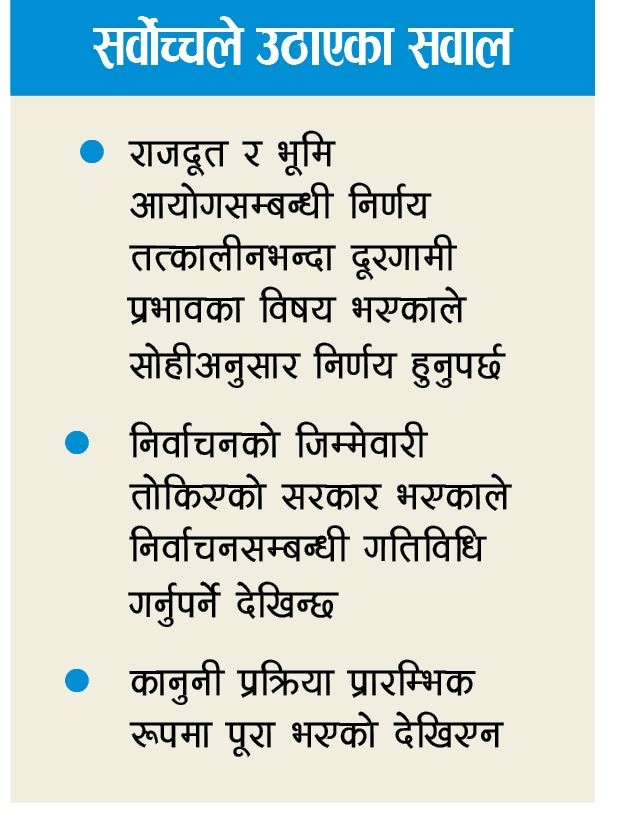 The Supreme Court has concluded that it is not appropriate in the current situation to mobilize and recall ambassadors who act as government representatives, even without a parliamentary hearing, even though it is the prerogative of the government. The Supreme Court has also reminded that a government formed for election purposes cannot make such a decision. The Supreme Court order states that the term of office of the recalled ambassador is still pending, the reason for the recall was not mentioned in the decision of the Council of Ministers, and no action has been taken regarding the new appointment of the ambassadorial post that will be vacant.
‘It appears that the current interim government has been formed to hold another election to the House of Representatives within six months in accordance with the constitutional provision entrusted to the President by the Constitution. Since the dissolution of the House of Representatives, taking into account Article 292 of the Constitution, it appears that the ambassadorial post will not be filled immediately, but rather will become vacant,’ the order states.
The Supreme Court also said in the order that the decision to recall the ambassador is likely to affect Nepal’s international relations. ‘There is no reason to confirm the necessity and justification for the decision to recall only 11 of the 17 resident ambassadors appointed on the same date as recommended by the then Council of Ministers,’ the Supreme Court order states.
Section 8(a) of the ‘Directive on Appointment of Ambassadors, 2075’ states that ‘the term of office of an ambassador shall be four years from the date of his/her arrival at the mission’. Section 8(b) states that ‘the Government of Nepal may, if it deems necessary, decide to recall the ambassador before the completion of his/her term of office’. Based on the recommendation made by the KP Sharma Oli government on 14 Shrawan 2081, 17 ambassadors were appointed in a phased manner.
The decision to recall Nepali ambassadors to China, Germany, Israel, Malaysia, Qatar, Russia, Saudi Arabia, Spain, Britain, America and Japan was taken on 30 Asho. Advocates Pratibha Upreti and Anantaraj Luintel had filed a writ petition in the Supreme Court seeking the annulment of the government’s decision to recall the ambassadors. The Supreme Court has stated in its interim order that since ambassadors are deployed for the benefit of Nepalis who go to those countries for study, employment and various other work, their appointment and recall should be considered a matter of public concern.
The Commission's Chairman Hari Prasad Rijal had filed a writ petition against the government's decision to abolish the Land Problem Resolution Commission and all district committees. In that case, a bench of Supreme Court Justice Meghraj Pokharel had issued a short-term interim order on 11 Kartik. In that, a bench of Justices Kumar Regmi and Shantisingh Thapa ruled on Thursday that the short-term interim order would continue.
The government had decided to abolish the commission and district committees formed under the Land Problem Resolution Commission Formation Order 2081, saying that the commission was a recruitment center for cadres and had added financial burden and was preparing for irregular land distribution.

