The army airlifted 61 people, including VIPs and family members, after protesters intensified their arson and vandalism of government and private structures on 24 Bhadra.
We use Google Cloud Translation Services. Google requires we provide the following disclaimer relating to use of this service:
This service may contain translations powered by Google. Google disclaims all warranties related to the translations, expressed or implied, including any warranties of accuracy, reliability, and any implied warranties of merchantability, fitness for a particular purpose, and noninfringement.
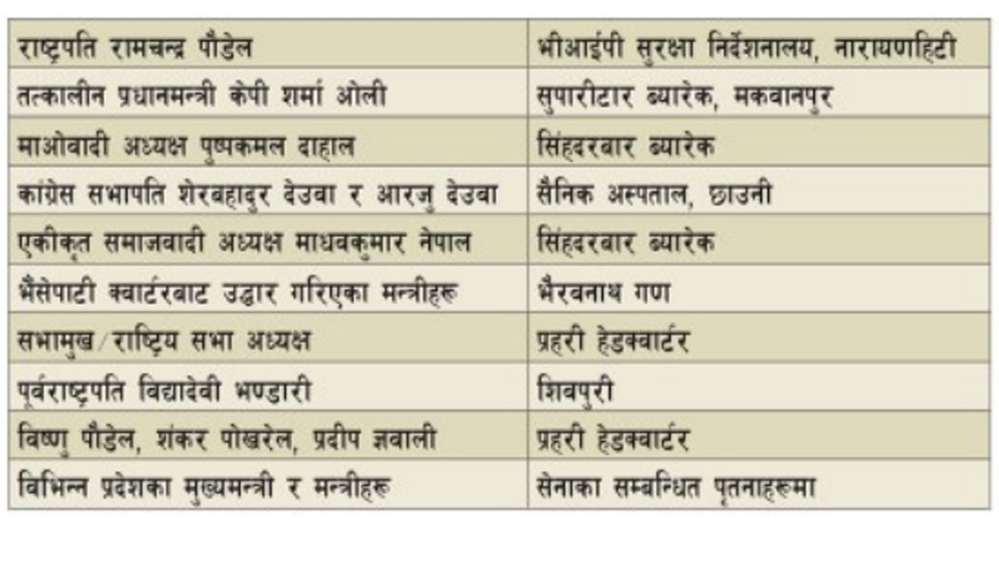
It has been revealed that the Nepal Army has airlifted 61 people, including highly distinguished/distinguished individuals and their family members, after protesters intensified arson and vandalism of government and private structures on Bhadra 24. The army has informed that KP Sharma Oli, who resigned as Prime Minister, was airlifted on Bhadra 24 and placed in Suparitar Barracks in Hetauda and the outgoing minister was placed in Bhairavnath Battalion in Kathmandu.
According to Lieutenant General Anup Jung Thapa, Director General of the War Operations Directorate of the Army Base, the security of the VIPs has been provided as per the Security Management Procedure for VIPs, 2077. ‘The procedure clearly states what should be done in various situations, it is an international norm that the knowledge about the country carried by the VVIP person and his appointment should be protected,’ he said, ‘In the process of protecting it, the area has been narrowed down to the relevant places.’
The procedure has placed the President, Vice President, Prime Minister, Chief Justice, Speaker of the House of Representatives and Speaker of the National Assembly among the VIPs. The VIPs include former presidents, deputy prime ministers, government ministers, former presidents, former prime ministers, etc.
According to Lieutenant General Thapa, the army had repeatedly informed the government that a dangerous situation could arise. ‘As such incidents have occurred globally and even in the neighborhood, the Nepali Army had informed the relevant responsible persons here from time to time,’ he said, ‘but, the scale and intensity of the incident was probably bigger and more than anyone had expected.’
Military officials say that Thapa was referring to the repeated ‘briefings’ given to the then Prime Minister KP Sharma Oli. The army ‘briefs’ the prime minister directly on a weekly basis about the country’s security challenges. ‘Ashok Sigdel Chief Saab had been saying for two/three months that there was a lot of dissatisfaction among the people, which could manifest itself in different ways at any time,’ said an army officer. ‘However, the prime minister was never sensitive to the army’s statements, and in fact, he had stopped listening to the army’s briefings the last time.’
Military officials had begun to feel that Oli was not taking the army seriously. In such a situation, military officials believe that the situation got out of control due to the failure to exercise restraint during the protest by Zen-G on 23 Bhadra.
Chief of Army Staff Ashok Raj Sigdel and the heads of all four security agencies had reached the Prime Minister's official residence in Baluwatar at 11 am on Bhadra 24, saying that the movement had gone out of control. However, after Oli sat down and narrated the history of Sikkim's merger with India even in difficult circumstances, the security officials including Chief of Army Staff Sigdel had separate discussions. Oli's resignation came after everyone concluded that 'if you leave now, you will have to return later, otherwise you cannot say'.
After resigning, Oli was rescued by helicopter from Baluwatar and taken to the Suparitar barracks in Hetauda. His wife Radhika Shakya and personal secretary Rajesh Vajracharya were also taken to the barracks by helicopter.
Speaker Devraj Ghimire, National Assembly Chairman Narayan Dahal, UML Vice Chairman Shankar Pokharel, leaders Bishnu Poudel, and Pradeep Gyawali were stopped in Baluwatar. “They had reached there after being told to leave the Prime Minister’s residence via an army helicopter, but it was for the Prime Minister and his family,” said a security source. “The army officer had said that he would come back to pick up others, but within a few moments, protesters had entered from outside.”
The leaders, including the Speaker, the National Assembly Speaker, and others, had gone to the police headquarters via another route under police and army escort from Baluwatabar. “Since the helicopter was no longer able to land, we confirmed which route we could take,” said a senior police officer. “Then we took them to the headquarters via a route with fewer protesters.”
At 2 am, the leaders had started going to various places from the police headquarters. “Later, it became the case that only Speaker Ghimire would be at the headquarters. He also went to stay at the residence,” said the officer. “He came to the headquarters again in the morning, and the situation was under control from the next day.”
The ministers were rescued from their quarters in Bhainsepati, Lalitpur. ‘The level of anger among the people was so high that they did not leave a single thing they were using,’ said an army officer. ‘After assessing the situation, we kept most of the ministers and their families in Bhairavnath Gana.’
A group of protesters had even reached the gate of Bhairavnath Gana. The army turned them away after explaining that there was no one there. ‘If there was any force, the officers were instructed to use force,’ said the army officer. ‘The policy is not to use force, but if there was a difficulty while working under security procedures, we could not remain silent.’
The chief ministers and ministers in various provinces were staying in their respective quarters. ‘As per the policy that the lives of prominent people should be saved first, instructions were given to provide security everywhere,’ said the army officer.
According to an army officer, Maoist Chairman Pushpa Kamal Dahal had been contacting Army Chief Sigdel since morning. He had earlier warned in Parliament that a situation like that of Bangladesh and Sri Lanka could arise. ‘That could have happened by assessing the situation, he was in constant contact with the army since morning,’ said a senior army officer. ‘When he reached Singha Durbar in the morning after calling a meeting of the opposition party, the situation had deteriorated. We had asked him to stay safe in the army barracks inside Singha Durbar.’
Madhav Kumar Nepal, the president of the United Socialist Party, was also staying inside Singha Durbar. ‘I was allowed to enter the Narasimha Dal after reaching the army barracks near Singha Durbar and telling him that he was also the former defense minister,’ Nepal said in an article. ‘Chief Justice Prakash Man Singh Raut, Judge Sapna Malla Pradhan and others were also brought to this barracks.’ He mentioned that his personal secretary Laxman Aryal, leader Metmani Chaudhary and Nepal Samajwadi Party president Mahindra Rai were also with him at that time.
According to army officers, contact was made with Congress president and former Prime Minister Sher Bahadur Deuba at around 11 am. ‘Prachanda had already reached the security perimeter of the army, Oli had not resigned as Prime Minister,’ said an army officer. ‘In that case, the War Operations Directorate had been instructed to rescue others even before the meeting with Oli in Baluwatar.’
Military officers say that Deuba was also given the message that the security threat had increased since he was responsible for protecting a prominent person, but he did not take it seriously. But Deuba responded by saying, ‘I have no challenge, the people here are with me.’ ‘It was understood that he was not aware of the situation outside,’ said the source.
Deuba’s wife and then Foreign Minister Arju Rana gave a positive message for the rescue, but the team went elsewhere after Deuba stopped it, according to army officers. By the time they started calling repeatedly asking for help for the rescue, it was too late. After the crowd of violent protesters started entering their house, it was not possible for even an additional police team to go.
The Deuba couple were beaten up by protesters at their own residence. ‘As soon as we received information that the protesters were trying to enter the house, we sent an army helicopter,’ an official said, ‘but the protesters were so aggressive that it was very difficult to land.’ The Deuba couple were later rescued and taken to the military hospital camp. They were then kept in a barracks in Kathmandu under the supervision of doctors.
President Ram Chandra Poudel was kept at the office of the Directorate of Security of Visible Persons in Narayanhiti on the night of 24 Bhadra. A day later, he returned to the building behind Sheetal Niwas. ‘The area behind Baluwatar and Sheetal Niwas is intact, the cordon was narrowed and the area was kept in a safe place since the VIP had to be protected,’ said Lieutenant General Thapa on Friday.

