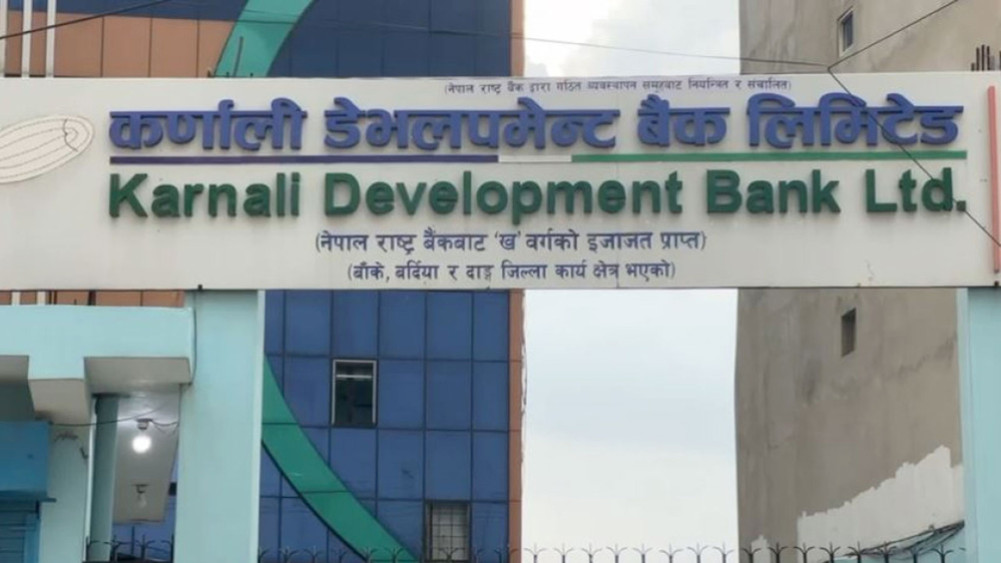
During the Gen-G movement, 900 pages of documents containing statements in the Karnali Bikas Bank scam case held at the CIB were taken out, and some of them were found to have been set on fire.
We use Google Cloud Translation Services. Google requires we provide the following disclaimer relating to use of this service:
This service may contain translations powered by Google. Google disclaims all warranties related to the translations, expressed or implied, including any warranties of accuracy, reliability, and any implied warranties of merchantability, fitness for a particular purpose, and noninfringement.
It has been revealed that some documents related to the Karnali Bikas Bank scam case, which were kept in the ‘pillar’ of the Central Investigation Bureau (CIB) of the police investigating economic crimes, were destroyed during the Gen-G movement. It was found that the protesters vandalized the pillar on economic crimes on the ground floor of the CIB in Lazimpat and brought a 900-page missile of the Karnali Bikas Bank to the street and set it on fire.
According to the Bureau's Superintendent of Police (SP) Niranjan Dutta Bhatta, the statements and interrogation documents prepared after the investigation into the bank's irregularities have been burnt. 'CCTV footage shows that 900 pages of statements were taken out and blown up,' he said. 'It appears that the documents were taken away by breaking glass.' According to him, some of the papers were even set on fire.
The CIB had completed its investigation into this irregularity case two months ago and submitted a report to the Office of the High Government Prosecutor, Banke, concluding that there was a scam of Rs 3.2 billion.
The CIB had arrested the then Chief Executive Officer of the bank, Rajendra Bir Rai, the then Chief Financial Officer, Ved Prakash Singh Thakuri, the then Chairman of the Board of Directors, Pashupati Dayal Mishra and Bhuwan Basnet in this case. A case of banking offences was filed against 107 people including them.
The defendant in this case, Mishra, is also a central member of the UML. He was a candidate from Banke-2 in the 2074 BS House of Representatives election. At that time, he was defeated by taking only the UML election symbol. He later joined the party. Rai, who fled Nepal after committing a bank scam, was living in an apartment in Lucknow, India.
According to the police, he was involved in banking crimes and was also close to various political parties. He was once associated with the RPP and joined the UML in 2079 BS. In the same year, he became a candidate for the House of Representatives from Salyan. After suffering defeat in the election, he left the UML and joined the Civil Liberation Party. He last joined the Maoist Center.
This bank, which has its head office in Nepalgunj, was declared crisis-ridden on 10 Poush 2081 BS. Then, according to a letter sent by the Rastra Bank, the CIB initiated an investigation. During the investigation, it was found that the bank employees were embezzling money by withdrawing cash directly from the vault and counter and even by creating fake debtors.
According to an officer involved in the investigation, it was found that after the land was passed in the name of the borrower, industrial loans were disbursed by keeping it as collateral and even that was not used for the industry. Officers say that it was found that the depositors' money was deposited in other banks, but the money was not deposited at all.
The CIB had also arrested Bhuwan Basnet, the former monitoring officer of the Nepal Rastra Bank, during the investigation of this case. The police had accused him of giving a report stating that the bank's condition was fine even when the bank was in serious crisis. The CIB had initiated an investigation after finding a report given by the monitoring employee stating that the bank was fine even when it was in crisis.
‘It has been found that he was offered various inducements by the officials of Karnali Bikas Bank, and about 1 million rupees were found in his account,’ said an officer involved in the investigation, ‘In his statement, he claimed that the money was obtained by selling his property.’
This case is pending in the High Court, Tulsipur, Nepalgunj bench. After the initial hearing, the court had ordered the remand of former Chief Executive Officer Ray, former Chairman Mishra and Finance Department Chief Thakuri for trial. Basnet, a former employee of the National Bank, was ordered to be released on bail of 200,000 rupees.
A sum of 2.63 billion 32 million 16 thousand 597 rupees was fixed against Ray, who is also the founding chairman of the bank, 820 million 46 million 29 thousand rupees in the name of former Chairman Mishra and 240 million 63 million 99 thousand rupees in the name of the bank’s finance department chief Singh Thakuri.
Some experts suspect that vested interests may have been involved in the destruction of the files in the serious case. ‘There have been reports that certain files were burned in the court and the government attorney’s office, which raises suspicions that other vested interests may have infiltrated the Gen-G movement,’ says Hemant Malla Thakuri, who is also the former head of the CIB. ‘Therefore, the investigation report, the files in the court, etc., should be examined in detail.’
Apart from the Karnali Bikas Bank file, three CPUs of the CIB have been damaged. Its hard disk has been sent to the digital forensics lab for recovery, officials say. ‘Two laptops and a mobile phone have also been seized, all of which are being examined,’ says SP Bhatta of the bureau.