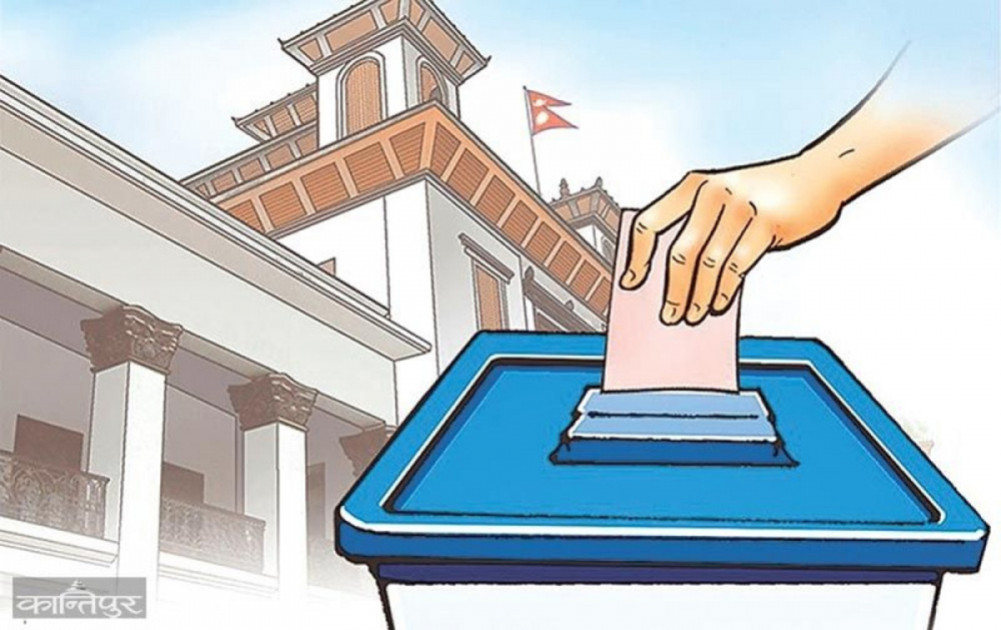
The right to vote at the age of 18, but only those who have reached the age of 25 can be candidates for the House of Representatives
We use Google Cloud Translation Services. Google requires we provide the following disclaimer relating to use of this service:
This service may contain translations powered by Google. Google disclaims all warranties related to the translations, expressed or implied, including any warranties of accuracy, reliability, and any implied warranties of merchantability, fitness for a particular purpose, and noninfringement.
According to the constitutional provision of age limit for candidates, young voters have to wait years to become a candidate. It has discouraged youth representation in the country's politics.
There is a legal provision to be considered a youth after reaching 16 years of age and obtain citizenship. Citizens who have completed 18 years of age have the right to vote. They have the right to elect people's representatives in the local, state and union. However, they cannot be candidates at any level. To be a candidate for the House of Representatives or the State Assembly, the age must be 25 years.
They are eligible to be candidates only after 7 years of having the right to vote . Young people in the age group of 18-24 are eligible to elect a person to rule over them. However, rather than being a candidate, they are disqualified. In the case of the local level, the constitution stipulates that the candidate must be 21 years of age. Young people in the age group of 18-20 who have qualified as voters cannot be candidates there.
Article 84 (5) of the Constitution has given every citizen who has completed 18 years of age the right to vote in one of the constituencies for the House of Representatives according to the federal law. Article 87 (1) states that to be a candidate for the House of Representatives, one must be 25 years of age. There is a similar arrangement in the case of the Provincial Assembly. In Article 178 of the Constitution, there is a provision that the age limit for the members of the Provincial Assembly must be 25 years. Similarly, according to Article 222 (5) of the Constitution, it is mentioned that the candidate must be at least 21 years of age to be eligible to run for the post of Chairman, Vice Chairman, Ward Chairman and Member of Rural Municipality/Municipality.
The National Youth Council Act, 2072 defines youth as a person aged 16 to 40 years. The National Youth Policy, 2082 introduced by the government on August 2 has changed the definition of the youth age group and in the context of Nepal, the age group of 18 to 35 years is considered youth. However, as the law has not been amended accordingly, according to the law, people in the age group of 16 to 40 are still defined as youth.
- Four million young people in the age group of 18-24 cannot be candidates
- The constitution completely bans the entry of young people to constitutional bodies and judges of the Supreme Court
Australia, Turkey, Slovakia, Britain, France, Germany, Spain and many other countries in Europe have a provision to be able to be candidates if they reach the age of 18. Similarly, in Denmark, Norway and Sweden, there is also a provision to be a candidate at 18 years of age . America, Italy, Greece, Japan and India have set a limit of 25 years to be candidates for parliament. Nepal seems to follow the same .
According to the National Census, 2078, the number of youth in the age group of 16-40 years is 42.56 percent of the total population. Even within the youth group, the number of people aged 18-24 years is high . One third of the total youth population falls in this age group. Those who can vote but cannot be candidates. According to the census data, the number of youth in the age group of 18-24 is 3995 thousand 456. A large number of youths who participated in the movement on 23 and 24 August were also of this age group. However, they will not be eligible to be candidates.
The law does not prohibit the youth group of 25-40 from becoming prime minister or minister if they win the majority in the House of Representatives. However, the political parties have not given priority to the youth in the selection of candidates. According to a study conducted by the Democracy Research Center (DRCN), 2,412 candidates were nominated for 165 constituencies in the 2079 House of Representatives elections. Among them, 759 people, i.e. 30 percent of the total candidates, were under 40 years of age. Among the youth candidates, there were 403 candidates from various parties and 356 candidates from independent parties. Among the winners were only 10 people under 40 years of age .
- Every party is using youth power in the name of various fraternal organizations, but rarely gives space to the youth when given the opportunity. However, they have always hesitated to give them a place in the mainstream politics . The youth is not given a proper share in the decision-making process of the party, making candidates for the representative assembly, state assembly or local level . Shekhar Parajuli, executive director of

center, says that parties use youth in party programs, election campaigns, protests and processions. "Each party is using youth power in the name of different fraternal organizations". They try to make a ladder for them to climb up,'' he said, 'but, when given the opportunity, it is found that the youth is rarely given a place . It is very weak for the youth to get a place in the party or in the election.
He says that the parties are bound by the concept that old and senior people are better. He mentioned that it is customary for those who are in the position of distributing tickets to make candidates by trusting only those who are close to them and trust them so that there is no loss in their power . That's why certain people keep repeating. Those who are candidates in 2046 are still getting tickets. It has been made difficult for the new ones to find a place in the old parties," he said.
He mentioned that the constitutional system is an obstacle to the representation system based on the population of the youth group. He interprets the setting of adult suffrage at 18 years but the age of entry into the state or the House of Representatives at 25 as unequal treatment .
- Whether it is to be a candidate or to be appointed to a constitutional body, age has been made the main basis, it has made it difficult for the youth to reach leadership roles
Nirmal Kumar Upreti, Advocate
There is a constitutional provision that only persons who have completed 35 years of age can run for candidacy in the National Assembly, the upper house of the federal parliament. The constitution itself has restricted the entry of the young age group to the presidency, vice president and constitutional bodies. There is a constitutional provision that only persons who have completed at least 45 years of age can be candidates for President and Vice President .

Similarly, there is a provision that the chief commissioner or commissioner of the Abuse of Authority Investigation Commission, the Auditor General, the chairman or member of the Public Service Commission, the chief commissioner and commissioner of the Election Commission, the chairman and member of the National Human Rights Commission must be at least 45 years of age . Similarly, the constitution has set the age limit of 45 years to be the chairman or member of National Natural Resources and Finance, Tribal Tribes, Women, Dalits, Inclusive, Madhesh, Tharu, Muslim Commission. There is a provision in the constitution that one must be 45 years old to be a judge of the Supreme Court.
Advocate Nirmal Kumar Upreti says that the constitution and laws have discriminated against the youth by making age the main basis for representation. "Be it being a candidate or being appointed to a constitutional body, age has been made the main basis in every place," he said. The constitution and laws have discriminated against the youth. Even if they have qualifications, the age limit has made the young people fall into the trap.
Advocate Upreti says that such a provision is against the right to equality given by the constitution. He said that Article 25 of the International Covenant on Civil and Political Rights of the United Nations, which Nepal is a party to, ensures that citizens with universal adult suffrage (universal and equal surface) will have equal rights to elect and be elected and to enter public service based on the universal principle of equality. Upreti says that since it is a party state, any law of Nepal should not conflict with the said arrangement.
United Nations refers to the age group of 15 to 24 years as youth . Based on that, the constitution and laws of Nepal prevent the entry of youth in many ways. Pradeep Pokharel, who has a long experience in election supervision, says that the 'merit' of the age set in the constitution has been controversial from the beginning. If the right to vote is given at the age of 18, the right to be a candidate should also be given at that age. We raised it when the constitution was being prepared," he said, "but it was not heard. Citizenship at the age of 16, right to vote at the age of 18 and the right to stand in the parliament at the age of 25 have created a situation where young people have to wait for many years. He says that according to the law, a person who has reached the age of 16 years has to wait 2 years to cast his vote, 4 years to be a candidate at the local level, and 9 years to be a candidate for the state and the House of Representatives. Pokharel, who is the founding chairman of the Election Supervisory Committee of Nepal and is currently an advisor to the organization, says that the representation and inclusion of groups other than those mandated by the constitution have been neglected by political parties or government agencies.
Constitutionalist senior advocate Radheshyam Adhikari, who has been a member of the Constituent Assembly, is considered to have continued the same in the constitution by looking at the practice elsewhere and the old system within the country. "Nothing else, maturity and experience should also work". It is only because of the belief that age increases the ability to see the society as a whole from a broader perspective," he said. "In other countries too, there is a provision that people who have reached the age of 25 in the lower house and 30-35 years in the upper house can be candidates . Similar age limits have been set for constitutional bodies and courts.
While other countries are correcting it, Nepal is under no obligation to continue following the old provisions adopted by them, he said. According to the demand of time, he suggests that the age limit should be reformed through constitutional amendment.