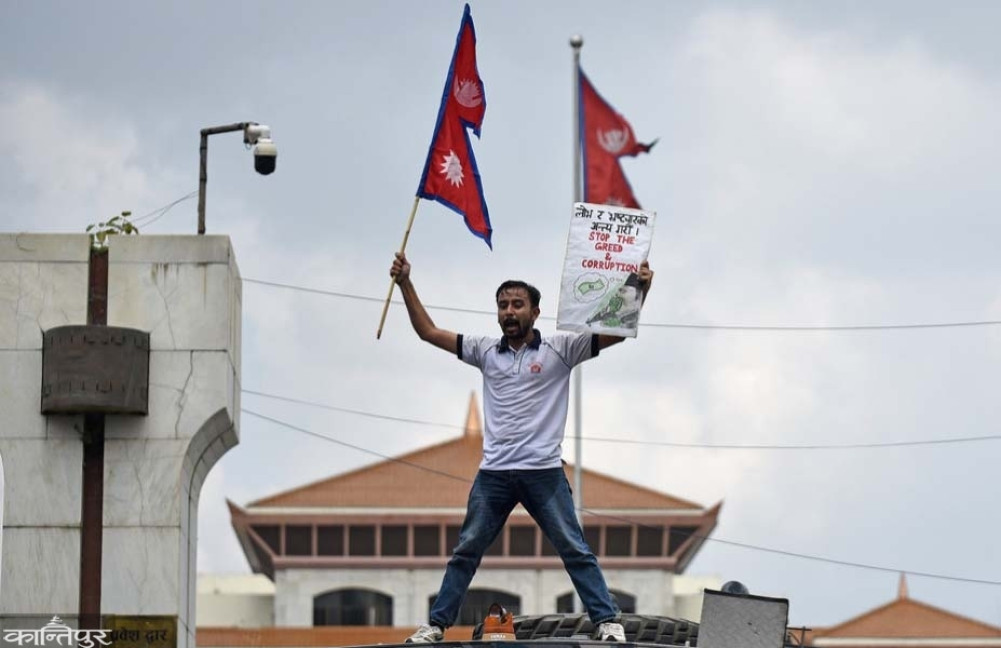
The state mercilessly opened fire on them, who engaged in a peaceful protest, in which 21 people lost their lives. Due to the barbaric activities of the state, the 24th movement turned violent. Finally, KP Sharma Oli resigned from the post of Prime Minister.
We use Google Cloud Translation Services. Google requires we provide the following disclaimer relating to use of this service:
This service may contain translations powered by Google. Google disclaims all warranties related to the translations, expressed or implied, including any warranties of accuracy, reliability, and any implied warranties of merchantability, fitness for a particular purpose, and noninfringement.
The youth of Nepal were angry because of long-standing corruption, lawlessness, inconsistency and unemployment. Especially the Gen-G (born from 1997 to 2012) generation was expressing their discontent in social media in a creative way against corruption and injustice.
 They were running 'Nepokid', 'Nepo Babies' campaign through social media such as 'TikTok', 'Reddit'. Meanwhile, the government decided to close 26 social networks including Reddit. In opposition to that, on August 23, Gen-J generation took to the streets .
The state mercilessly fired at them who were engaged in a peaceful protest, in which 21 people lost their lives . Due to the barbaric activities of the state, the 24th movement became violent. Finally, KP Sharma Oli resigned from the post of Prime Minister. Oli's exit was due to the Jen-G rebellion. An interim government has been formed under the leadership of Sushila Karki, who is also a former Chief Justice.
It is not only in Nepal that the youth rebellion took power. In other countries too, youth rebellion has brought down the power . Among them are the well-known youth movements from 2010's Arab Spring to 2025's Gen-G Rebellion.
'Arab Spring'
About a decade and a half ago, a revolution was born in the countries of North Africa and the Middle East. Which forced the dictatorial rulers who had been rooted for decades to kneel down. This popular revolution, known as the 'Arab Spring', is also known as the 'first big movement of the digital age' and the 'Facebook revolution'. In which social media played a very important role .
In December 2010, the fire of this rebellion started in Tunisia and by 2012, it had spread to Egypt, Libya, Yemen, Syria and Bahrain. This movement carried the grievances of years of dictatorial rule, corruption, uncontrolled unemployment, violation of human rights and restrictions on the political participation of citizens.
Tunisia's 'Jasmine' revolution
17 December 2010 . Mohamed Bouzizi of Tunisia committed self-immolation . He committed self-immolation after the local police confiscated his vegetable basket and insulted him. The video and news of Baujiji's self-immolation went 'viral' through social media. This incident exploded the anger among the Tunisian people at once . Which inspired the youth across the country to take to the streets and a movement was born. Which is known as 'Jasmine Revolution'.
As a result, massive public demonstrations against the then dictator Zine El Abidine Ben Ali began. The protest was so strong that the President was forced to kneel within a month of the protest. The 23-year-old regime has fallen . On 14 January 2011, he fled to Saudi Arabia with his family. This was the first victory of the Arab Spring. It gave new hope to the Arab and North African countries. In those countries also, the wave of people's rebellion started to spread .
The end of Mubarak's 30-year rule
Encouraged by the success of Tunisia, the people's movement also started in Egypt. From January 25, 2011, hundreds of thousands of protesters began gathering in Cairo's Tahrir Square. The crowd demanded the resignation of Hosni Mubarak, who had been ruling Egypt for 30 years. His reign was notorious for corruption, human rights abuses and political interference. The people who were irritated by Mubarak's dictatorial behavior were protesting at once .
Mubarak resigned on 11 February 2011 after 18 consecutive days of peaceful protests. This event reinforced the message that Arab political change is possible.
Gaddafi's downfall in Libya
With the power in the hands of the people in Egypt, the movement also started in Libya from February 11, 2011 . Protests began against Muammar Gaddafi, who has been in power for 42 years. However, Gaddafi refused to leave the regime . On the contrary, they adopted a policy of oppression on citizens. Which sparked a nationwide movement. As Gaddafi's repression escalated, the country entered a civil war . On March 27, 2011, NATO, a military alliance group of Western countries, entered Libya after Gaddafi's torture of civilians.
NATO launched airstrikes on Gaddafi's forces calling for humanitarian intervention. Gaddafi was killed on 20 October 2011. After the fall of Gaddafi, Libya plunged into political instability. Beset by division and violence . The situation in Libya is still the same.
Yemen's different scenario
During the 'Arab Spring', the then president of Yemen, Ali Abdullah Saleh, was trying to extend his tenure by amending the constitution. Demonstrations against him, who took power in Yemen for 33 years, began on January 27, 2011 .
Although those who started the movement demanded Saleh's resignation, he was not ready to give it . On the contrary, they started to increase the oppression on citizens . Dozens of protesters were killed in June 2011. After global pressure, he announced his resignation in November 2011, and in 2012 he left after handing over power through elections. Although elections were held in 2012, in 2014 the Houthi group (the main Shia community in northern Yemen) took control of the capital and weakened the government of then-President Abd Rabbuh Mansour Hadi. The civil war that started since then is still the same .
The capital Sana'a and most of the northern areas are under the control of the Houthi rebels . Even today, the political and security situation in Yemen is extremely unstable. Due to this civil war, 300,000 people have lost their lives by the end of 2021 alone.
Syrian uprising
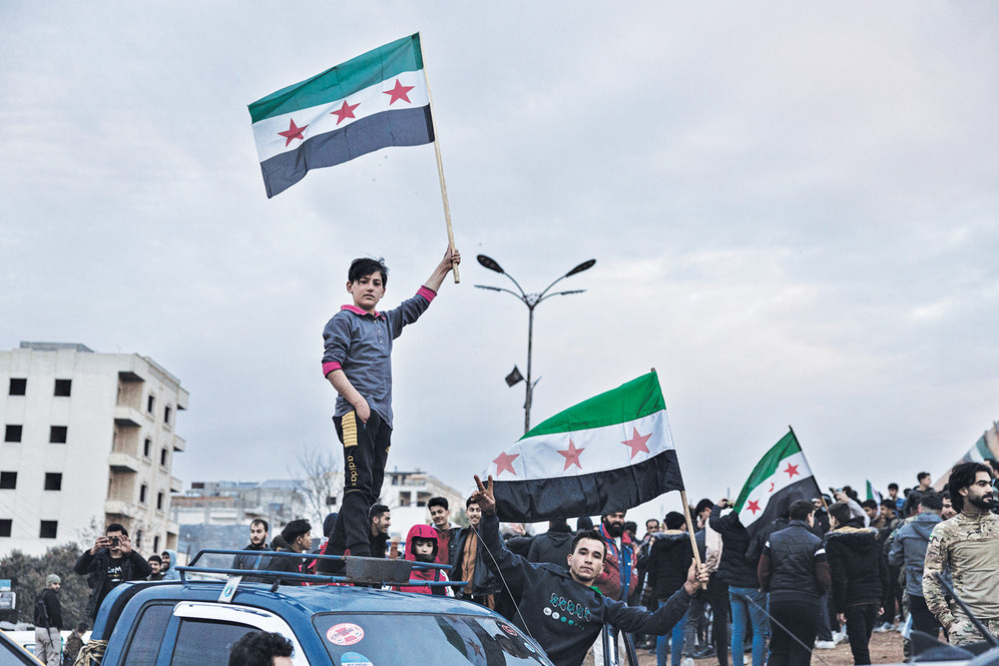
In March 2011 in Syria, some students were arrested for writing 'people want the fall of the regime' on the walls of the city of Deraa. Enraged by their arrest, the people who took to the streets demanded political reforms, an end to corruption, reducing unemployment and ensuring human rights. Although the demonstration was peaceful in the initial stages, the movement turned violent after the government started suppressing it.
Instead of addressing the voices of opposition, then-President Bashar al-Assad's government brutally repressed the protesters . As a result, the peaceful protest turned into a civil war . In 2012, rebel groups began fighting government security forces . Finally, in April 2013, ISIS (Islamic State) also emerged in Syria. Then began, the international intervention in Syria .
Since 2015, Russia has provided military support to al-Assad. Then the war displaced millions of civilians and killed thousands. Currently the war is not completely over until 2025 . Despite repeated peace talks by the international community, a permanent solution has not yet been found. It's been like a recurring sore.
The impact of the Arab Spring was also seen in Bahrain, Morocco, Algeria and Jordan. The Shiite majority in Bahrain demonstrated against the Sunni monarchy. But with the military support of Saudi Arabia, those demonstrations were suppressed. Smaller movements took place in Morocco, Algeria and Jordan, which brought some political reforms but failed to change power .
Hong Kong's 'Umbrella Movement'
Just as the 'Arab Spring' started a new chapter of people's revolution in the digital age, the 'Umbrella Movement' in Hong Kong in 2014 attracted democracy lovers from around the world . On 31 August 2014, the then Chinese government decided to hold direct voting (in 2017) for the election of Hong Kong's 'Chief Executive'. In which the candidates were said to be selected only by the pro-Beijing "Nominating Committee". The youth of Hong Kong protested against this decision. The youth termed this decision of China as 'fake democracy'.
Then from 22 to 26 September 2014, Hong Kong students started a 'class boycott' campaign against China's decision. Thousands of students gathered in 'Civic Square' and started demonstrating. This started the first phase of the movement . On 28 September 2014, the situation took a different turn. The police used tear gas and 'paper spray' on the protestors. To avoid this, the protesters used the umbrellas they had, which later became the hallmark of the movement - 'Umbrella Movement'. The repression of the police made the protestors more angry and the movement became stronger. Clashes between the police and the protesters started to increase, the situation became more tense . On 11 December 2014, the police forcefully evacuated the Admiralty demonstration site. With this, the 'Umbrella Movement' which lasted for 79 days has officially ended.
Although the 'Umbrella Movement' could not immediately establish democracy in Hong Kong, it created a long-lasting democratic spirit and awareness of resistance among the youth. On the basis of this movement, a big revolution took place in Hong Kong in 2019-2020, which is known as the 'Anti-Extradition Bill'. Which was the extradition bill proposed by China .
When the government proposed a law that would allow China to extradite suspected criminals, students, youth and citizens protested widely . Which proved how deep the influence of the Umbrella Movement was. Thus, the "Umbrella Movement" has been established as an important milestone in the history of Hong Kong's democratic struggle.
The Sudanese revolution and the Khartoum massacre
The Sudanese discontent that started in December 2018 against rising prices has suddenly turned into a massive movement . The protests that started in Atbar city on 19 December 2018 spread across the country within a few days. High inflation, rising unemployment, corruption and a decades-long authoritarian regime had brought citizens to the streets . Especially students, women activists and youth were at the forefront of the movement.
On April 6, 2019, thousands of citizens started a sit-in in front of the military headquarters in the capital, Khartoum. After constant pressure, the army took power by deposing President Basir on April 11, 2019. Then the peaceful movement turned violent. On June 3, 2019, at least 128 people were killed when the army attacked the protest site. Hundreds were injured. Women were raped . It is known as 'Khartoum Massacre'. But the people did not stop the movement.
After continuous pressure, an agreement was reached between the military council and the protesting parties in August 2019. An agreement was reached between both parties to hand over the power to the citizens. But after the military 'coup' again in 2021, the transitional process has become uncertain . Although this movement overthrew the Basir regime, the country has not yet entered full democracy.
Nigeria's 'IndSARS'
The 'IndSARS' movement in Nigeria in 2020 is recorded as an important event in the country's history. This movement was particularly focused against police repression and misrule.
In 1992, a police unit named 'Special Anti-Robbery Squad' (SARS) was formed for crime control. However, over time, this unit began to engage in serious crimes including murder, torture, kidnapping, extortion and rape. As a result, panic and anger arose among the common citizens. The 'EndSARS' movement started in October 2020 to end this unit. During the protest, a video of a "SARS" officer shooting a young man went "viral". Nationwide demonstrations started against that. The hashtag IndSARS spread widely on social media and millions of youth took to the streets. Soldiers opened fire on youths who were peacefully protesting on the street at the Lekki Toll Gate in Lagos . According to Amnesty International, at least 12 people were killed and hundreds were injured in this incident. This rebellion is also known as 'Lekki Toll Gate Shooting'.
After the Lekki incident, there were violent clashes across the country, government buildings were set on fire. The government mobilized the army and suppressed the movement. The number of dead is increasing. According to Amnesty International, at least 56 people were killed in the protests throughout the month of October. The movement formally disbanded the 'SARS' but a new unit 'SWAT' was formed, which did not bring about substantial changes in police reform . However, the 'IndSARS' movement powerfully exposed the political awareness, digital power and voice of the Nigerian youths on the international stage .
Thailand's 'Thai Democracy Movement'
There was also a movement in favor of democracy in Thailand. In this movement known as 'Free Youth Movement' or 'Thai Democracy Movement', the youth took to the streets. The continued rule of Prime Minister Prayuth Chan-o-cha, who came to power through a military coup in 2014, and the undemocratic practices that followed caused deep discontent among the younger generation.
In February 2020, the decision to ban the populist youth party 'Future Forward Party' added to the anger of the youth and they took to the streets . This movement was different from a traditional political movement & nbsp ;. It was not a clear leader and it was operating in decentrist style & Nbsp ;. Jane, G, Students and Youth Caders were leading it & nbsp;. They had widely used digital equipment to spread their message and nbsp;. Social networking platforms such as 'Tuck Fanduf', 'Ticket Fanduf', 'Ticket Fandy', 'Ticket Fandem', 'Tatti Fandem'.
'Hungar Games' film, the powerful symbol of this movement was the powerful symbol of this movement, which represented the feeling of the dictator against a dictator and nbsp;. For instant, this movement could not be directly changed or improved & nbsp;... Prime Minister Chariage remained in power and Nbsp ;. However, there are some of the long-term effects of the movement and nbsp;. The possibility of changing the future political direction and strength to balance the power and nbsp;. Sri Lankan was drowned in the Rajkhari Outgoing Outgoing
2022 in Sri Lanka. Arguted to corruption, knowledge and long-term economic failure chose the way to the movement & Nbsp ;.. The leadership of this movement was done by students & nbsp; 5 To whom later known as 'Jane-G move,' ;. Dissatisfied young people in
political structures and old class are gathered towards capital Colboeo & Nbsp ;. The students and youth from the village and from villages were directly challenged the responsibility of President Goatabaya Rajapapaya and his family, and Nbsp ;. This movement continued about 13 days and Nbsp ;. Eventually, the Rajapatha Rajport's Rajapani Rajporta receded and Gotabaya Rajports fell and Nbsp ;.
this movement had a new leader in Sri Lanka, Sri Lanka gave birth to Sri Lanka, Sri Lanka. Be defeated by traditional parties and old leaders in general election of 2024. Anyu Kumarai, who was opposing the traditional political and economic elite, won the victory and Nbsp;. But Sri Lanka is still in search of economic challenges and political stability and nbsp;. Student-BREAK Power in Bangladesh, like Sri Lanka, also in Bangladesh, as in Bangladesh, and Nbsp; 5.. It was the beginning of this movement with the high court ordinance of freedom of freedom of fighter services that ordered 30 percent service in the civil service? Students were furious and Nbsp after the court was restored in 2018. The aging student started for about two months, which started by 2024 BS and Nbsp;. With the influence of
Movement, then the next Prime Minister Settle Hasinina was forced to take refuge of India and Nbsp; 5 The Interim Government formed under the leadership of Nobel Prize winning Muhammad UNusus, and Nbsp ;. But even a year, political stability has not maintained and Nbsp ;. Bangladesh is now waking political instability, economic crisis and Nbsp ;.
Indonesia had been rising against the luxurious allowances and facilities that Scriptures in Samps and Nbsp ;. But from 25 August 2025, that sound came and hit the road and nbsp;. 580 Sappracks were opened on the streets and Nbsp, the Indonesian of Rs. 300 million men (USD USD). The general public in the movement of
-BREABLE Young people and nbsp;. The movement spread in 32 provinces of the countryctors and nbsp ;. Meanwhile, incidents have been hit by the police at 21-year-old Building outside the party, and Nbsp ;. The criticism of its criticism in the social network has increased? Two people were killed while 11 people were injured in the agitation and nbsp;. But even their movement did not stop & nbsp;. Eventually, the government was forced to cancel the luxurious feature of the parliament & nbsp;.