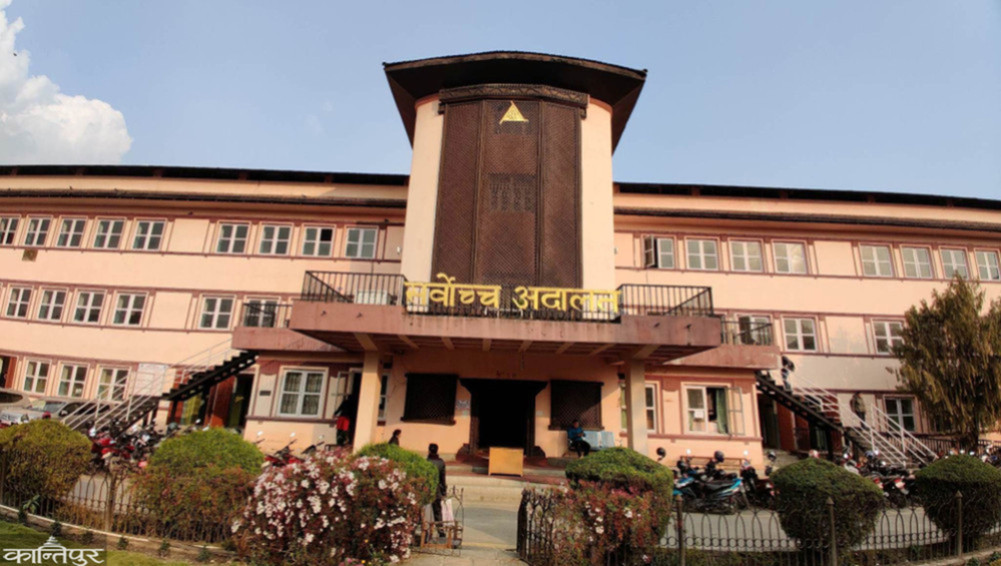
The government has not taken any initiative on the mandate given by the Supreme Court to give immediate payment to the sugarcane farmers, to enact a law to prevent the abuse of proportional seats and to ensure the voting rights of Nepalis abroad.
We use Google Cloud Translation Services. Google requires we provide the following disclaimer relating to use of this service:
This service may contain translations powered by Google. Google disclaims all warranties related to the translations, expressed or implied, including any warranties of accuracy, reliability, and any implied warranties of merchantability, fitness for a particular purpose, and noninfringement.
The full text of the order issued by the Supreme Court on October 13 last year to allow social networks to be used only after registration was made public on July 30. Less than three weeks later, the government started shutting down unlisted social media platforms based on that order. However, the government has not given priority to the implementation of the Supreme Court's order to 'regulate and monitor social networks'.
Notable Orders Awaiting Implementation
- Legislation to Prevent Proportional Seat Abuse (2080/11/30)
- Making proper arrangements with compensation for ineligible fighters (2081/1/13)
- Giving reservation to Tharu community (2079/10/24)
- Legislation for stone, gravel export and crusher (2081/1/17)
- Immediate payment to sugarcane farmers (2077/09/16)
- Making battery management plan for electric vehicles (2079/3/30)
– giving the right to vote to Nepalis living abroad (2074/12/7)
– testing (vetting) human rights violations before government appointments (2073/12/17)
– building the missing border post and clearing Dashgaja area (2078/1/12)
– stopping noise pollution in front of educational institutions and hospitals (2074/05/15)
– every Distributing the constitution to the citizens (2080/5/24)
- Arranging housing and sustenance for the helpless, extreme poverty and elderly Nepalese (2073/2/26)
- Protecting Fewa Lake and demolishing illegal structures (2075/1/16)
- The demarcated land of Giribandhu Tea Estate cannot be used for other purposes (2080/10/24)
- Natural resources benefit all Nepalis (2067/04/21)
...
This is not the first time that the government's behavior in the implementation of the Supreme Court's order has been contradicted. There is a tendency for the government to implement an order/mandate immediately after looking at its suitability and to delay some even for years . There are also instances where some orders were not implemented and contempt cases were filed.
The government shows caution when it sees that it benefits itself or fulfills its own interests, otherwise it does not try to implement it. - Prakashmani Sharma, Senior Advocate According to the Supreme Court's Judgment Implementation Directorate, 144 orders/mandates are awaiting implementation. The oldest decree issued by the Supreme Court to be implemented immediately, but not implemented, appears to be dated 25 December 2060 . In the writ petition filed by advocate Rajaram Dhakal demanding that the Geneva Convention be violated and to create a law, the Supreme Court ordered to do as per the petition.
After the directorate advised for the implementation of the mandate, the Law and Human Rights Branch of the Prime Minister's Office wrote a letter to the Ministry of Law, Justice and Parliamentary Affairs and Ministry of Defense on 15 May. But it has not yet been implemented .
is about the famous case related to the land of Giribandhu Tea Estate in which the government hesitated to implement the order of the Supreme Court . The Constitutional Bench of the Supreme Court had ordered that at that time the condition of the land that was given under the demarcation exemption should be ascertained, and that the land that was unused or used for other purposes and found to be in excess of the demarcation should be immediately brought under the name of the government.
The full text of the judgment issued on 24th March 2080 reached the Attorney General's office on 5th June 2081 and four days later it was also registered at the Prime Minister's and Council of Ministers' office. Advocate Omprakash Aryal filed a contempt of court case on January 28 after the government showed no interest in implementing the order regarding Giribandhu. Then on February 4, the order to show cause is pending.
The court issued an order on a writ filed against the Giribandhu Tea Estate in Birtamod, Jhapa after the game of misappropriation of land. Prime Minister KP Sharma Oli has also joined this. The Land Act was amended on 28 Jan 2076 so that demarcated land in the name of Giribandhu Tea Estate can be sold and transferred. On 3rd May 2078, the Government of Nepal published a notice in the gazette and issued the order, 2078 regarding the exemption of land limits.
Before that, on 13 Baisakh 2078, the Council of Ministers had decided to approve the transfer of 343 Bigha 19 Kattha 12 Dhur land in former Anarmani Gavis 1 of Jhapa District and current Birtamod Municipality 6, registered in the name of Giribandhu Tea Estate Pvt. The proposal was submitted to the Council of Ministers by the then Secretary of the Ministry of Land Management, Cooperatives and Poverty Alleviation (currently suspended) Tech Narayan Pandey. Oli was the Prime Minister when these events took place.
The Supreme Court issued an order on 16 May 2075 in the name of the federal, state and local governments in the case related to the protection of Phewa Lake in Pokhara. In the writ filed by Khagendra Subedi on 10th January 2067, after 8 years, the bench of the then judges Omprakash Mishra and Sapna Pradhan Malla ordered to remove the illegal structures within 6 months and to determine the area of the lake within a year.
Supreme Court Justices Kumar Regmi and Hariprasad Phuyal again issued a mandate on 4 June 2080, in which the illegal structures built on the land of the lake should be demolished immediately and 65 meters should be maintained in other areas to protect the lake . These orders have not been implemented yet. All three levels of the government are responding to the Directorate of Decision Implementation saying that they are making plans.
The government has not implemented the mandate on voting rights issued by the Supreme Court on 4 Chait 2074 . In the petition filed by Advocate Premchandra Rai, the Supreme Court was asked to ensure the right to vote from the embassy of the country they are in to the Nepalese who are employed abroad at that time. The government has been giving the answer to the directorate that the law is being drafted. The draft of the Election Bill prepared by the Election Commission has been kept in the Ministry of Home Affairs for a long time.
The government does not seem to give priority to the implementation of orders/mandates of public concern, they are implemented only out of compulsion without desire. - Omprakash Aryal, Advocate proportional election On 30 February 2080, the Supreme Court said that the representation through the system had reached the hands of the Tarmara class and immediately reviewed the law and arranged for the representation of the target class. The government is not interested in implementing the order of the Supreme Court because the relatives of the political parties and the people they want will be out of line when creating such a law.
The Supreme Court said to be aware of environmental protection and environmental issues in 2081 and thereafter to enact scientific management for stone and gravel extraction . But the government has been trying to extract stones and gravel based on the guidelines or instructions or through the budget. Similarly, in the context of the fact that the farmers were forced to come to Kathmandu time and again to protest for the payment of sugarcane sales, the Supreme Court had issued a mandate in 2077 to make a law and make a mechanism for monitoring the payment. But since the government is not interested in the implementation of the mandate, the sugarcane farmers are still facing the problem of payment.
Advocate Shashi Basnet filed a writ after seeing that there may be problems in battery management in the future as the number of electric vehicles increases in Nepal. Hearing about it, the Supreme Court issued an order to make an action plan on 30 June 2079. But the government has not made such an action plan yet. The government has replied to the decision implementation directorate that the discussion is ongoing.
The Supreme Court had issued a mandate on 17 Chait 2073 to conduct an examination (meeting) of human rights violations before government appointments. But this too has not been implemented . In the case filed by senior advocate Chandrakant Gyawali, the order issued on 12 Baisakh 2078 to construct the missing border pillars and vacate Dashagaja area has not been implemented.
The Supreme Court issued an order on 24th August 2080 to distribute the constitution to everyone saying that every citizen has the right to know the constitution. The government has been saying that the process is underway. On 26th June 2073, an order was issued to arrange housing and sustenance for helpless, extreme poverty and elderly people and to implement arrangements including employment under fundamental rights, which has not been implemented . On 21 July 2067, an order was issued to ensure that natural resources are used only for the benefit of all Nepalis (common benefit), but its procedure And the law has not been made by the government.
Why is the mandate not implemented?
Senior Advocate Prakashmani Sharma, who has been practicing in public interest cases for a long time, comments that the government is showing a selfish nature in the implementation of the decree. "If it sees that the implementation of the mandate of PIL (Public Interest Litigation) will benefit itself or fulfill its own interests, the government shows caution, otherwise it does not try to implement it," he says, "The government's focus seems to be on getting money". The government does not pay attention to issues of public interest and far-reaching importance.'
The government's work is done by the court Sharma says that there is a problem of non-implementation even after reminding. "The Supreme Court has ordered many times in the case of Bagmati River but it has not been implemented. It has been years in the case of Fewatal, but the implementation?'
Advocate Omprakash Aryal analyzes that the government has implemented public interest orders/mandates with difficulty and only by compulsion without any desire . All PILs cannot be implemented quickly. Legislation is a process, it takes time . "Some big projects have to be done," he says, "even if it is time-consuming and financially difficult, it should be started immediately." Some have a fixed time . It is stopped without even starting. It also knows the intention of the government.' The government's initiative to stop
on social media, the decision implementation He says that it can be taken as an illustration that it depends on the intention of the government. There is also a mechanism in the Prime Minister's Office under the leadership of the Chief Secretary to implement the decision. The Supreme Court also has a judgment enforcement directorate. However, the government does not seem to give priority to the implementation,' he says, 'when there is a situation to fulfill the political objective, it is implemented immediately . Otherwise it will be left bereft.'
Deputy Attorney General Sanjeevraj Regmi of the Attorney General's Office comments that it cannot be expected that the implementation of all judgments should be immediate . "It is not possible for the government to immediately implement the decisions that need to be made to make laws, allocate budgets and make plans," he says, "making laws cannot happen immediately." Financially, the budget may not be available at the desired time . In such cases, implementation takes time.' He says that it will take time because there is a lot of time and preparation for environmental protection and other issues.
According to Janak Prasad Sharma, Spokesman and Director of the Directorate of Judgment Implementation, the division will advise to implement it and if not, it will send comments for contempt of court. "The decree or order of the Supreme After receiving for implementation Correspondence takes place in the concerned body. Its The department and the ministry are responsible for implementation," he says. "We are continuing to discuss and guide the decision so that it is implemented as soon as possible and at the appointed time.
Sharma also informed that if the order/mandate is not implemented, the directorate will warn that action will be taken in case of disobedience. "During the discussion with us, there is a commitment that we will implement . Again, there is a delay in the implementation,' he says .
How many decisions of the prime minister's time were not implemented?
Out of the 144 orders/mandates of public interest that have not been implemented so far, there are 150 related to the Union Government including the Prime Minister's Office. Other orders/orders pending implementation are from local level and other concerned bodies.
Out of 115 orders/mandates under the Union Government, 111 have been sent for implementation since the promulgation of the Constitution on 3 October 2072, according to the Directorate of Decision Implementation. During the tenure of Prime Minister KP Sharma Oli, 57, 32 during the tenure of Pushpa Kamal Dahal and 12 during the tenure of Sher Bahadur Deuba were sent to the ministries and departments under the Union Government for implementation.
KP Sharma Oli
15 October 2072 – 19 July 2073 : 1
3 February 2074 – 30 May 2078 : 15
31 May 2078 – 29 June 2078 : 1
30 June 2081 to date : 40
Pushpa Kamal Dahal & NBSP; Story 193-49274:27274: 29292791 July 10, 109 - 30,081: 30 & Nbsp;
Sher Bahadur Deuba Duwa-BREAK 24:29274: 1 PURAK 29 July 29 July 2078: 10 PS 2079: 11