The government is going to amend the police regulations to extend the tenure of Inspector General Deepak Thapa, who is going to retire on August 18 after completing his 30-year term, while the Supreme Court itself has given a mandate 12 years ago to make a law related to police service and conditions and not to deviate from the regulations.
We use Google Cloud Translation Services. Google requires we provide the following disclaimer relating to use of this service:
This service may contain translations powered by Google. Google disclaims all warranties related to the translations, expressed or implied, including any warranties of accuracy, reliability, and any implied warranties of merchantability, fitness for a particular purpose, and noninfringement.
The government has been active in creating the system of appointing the Inspector General of Nepal Police on the basis of qualifications. The government is going to suspend the provisions of the police regulations to extend the tenure of Inspector General Deepak Thapa, who is going to retire after completing his 30-year tenure.
While the Supreme Court itself has given a mandate 12 years ago not to make laws related to police service and conditions and not to go above and beyond the regulations. The government has already drafted a law to remove the 30-year service period of the Nepal Police, but instead of passing the law and establishing the law through the parliament, the government is working on revising the regulations for special people who are going to retire.
This has increased the concern within and outside the organization that the loyalty of the police organization should not be to the law, but to the leader in particular.
Inspector General Thapa, who joined the service in 2052, and his batchies are going to retire from the next 18 August. After that, AIG Chandrakuber Khapung of the Central Bureau of Investigation (CIB) is the only contender for seniority and seniority in the Inspector General. If he is IGP, he will remain in the post for only about 2 and a half months due to his service period. After that, the officers who joined the service in 2054 are eligible for leadership.
Now the Nepal Police is governed by the Act of 2012, the bill registered to create a new law has been stalled in the parliament for 6 months, instead of showing readiness to make laws, preparations for amending regulations for special individuals, concerns within and outside the police that the roll order will be distorted
Although there is an opportunity to choose leadership from among the most qualified, the government has proceeded to interfere in the regulations itself. According to an official of the Home Ministry, an agreement has been reached between Prime Minister KP Sharma Oli, Congress President Sher Bahadur Deuba, and Home Minister Ramesh Ulak to amend the regulations. The Home Minister has prepared to submit the proposal to the Council of Ministers to remove the '30-year service period' contained in Rule 127 of the Police Regulations 2071.
The Supreme Court had issued a mandate 12 years ago that "to make a law including the provisions of police services and conditions and not to do otherwise". In a writ filed in 2069 by 11 police officers including the then AIGs Madan Khadka, Naresh Gurung and Kalyan Timalsina, the then Chief Justice Kalyan Shrestha and the Constitutional Bench of Justices Girish Chandra Lal, Sushila Karki, Vaidyanath Upadhyay and Gopal Parajuli asked not to amend the provisions of the service rules.
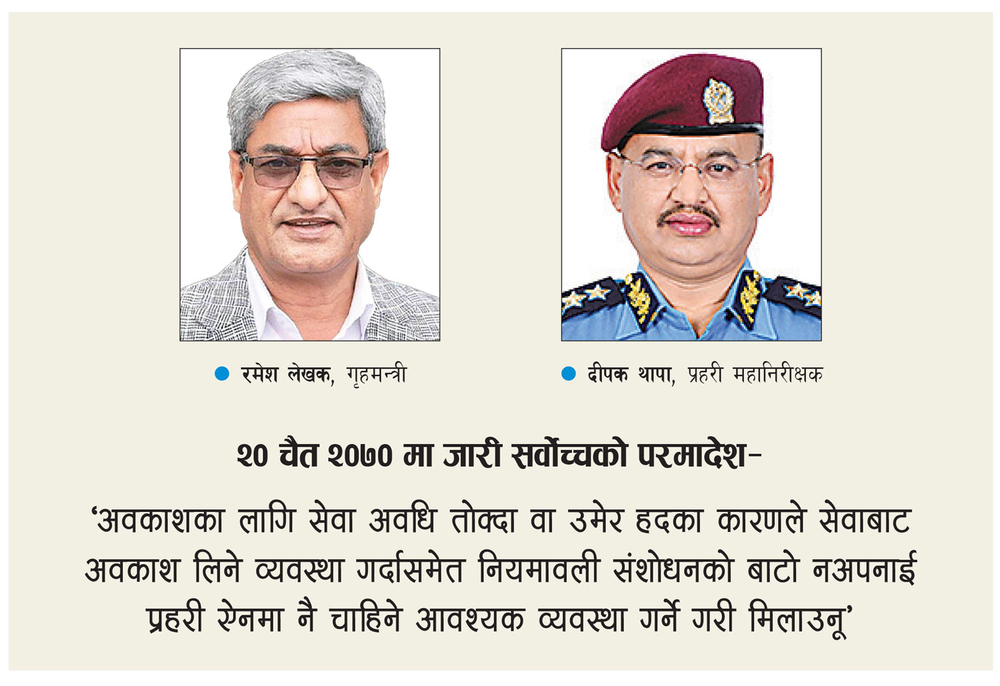
The Supreme Court concluded that the tendency of the government to amend the rules whenever it wants is not only fair and objective but also contrary to security sensitivity and its maintenance. It was said in the mandate, "Since it is necessary to make arrangements immediately to ensure that the conditions for entering service, professional development and retirement in the police are well defined and ensured, a directive order has been issued in the name of the opposition Nepal government to make the necessary provisions in the Police Act itself without resorting to amending the regulations."
In the 'Nepal Police Bill' which the government took to the parliament, it is proposed to remove the 30-year service period and retain only the tenure and age limit for retirement. Instead of showing readiness to pass the bill, the government is preparing to amend the rules only for the job of the police officer who is going to retire.
Currently, Nepal Police is governed by the Act of 2012. According to the rules made in accordance with the same law, the police organization has been in chaos. Because the provisions of service and conditions are kept in the regulations, now the decisions related to the police are becoming controversial because of the interests of the power, rather than transparency in the transfer, retirement and career development.
Home Minister Author himself registered the Bill on Nepal Police and Armed Police at the Federal Parliament Secretariat on 15th January 2081. After a general discussion on the Police Bill on February 5, it was sent to the State Order and Good Governance Committee of the House of Representatives for quarterly discussion on February 11. Similarly, the Armed Police Bill was discussed in the House of Representatives on February 11 and sent to the committee for quarterly discussion on February 6. Both bills have been in the committee for 6 months.
There are currently three arrangements for retirement in the police. Length of service, age and tenure. The Inspector General of Police has a tenure of 4 years or 30 years of service or 58 years of age, whichever comes first, for retirement. Age limit of AIG and DIG is same 56 years and tenure is 5 years. The age of SSP and SP is 55 years and tenure is 6 years and 10 years respectively.
 The service period of all these levels is said to be 30 years. There is a rule that up to DSP and below office assistants, the tenure of office is not maintained, and retirement is only based on the length of service and age. The government is about to abolish the provision of mandatory retirement on completion of 30 years of service in sub-rule 1 (d) of Rule 127.
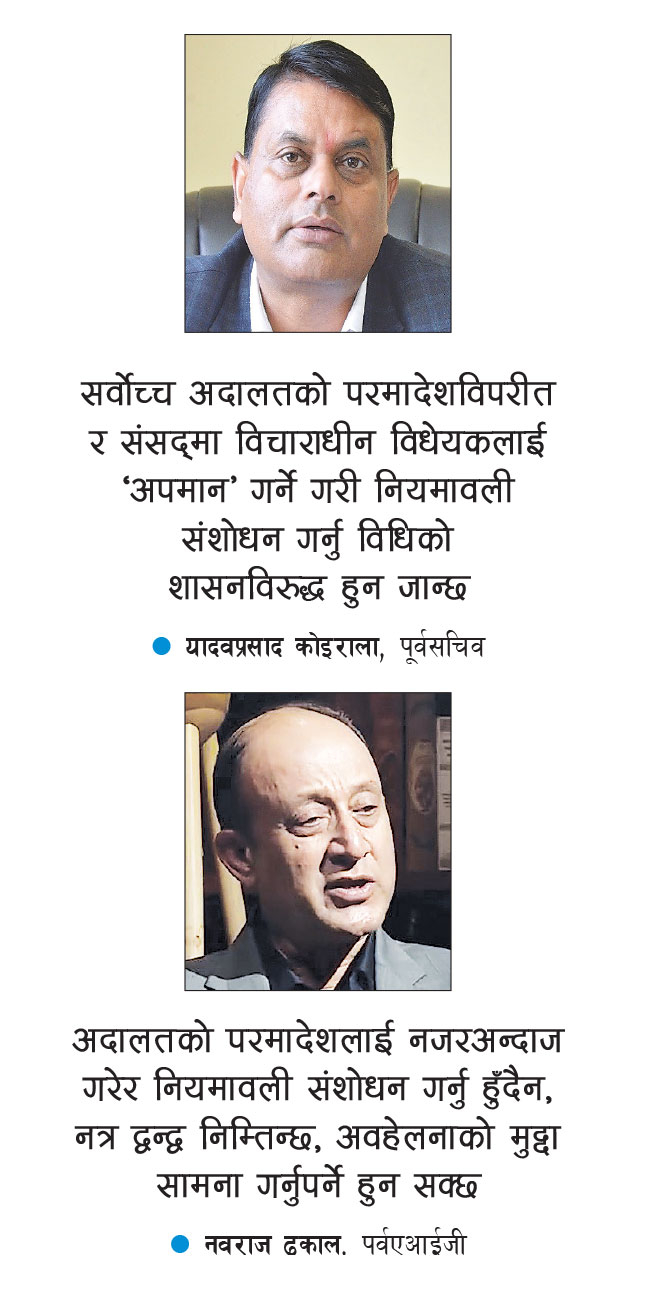
Ex-Secretary Yadav Prasad Koirala says that it is against the rule of law to amend the rules in a way that goes against the Supreme Court's order and 'insults' the bill pending in the Parliament.
The Supreme Court has already amended the provisions of the police service and conditions, Manmauji Nagar, and has given a mandate to include such provisions only by making a law through the Parliament. It is objectionable to try to revise the regulations by focusing on individuals. If such a decision is taken, there may be a case of contempt, the government must take care of it,'' he says, who is also an advocate. Ratnashamsher Rana, who became IGP in June 2047, was removed with 30 years of service remaining. Motilal Bohra was made Inspector General of Police on 6 December 2049 by amending the rules.
After Bohra became IGP, on 15 February 2049, by amending the regulations again, the provision that the service period can be extended by 2 years to 30 years was included. Again, 35 years service period was maintained by adding 5 years instead of 2 years through the second amendment. At that time, Girija Prasad Koirala was the Prime Minister and Sher Bahadur Deuba was the Home Minister.
After Bohra, Achyutakrishna Kharel became IGP in February 2053. But after 36 days, Kharel was transferred to the National Investigation Department and Dhrub Bahadur Pradhan was made IGP. At that time, the Prime Minister was Lokendra Bahadur Chand of RPP and the Home Minister was Vamdev Gautam of UML.
Kharel went to the Supreme Court against the government's decision. The Supreme Court did not give an interim order, the case continued to drag on. In October 2054, the Chand government fell. Surya Bahadur Thapa of RPP became the Prime Minister. In Thapa's cabinet, RPP leader Budhishan Tamang and Congress leader Khum Bahadur Khadka became Home Minister a month later. After that, Pradhan was transferred to advisor to the Prime Minister and Kharel was reinstated as IGP. After Kharel returned to IGP, the Supreme Court declared the decision to make Pradhan as IGP illegal. After that, there was no 30-year service period in the police. This order continued till 2063.
Officials including the then IGP Shyambhakt Thapa and AIG Rajendra Bahadur Singh were under suspension for suppressing the public movement. Singh, who was in line to become the IGP after Thapa, was removed at the same time as the suspension by amending the rules and imposing a 30-year service period. Then Omvikram Rana became IGP. At that time, Girijaprasad Koirala was the Prime Minister and Krishna Prasad Sitaula was the Home Minister. After the first election of the Constituent Assembly, Pushpa Kamal Dahal of the Maoists became the Prime Minister and Vamdev Gautam, the leader of the UML, became the Home Minister. By amending the regulations, the provision that the term of office of the Inspector General can be extended by 2 years has been removed. After Rana retired after 30 years of service, Hem Bahadur Gurung became IGP after him.
In the year 2066, the regulations were again amended and 'the previously arranged 2-year and 5-year extension of tenure was abolished and the previous 30-year service period was maintained'. Since then, 30 years of continuous service in the police has been maintained. Since Gurung retired after 58 years, Rameshchand Thakuri, Rabindra Pratap Shah, Kubersinh Rana, Upendrakant Aryal, Prakash Aryal, Sarvendra Khanal, Thakur Prasad Gyawali, Shailesh Thapa Chhetri, Dheeraj Pratap Singh, Basant Kumbar and now Deepak Thapa have reached the leadership.
The practice of leading the power center in the police to make their own decisions has been going on in the past as well. After Upendrakant Aryal retired in 2073, the government promoted Jai Bahadur Chand to IGP. According to the petition filed by another contender for the leadership, Navraj Silwal, the Supreme Court overturned the decision to make Chand the IGP. After that, after the controversy over the selection of IGP was prolonged due to the case, AIG Dinesh Pokharel on the technical side was taken to the acting leadership. After the
, Prakash Aryal appeared before the performance appraisal number and he himself was promoted to IGP. Ramesh Kharel resigned as DIG expressing dissatisfaction after Sarvendra Khanal was made IGP after Aryal. After Khanal, Thakur Gyawali became IGP on the basis of seniority. Shailesh Thapa Chhetri became the police chief after him who was in the leadership for about 5 months. After him, senior AIG Vishwaraj Pokharel was in charge for 18 months, but the government made AIG Dheeraj Pratap Singh the IGP. After his retirement, Basant Kumbar and Thapa took over the leadership.
Along with IGP Thapa, the current rule remains, AIG Sudeep Giri and Tek Prasad Tamang will also retire on August 18. However, if the rules are amended, the roll order will be chaotic. Former AIG Navraj Dhakal says that as per the mandate of the Supreme Court, a law should have been made a decade ago, it is wrong for the government to try to make individual-friendly decisions through the regulations without going into it.
'Government should take the path of legal and natural decision only,' he says, 'the mandate from the court cannot be ignored, if it is ignored, the case of contempt must be faced, it will lead to a situation of conflict.' "On the one hand, the court has said that it is not an amendment to the regulations, but the issues of service and conditions should be included by making a law. On the other hand, the bill is under consideration in the House," he added, "if a decision is made in favor of such and such an individual by deliberate coercion, it will be to the detriment of the organization. It will establish the belief that the individual is stronger than the system, and this is not in anyone's interest."

