When the alliance was formed 13 months ago, the two major parties in the parliament made constitutional amendment the main agenda, which has now been overshadowed, instead, Congress-UML have faced each other on the issue of dozens of law amendments.
We use Google Cloud Translation Services. Google requires we provide the following disclaimer relating to use of this service:
This service may contain translations powered by Google. Google disclaims all warranties related to the translations, expressed or implied, including any warranties of accuracy, reliability, and any implied warranties of merchantability, fitness for a particular purpose, and noninfringement.
Disagreement between the two main ruling parties, Congress and UML, is increasing on issues related to policy and law making. The different positions and priorities of the two parties have started to be seen on the surface of the constitution amendment presented as the main basis of the coalition building agenda.
On the issue of constitutional amendment, the Congress has been taking a stand to immediately identify the points of amendment by forming a working group, while the UML does not want to proceed with this issue with the argument that the numbers are not enough to pass it in the National Assembly.
It was said during the Congress-UML alliance that reforming the electoral system was the main agenda for reforming the electoral system, saying that the current electoral system was expensive and that the 'threshold' was low and instability was increasing due to the presence of many parties in the parliament.
An agreement has not been reached between the two parties regarding the information technology and cyber security bill. The Congress is insisting that the provision of this bill to control the freedom of expression is unacceptable. UMA, on the other hand, is in favor of removing those provisions with the stance that such provisions are necessary to prevent false information and abuse.
The Congress is opposed to the provision to punish those who illegally collect personal information, record secret conversations or leak information, produce, distribute and publish obscene content through social media.
However, UML is of the position that there is a need for strict punishment on those who produce, distribute and publish obscene material in order to provoke the society. There are provisions in the cyber security bill for illegally collecting personal information, recording confidential conversations or leaking information, producing, distributing and publishing obscene content through social media, up to 5 years in prison and a fine of up to 500,000 or both.
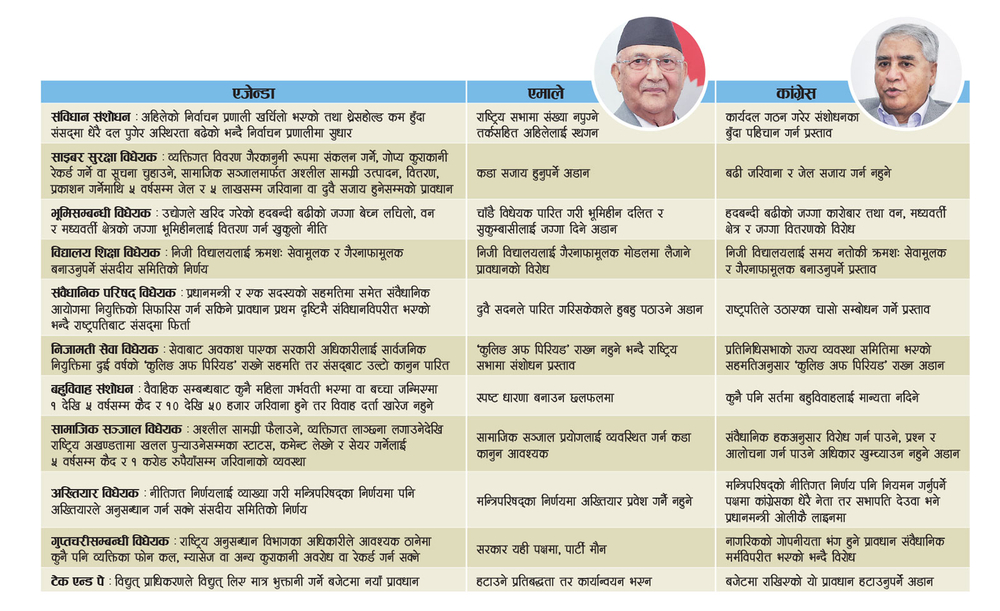
UML wants to pass some Nepal Act amendment bill related to land through 'fast track'. But the Congress Bill is in favor of stopping excessive land misuse and lax policies towards forests, intermediate areas and land distribution. UML has also been claiming that the bill is in favor of landless Dalits and squatters, saying that the delay in drafting the law is causing problems for the Land Commission.
The school education bill, which has been stalled for a long time, is in favor of not being made with provisions according to the interests of the private sector. The Congress has rejected the provision of 60 percent internal and 40 percent open competition in the appointment of teachers as decided by the sub-committee. In this, UML's demand is that 75 percent of internal and 25 percent of open competition should be made to make temporary teachers permanent. There is also a proposal to reduce the number of internal evaluation.
Congress and UML also have different views on the constitutional council bill. The Congress is of the opinion that this bill should be sent with amendments after addressing the concerns raised by the President. But UML is not accepting the stand of Congress. UML insists on re-sending it in the same form as it was passed by both Houses. The provision that the appointment can be recommended to the Constitutional Commission even with the consent of the Prime Minister and one member has been returned to the Parliament by the President saying that it is prima facie contrary to the Constitution.
Congress and UML are standing on two sides even regarding the Civil Service Bill. The Congress has taken a stand to keep the two-year 'cooling off period' provision to stop the immediate appointment of retired employees, while recently the UML has moved ahead with the amendment with the vote to remove the 'cooling off period'.
There is interest and discussion at the public level regarding the polygamy amendment bill of the Criminal Code. Although Congress has made a clear opinion on this, UML has not been able to be clear. Congress is on the stand that polygamy should not be recognized, but due to different opinions in UML internal discussions, a clear opinion has not been formed. If a woman becomes pregnant or gives birth to a child out of wedlock, the bill contains provisions such as imprisonment for 1 to 5 years and a fine of 10,000 to 50,000, but the marriage registration will not be cancelled.
There is also disagreement between Congress and UML on the social media bill. The Congress has said that the provision restricting freedom of speech is unacceptable. UML is saying that strict laws are necessary to stop spreading fake news and hatred in the society.
Congress has taken a position that the right to protest, to hold different opinions, to question and criticize should not be curtailed according to the rights granted by the constitution. In the bill, those who write and share statuses, comments, from spreading obscene content, using personal insults to disrupting national integrity, will be imprisoned for a maximum of 5 years and fined up to 10 million rupees.
The two main ruling parties are not on the same page even in the Bill on the Commission for Investigation of Abuse of Authority. Congress is of the opinion that the Authority should regulate the policy decisions of the Council of Ministers. But UML is maintaining a position that authority should not enter into the decision of the Council of Ministers.
Regarding the National Investigation Bill, the Congress has been saying that the provision of breaching the privacy of the citizens is against the constitutional essence and should not have such a provision. UML has not yet given a clear opinion on this. UML is silent on this provision after public opposition.
It is mentioned in the draft of the bill that the official of the National Investigation Department can intercept or record the phone calls, messages or other conversations of any person if he deems it necessary. There is also a controversial provision allowing the government to appoint permanent staff to the National Investigation Department without open competition. A draft has been prepared to recruit 50 percent of unranked and junior posts and 20 percent of Assistant Inspectors (Assistant Inspectors) without competition.
There is also a dispute between Congress and UML regarding the 'take and pay' (electricity purchase and sale) provision. Congress is in the position of removing this provision from the budget, while UML is not positive to remove the provision of 'take and pay' placed in the budget presented by its own finance minister. Former Chairman of the Administrative Court Kashiraj Dahal says that there is conflict within the ruling party as interest groups dominate the policy agenda and law making. "When studying the content of the bill, there is room to suspect that the bill originated from outside rather than from within the process," he says. "School administrators trying to make the school education bill their own, cooperative owners trying to influence the cooperative bill, civil servants trying to make their own laws, those involved in the financial sector and those involved in contracts are manipulating for their own interests," says Dahal.
The National Intelligence Bill under consideration in the Prime Minister and Council of Ministers' Bill Branch and the Civil Code Criminal Code Amendment Bill, which seeks to amend the Civil Code to recognize polygamy, have attracted not only the party, but also the citizens.
The controversy of 'cooling off period' in the Civil Bill has reached its climax. Ramhari Khatiwada, chairman of the State Order and Good Governance Committee, has resigned as soon as the parliamentary committee formed under the leadership of MP Jeevan Pariyar, who is also the Congress joint general minister, to investigate the 'cheat' related to the 'cooling off period' included in the bill.
The 'cooling off period' trickery in the bill has not yet come true. There is still distrust between the Congress and the UML whether the mess that was passed by the House of Representatives will be corrected by the National Assembly or not. UML has introduced an amendment in the National Assembly not to correct the mess of 'cooling off period', but to help eliminate it. But the Congress has put an amendment to correct the deception of 'cooling off period'. MP Dilendra Badu UML, who is also a member of the Congress Central Committee, says that serious mistrust between the two parties will increase if the amendment put in the National Assembly to remove the 'cooling off period' is not withdrawn.
The Congress is of the opinion that the implementation of the Pariyar-led committee's report should not be limited to Khatiwada. The committee has also raised the question of official conduct on the role of administrative leadership staff. Chief Secretary Ek Narayan Aryal, General Secretary of Parliament Padma Prasad Pandey and Secretary Suraj Kumar Dura have been mentioned as not having proper official conduct.
The staff leadership has been accused of continuously trying to remove the 'cooling off period' included by the State Order and Good Governance Committee and running to the power center to manipulate the bill.
The provisions of the 'cooling off period' provisions, which were not proposed by the government in the Federal Civil Service Bill, were kept by the committee. According to which, the provision included that a person who has resigned or retired from civil service or other government service cannot be appointed to any constitutional or government post for two years. While the sub-committee had a period of one year, it was extended to two years at the insistence of the chairman of the committee, Khatiwada. Prime Minister KP Sharma Oli and the leaders close to him did not agree with such a provision made by the
committee. The main objective behind this provision is to maintain good governance and fairness by preventing immediate political appointment of employees after retirement. But the interests of Congress and UML are different.
Congress wants to stop the influence of UML on the constitutional bodies as the network of UML is more in the bureaucracy. But UML wants to give opportunity in the constitutional body to employees who have earned trust since being in power rather than outsiders. This interest between the two parties has led to the most controversy over the 'cooling off period' included in the bill.
Mahesh Bertaula, the chief whip of UML, says that it is a parliamentary practice for the parties to put their own amendments in the bill registered in the parliament and to advocate in favor of it. "Congress's method of amendment is one, UML's is another, there seems to be a gap in that," he says. Prime Minister Oli's plan to pass the land bill through 'fast track' was put on the agenda of the House of Representatives meeting on June 25 by Mutavik Speaker Devraj Ghimir. But not only was it removed from the agenda due to opposition from the Congress, the bill was taken to the parliamentary committee against Prime Minister Oli's wishes.
After a dozen MPs of the ruling party, including the two general ministers of the Congress, Gagan Thapa and Vishwaprakash Sharma, took the stand that the bill should be taken to the committee with amendments, the discussion is now going on in the agriculture, cooperative and natural resources committee of the parliament.
After the Federal Parliament passed the Constitutional Council Bill, Sheetal Niwas was sent to Lalmohar on 31 June. After President Ramchandra Paudel sent it back to the parliament without wearing the red seal, now the dispute has started between the two ruling parties.
President Paudel sent the bill back with 5 messages stating that it was 'against the meaning, spirit and democratic principles of the constitution at first sight'. But Prime Minister Oli is dissatisfied with the President's move. There is a dispute between Congress and UML whether to amend this bill or send it as it is. Most of the Congress leaders are of the opinion that the President's concerns should be addressed. Prime Minister Oli is of the position that it should be passed and sent as is.
The bill includes a provision that the decision of two people in the 6-member Constitutional Council recommending the appointment of officers of the Constitutional Commission can be official. The main concern of the President seems to be about this. The Congress also did not consider the option of four conditions added as 'examples' by the National Assembly in the bill passed by the House of Representatives. Congress is of the opinion that the 'example' passed by the National Assembly should be removed. In the
bill, if the chairman and five members are present, the decision of four members will be official, if the chairman and four members are present, or if the chairman and three members are present, the decision of three members will be valid. Similarly, even if there are only three people present including the chairman and two members, it is considered a quorum and the decision of two people is final. This arrangement placed in the bill is a subject added by the National Assembly as an example in the bill passed by the House of Representatives. The Cancer leader Badu said the Cancerian leader Badu, who has removed this system. & Nbsp; The
-BREAK NIGHT Sytchau is not found in Parliament. Intelligence provision to monitor the storehouses, monitoring and taping materials including any person's phones. This has opposed the Congress leader in the parliament, while UML leaders are still silent so far. The draft of the
bill of information has been in public with the 'intercessance' (tping).
government has been drafted in the draft constitutional staff will be appointed to appoint an open employment in the National Investigation Department. The draft is prepared to recruit between the rally and the auxiliary inspector (Asa) in the provider. It is still left to come from the Council of Ministers. According to the draft, the right to confront against the promotional constitution and the employees protest against the criteria of the Law and practice of the Law Service Commission and the commandment of the Supreme Service and the commandments from the Supreme Court Against protest. Subjective law has stored civil society formed by the Subject to amending the government that the government could not be able to do. It has a heavy opposition outside Parliament and Parliament. The main two-party Congress-UML are also politely polluted in it. The bill to be made to amend the Crime City of the country 2074 is now under consideration to the Committee on the Council of Ministers. The government has gone back to amend the government as there is only author protests that have been protrapped for the intention of recognizing polygamy with polygamy. & Nbsp; The
is not the case with the social networks, media Council, the Information Technology, and Cyber Security Bill. In particular, the ritual cyangrus cannot be accepted by the ritual cyang, especially in the social network bill. The unity of the media has arrested some hard provisions for the media by UML leaders saying that abuse should be reared. UML leaders have a claim of needing to prevent tendency to spread false news and hatred in society. & Nbsp; Defending the provisions of the 'Tech Ir Municipal Pilotment Procedure (PPA) of
2082/83, Congress leaders are irritated when the Congress leaders have not been positive. Budget & Nbsp; Before the passage, Prime Minister Oli said that Prime Minister Oli said that Prime Minister Oli, Prime Minister Oli, was committed to remove the provisions related to 'Tech I'. Congress is dissatisfied when UML is not positive. The Free Energy Production Institute of Energy Products Nepal (Ippan) announced the first step movement. & Nbsp; The revision of the constitution for the 3-BREAK two parties has become the most mattical subject. 23 In Jauar, the Congress meeting was determined to make the party he tasted after becoming a joint task between the two parties. The agenda of amendments is the foundation of this government. 17 in July 7 in agreement, the general issue of amending the constitution was made to the agenda of amending the constitution. However, 13 months of formation of government has not also moved away by the amendment constitutional amendment.
is in favor immediately to identify the subject matter of reviewing the implementation of the constitution. However, Prime Minister has been disgusting by showing that the Prime Minister Oli need to amend the constitution. Although the number of cooperation with the government will reach the government in the House of Representatives two-thirds, the Congress and the UML are at a minority. When the Congress and the UML does not have a matter, the task force for amending the constitution. & Nbsp;

