About 400 cases are under consideration in the constitutional bench, but due to procedural disputes, the bench could not be formed after June 25.
We use Google Cloud Translation Services. Google requires we provide the following disclaimer relating to use of this service:
This service may contain translations powered by Google. Google disclaims all warranties related to the translations, expressed or implied, including any warranties of accuracy, reliability, and any implied warranties of merchantability, fitness for a particular purpose, and noninfringement.
The judges of the Supreme Court are divided over the constitutional bench formation process. Chief Justice Prakashmansingh Raut has been holding the view that the constitutional bench should be constituted through the Gola process like other benches. But half of the judges of the Supreme Court are in favor of basing seniority as it is now.
The Supreme Court has a Chief Justice and 19 judges. At present, it is the practice of the Chief Justice to form a bench to hear constitutional cases from a 'roster' of 10 judges.
With the conclusion that the image of the judiciary has been damaged by the controversial decision regarding the appointment of 52 officials of the constitutional body, some judges have been saying that the constitutional bench should be appointed through the Gola process. Raut has advanced this as a proposal in 'full court'.
Chief Justice Raut had put forward a proposal to implement the Gola process in the constitutional bench in the full meeting (full court) on 14 July. The senior-most judge Sapna Pradhan Malla argued that the Gola process cannot be followed citing the Constitution, the order and practice of the Supreme Court. After that, Justices Kumar Regmi, Hari Phuyal and Manoj Sharma left the meeting along with Malla. When trying to return, they took a stand not to go to the 'full court' to discuss it. Other judges also split into two groups.
10 people, including the senior-most judge Malla, are against the round process. There are nine judges in favor of the round procedure. Regmi, Phuyal, Sharma, Kumar Chudal, Nahkul Subedi, Nripadhwaj Niraula, Nityanand Pandey, Srikant Paudel and Shanti Singh Thapa along with the most senior judges are in favor of appointing the judges of the constitutional bench.
Judges Til Prasad Shrestha, Vinod Sharma, Saranga Subedi, Abdul Aziz Muslim, Mahesh Sharma Paudel, Tek Prasad Dhungana, Sunil Kumar Pokharel, Balkrishna Dhakal and Meghraj Pokharel are in favor of the Gola process. Before that, in the annual review meeting on the action plan of the Supreme Court on 12th July, when Raut brought up the subject of 'applying the round process in the formation of the constitutional bench as in other cases', Pradhan stopped her saying that there will be no discussion on the formation of the bench in the meeting of the planning committee. She is the Chairperson of the Research and Planning Committee of the Supreme Court.
In its report submitted on 14 July 2078, the committee formed on 30 July 2077 under the coordination of the then Judge Harikrishna Karki to study the distortions and inconsistencies of the court recommended that the automatic payee list system should be implemented by amending the legal system and until then the payee list should be published by the Gola process. The current Chief Justice Raut was also a member of the
study committee. Four months after the committee submitted its report, the formation of the non-constitutional bench was started.
The 'Study Committee on Payee Management by Gola Process, 2078' formed under the coordination of the then judge Meera Khadka gave an opinion that Gola process cannot be implemented in the constitutional bench. The five-member committee consisted of Justices Anand Mohan Bhattarai, Prakash Dhungana, Hari Phuyal and Nahkul Subedi. All of them were of the opinion that the Gola process cannot be applied in the constitutional bench because of the provision in the constitution itself, but it is compatible with the rest.
Nepal Bar and the leadership of the Supreme Bar are also in favor of the implementation of the constitutional bench round procedure. Nepal Bar President Vijay Mishra's argument is that a person who has become a judge of the Supreme Court cannot be classified as qualified or unfit to hear a case.
Former judge Balaram KC says that instead of appointing the constitutional bench by round, the Chief Justice should move towards appointing the bench according to expertise by increasing the 'roster' from the Judicial Council. "The Judiciary Council has the right to make the roster, and since the Supreme Court has also given a similar verdict, this is the best option," he says.
The proposal of round procedure for the constitutional bench has caused a division among the judges, some of the existing judges have commented that the image of the judiciary has been damaged. A judge of the Supreme Court said that it was sad to have public comments on court matters. "It should be taken seriously immediately and a solution should be found," he said.
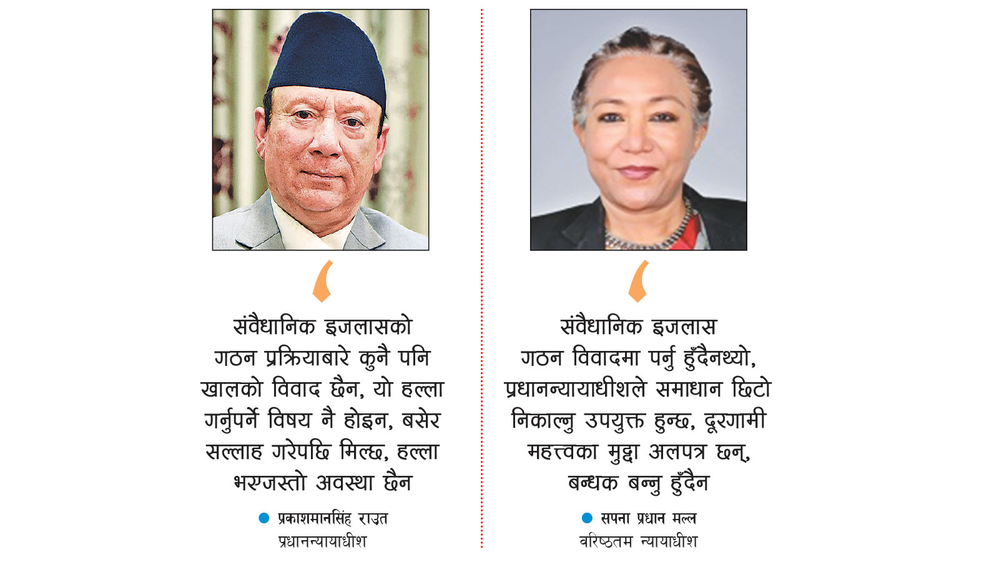
Senior Judge Malla says that the constitution bench formation process should not be made controversial and for this the Chief Justice should take the initiative and find a quick solution. "The formation of the constitutional bench should not have been in dispute, it is appropriate for the Chief Justice to find a solution quickly, issues of far-reaching importance are pending, they should not become hostages," she said.
Chief Justice Raut claims that there is no dispute in the formation of the constitutional bench. "This is not a matter to make a fuss about, it can be settled after sitting and consulting," he told Kantipur, "a solution will be found quickly after consulting among all the judges." There is no such thing as a rumor.'
It was the practice of the Constitutional Court to hear first and foremost cases every Wednesday and regular cases on Fridays. However, after 25 June, the constitutional bench has not been formed. About 400 cases related to the elections of 2074 and 2079, conflicts with the constitution and other issues are under consideration in the constitutional bench.

