On the one hand, the tendency to limit the competition by hiding information about government tenders and on the other hand, paying the full amount from the government account but paying only the minimum to the media is becoming institutionalized.
We use Google Cloud Translation Services. Google requires we provide the following disclaimer relating to use of this service:
This service may contain translations powered by Google. Google disclaims all warranties related to the translations, expressed or implied, including any warranties of accuracy, reliability, and any implied warranties of merchantability, fitness for a particular purpose, and noninfringement.
Billions of corruption is taking place from the state fund due to collusion in the publication and broadcasting of advertisements by the government to inform the citizens. In the case of mutual competition in government advertisements, the media will give a discount of up to 95 percent, the government will not get any concession from that amount, instead, when the employees take illegal commissions in the middle, there is a corruption of about 1.53 billion rupees.
When there is a consensus on the amount of advertising that should be published and broadcast so that more readers know it, the tendency to make as few readers as possible to read it, the accountability towards the state budget is also in crisis. On the one hand, the tendency to limit the competition by hiding information about government tenders and on the other hand, paying the full amount from the government account but paying only the minimum to the media is becoming institutionalized. Collusion between government employees and agencies has also been institutionalized by the media.
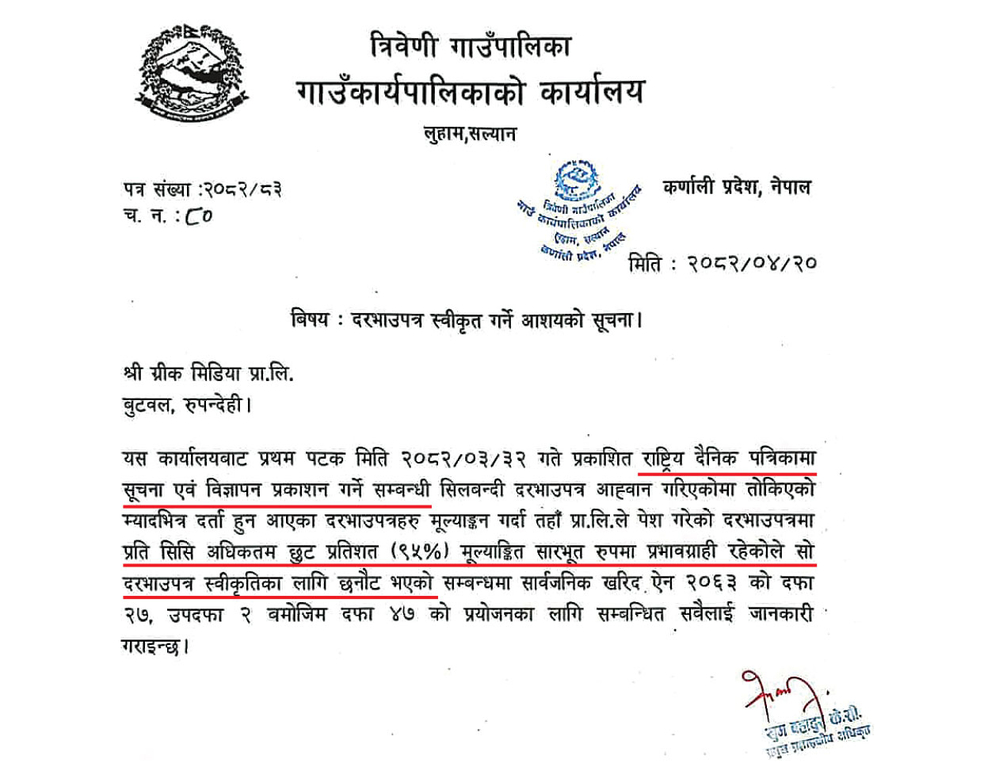
The Triveni Rural Municipality office of Salyan had issued a notice to submit the Seal Bandi Darbhau for advertising purposes. Greek Media Pvt Ltd has given a discount of up to 95% and the municipality has said that the bid was approved as it was 'assessed to be substantially effective'.
Similarly, the Sunvarshi municipality of Morang has accepted the bid of Zero Media Pvt Ltd of Kathmandu Shankhamul with a 93.25 percent discount. The municipality's advertisement will be printed in Prabhav Daily at the rate of Rs 94.50 per column centimeter with a discount of 93.25 percent, according to the municipal executive.
According to the notification issued by the Dakshinkali Municipality of Kathmandu on 13th July, the price list of Ed Chautari Pvt Ltd and Zero Media has been approved with the details of the advertisement rates of 9 print media. According to the information, Kantipur's advertising rate is 589 rupees per cc, Citizen, Naya Patrika and Annapurna 237, Business and Rajdhani 169, Abhiyan 139, Himalaya Times 111 and Midday 104.49 rupees. According to Direklal Shrestha, General Secretary of
Media Alliance, the announced advertising rate of print media is 1400 rupees per cc, but they agreed not to drop below 500 rupees since last year, while the advertisement board made the rules and made it public. Why are the related media keeping silent even when the government agencies publish the information by keeping it below the minimum advertising rate.
Corruption in government advertisement publishing and broadcasting has also started to be exposed. About two and a half hundred complaints are filed in the advertisement board every year. According to the chairman of the board, Laxman Humagain, recently, the Health, Information and Communication Center had signed an agreement with an advertising agency for radio advertisements at a rate of Rs 109 per minute. But for the same advertisement, there was a complaint that the affiliated radio was paid at the rate of 11 rupees per minute.
It was confirmed when we investigated. Then we fined the agency and stopped the business for three months," says Humagain. He said that the Center has also been warned not to pay the media's bill-begging agency.
The Commission for Investigation of Abuse of Authority has recently started to prosecute cases of widespread corruption in government advertisements. The authority has filed a case in the special court against three people including Brijkumar Yadav, publisher and editor-in-chief of Janakpur Today Daily, on the charge of misappropriation of funds through fake bills without printing advertisements.
Unhealthy competition among the media has allowed up to 95 percent discount on advertisements, the government has no concession from such discount, in the pockets of the commission employees They are accused of not publishing the tender notice for the construction of Health Post Building and Deep Boring in Bateshwar Rural Municipality of Dhanusha and hiding the notice by printing only one copy of the newspaper for records but submitting a bill of 644 thousand rupees. The authority's investigation has revealed that along with Yadav, the chief administrative officer of the rural municipality, Sawankumar Chaudhary and the accounting officer, Sumankumar Puri, are involved.
The Authority has filed a case last May against the then chief administrative officer and the owner of various advertising agencies for publishing irregularities in the advertisement related to various construction contracts in Tilathi Koiladi Rural Municipality of Saptari. In the financial year 2079/80, the municipality is accused of hiding the information by printing only one copy of the four bids published in the National Daily.
In the same way, it was revealed that the amount was paid for the purchase of spray tanks to be distributed to farmers in Fatuwa Vijayapur Municipality-4 of Rautahat without any notice being printed in collusion between journalists and employees. Although the tender notice was not published, it is mentioned in the investigation of the Authority that 1 lakh 72 thousand 825 rupees were paid to Janaswal Daily and 39 thousand 400 rupees to Tarai Post. In this regard, the authority registered a case against two employees and three journalists in a special court last May.
Government agencies publish/broadcast advertisements through newspapers, radio, television, online media, hoarding boards, etc. in various contexts such as call for bids, public hearings, policy and program reports, budget and plan notices, job application calls, election purposes, national days. However, around 90 percent of the money is corruption due to misuse of government funds.
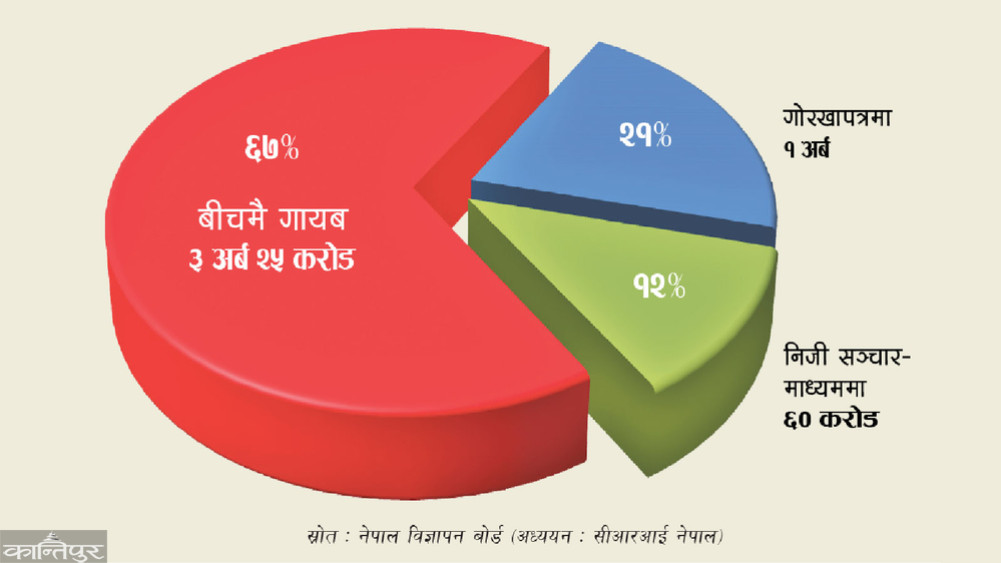
According to a study conducted by the Communication and Research Initiative (CRI) Nepal last year at the initiative of the Nepal Advertising Board, the size of government advertisements is 10.39 billion 1.6 million. According to the board, the advertisement worth 1 billion rupees goes directly to Gorkhapatra. 3/4 page advertisements of Public Service Commission, Government Banks and Financial Institutions, Courts, Universities are often seen in Gorkhapatra. However, despite publishing advertisements worth about 3.84 billion rupees in private media, the media receives only 50 to 60 million rupees. According to Direklal Shrestha, General Secretary of Media Alliance Nepal, about the remaining 3.5 billion will be lost in the middle.
According to the Public Procurement Act, when publishing advertisements above 10 lakh rupees, the media must be selected by calling for a sealed bid (tender). For 1 lakh to 10 lakh, you have to ask for the 'quotation' (tariff rate) of three media and for less than 1 lakh, you can do business directly. "There is a legal provision that most government advertisements must be printed in the national daily, but some media print only five/ten copies of the newspaper or make fake bills without printing the advertisement," Shrestha says, "This is where corruption starts."
Shrestha said that they are fed up and surprised that no action has been taken even though the media society and the media alliance have been alerting the agencies from the prime minister to the authority in writing and verbally about the illegality of government advertisements. "If some employees and advertising agencies take a share of up to three and a half billion and reach the media, we would not have to go through the financial crisis now, and the government would also get good revenue," he says. The money for
advertisements is taken by the staff and advertising agencies which are being promoted by the media in the name of competition. Operators of small print media, which have small number of customers and operating expenses, say that they have to give discounts on advertising in order to stay in the market.
The data and monitoring reports released by the Advertising Board and other agencies also show that there is distortion in the process and implementation of government advertising. According to CRI Nepal's report, "The amount of advertising money is received by the related media in a very small amount and due to the advertising agency and opaque manipulation, the advertiser government and the media have both been hit." "Akhtiar has filed a case in these cases, but the demand is only for a fine equal to the bigo," says Shrestha, General Secretary of the Media Alliance, "Such weak actions will not prevent corruption." State bodies should be serious and citizens should be aware.
CRI Nepal researcher and report writer Prabhakar Ghimire says, "When taking government advertisements, a large amount of commission has to be paid to the employees, even if the media gives huge discounts on advertisements, the government is not benefited and the advertisement cannot go to the right media."
In the case of government advertisements, the share of print media is 8.5 billion rupees before discount and 3.5 billion rupees after discount, radio 97.81 million rupees before discount and 59.32 million rupees after discount, television 91.75 million rupees before discount and 56.57 million rupees after discount. The employee suggests that the Press Council should update the standards according to time and update what kind of media should be considered as 'national level'
. The council had last classified newspapers in the financial year 2078/79. Accordingly, there are only 292 "A" category newspapers, out of which 200 newspapers are dailies. Among these, there is a government regulation that includes the publication of advertisements. Government employees say that because of the provision of selecting the cheapest national level media during the
Experts in this field say that it is wrong for private media to give discounts of up to 95 percent to agencies without following their advertising rate (rate card). "Nepal's media houses are selling advertisements very cheaply, some media print advertisements for 70/80 rupees per column," says Sudeep Thapa, President of Nepal Advertising Association (AN), "If you look at advertisements published in newspapers, you can see a market of 3/4 billion. But when calculating the bill, that amount is not visible.' Thapa's analysis is that the unhealthy competition between tender process, they are forced to give advertisements to newspapers that have low circulation (less customers and access) and are printed at a cheaper rate. "The magazines that sell less will print cheaply. But if the advertisement for bidding for a building worth 100 crores is printed in a newspaper with 200 subscribers, there will not be enough competition because there is not enough information everywhere," says an official. While the government is trying to save lakhs in advertising, it is losing crores in big tenders.' Madan Lamsal, president of the Media Society, says that the main reason why the media cannot stick to their declared advertising rates is unhealthy competition along with weak regulation and monitoring. "Even the media that print only 200 copies are in 'A' category, their staff and expenses are very low, so it doesn't matter if they give a 95 percent discount," he says, "not all media are self-disciplined." In a country like America, people themselves have not stopped throwing garbage on the streets because they are cultured and knowledgeable, they have stopped throwing garbage after being forced by the law and punishing those who litter. The government can regulate and regulate the advertising sector by making it stricter.
media on how to attract more advertising by giving more discounts is rampant. He says media operators should stick to their rates. Agencies are just a bridge between advertisers and media. Exaggerated rumors of collusion between agencies and employees have spread. If that is the case, the media can do investigative journalism,' he says. Although the
advertisement board set a minimum rate of 500 rupees per page last year, the media are printing advertisements much cheaper than this, said Humagain, the chairman of the board. "We have made the third party bill mandatory since last year to remove distortions while maintaining fair competition in government advertisements, since then there has been some improvement," he says. We are monitoring and taking action against those who do not issue or submit the bill of the third party (media).''
Media Alliance General Secretary Shrestha, who is also the head of Kamana Masik, said that due to distortions in the collusion between the staff and the agency, the advertising agencies are in a position to influence the content of the media as well. "They try to influence the media by giving some advertisements," he said. It is hindering the development of truth reporting and independent journalism. The board has been said to demand annual rates annually for the public procrastination of public advertising or broadcasting public communication. "Provide by government agency does not reject the Board rates or not turning to the rate of the board, the government funds are throwing in its own pocket. "The advertising board and the Audent candidate may arouse the benefit of the media, agency, agency, agency and the state of the state fund. He says that the process of the third party 'is not effective. The thorr party bill 'is the bill released by the media. & Nbsp; How to Improve
now? & NBSP; The copy and agency issued by the Rules of Stores 6 (2) (2) (2) (2) (2) (2) government agencies should be subsequent issued by the agency to release the service fee. According to the Adjectives, not to pay the amount of the advertisement, so it has become the Chairman of Humugak. "Billing of the media is also paid to the province of the law of the media." They say that effective is play. 'Pranected government advertisements requires 95 percent commitment to 95 percent of commitment and such advertising depending on government advertising will be required for transparency. If it is not the initiative of it, the rural and accountability is published in the advertisement, "he said. He begins positively to investigate the payments of government advertisement of government advertisement of government advertisement. & Nbsp; Stair-BREAK Auditorial Tester-Royal is hard to audit all the bills by dividing the amount of the advertisement. "If you start to look at the bills of each of the body, our work grows and 'says,' we have started watching the third party for last year. '& NBSP;
is not an implementation of the government advertising board in the 62th annual report of the Auditor General. The report points out that the board has not been able to organize the advertisement market expected due to poor and monitoring. The advertising work should be further organized according to the provision of the Act, "states in the report. & Nbsp; Spokesperson of Rambent Monitoring Office of Ramburti Subeter advertising office is not so large or complex regarding irregularities of Story Administration. He said that there is no question in the office in this regard. He said that he had been complaining that it would impromise the value when they have an unnaturally imparted / advertising publishing information and advertising publishing. "The Ministry Addered Board, who only take action on randomism in government advertisement, and said Gazondondekumar Thakur Thakur Thakur Chief Technology.
, the board chairman Humagai, such as the Media, Classification, Classification and TRP (Television Reting Point), the government's opinion that the government ad distribution is said. "When the media regulation is weak," He says, "The Adsal Media also said that the body of regulatory advertisements, such as the Ministry of Media Society, Media Society, said that it is possible to remove the opposition to the Maoist Media, the Ministry of Media Society, the Ministry of Media Society, the Ministry of Media Society, the Ministry of Media Society, the Ministry of Media Society, said that the body of the Ministry of Communications and Auditor General. "He sits on the law, 'he says,' He says, & Nbsp. '