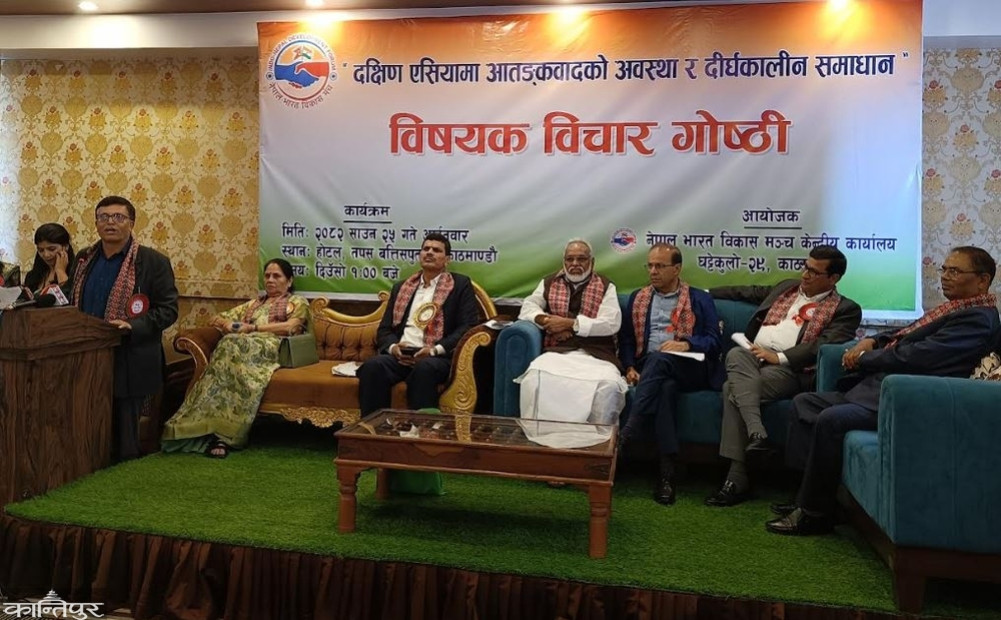
Emphasizing the need for collective efforts against terrorism, the stakeholders said that South Asian countries should take common steps.
We use Google Cloud Translation Services. Google requires we provide the following disclaimer relating to use of this service:
This service may contain translations powered by Google. Google disclaims all warranties related to the translations, expressed or implied, including any warranties of accuracy, reliability, and any implied warranties of merchantability, fitness for a particular purpose, and noninfringement.
Stakeholders emphasized that only military action is not enough to solve terrorism and multi-faceted cooperation is required by identifying its root cause. Senior advocate Dinesh Tripathi said that cross-border terrorism, geopolitical competition, the challenge of open borders and the trend of proxy wars are major threats to South Asian stability in a program on 'Terrorism and Sustainable Solutions in South Asia' held in the capital under the auspices of the Nepal-India Development Forum.
Noting that countries from Afghanistan to the Maldives have been affected by separatist insurgencies, religious extremism and state-sponsored activities, he emphasized that not only security but also political and economic initiatives are inevitable.
Former Foreign Secretary Madhurman Acharya stated that it is necessary to go to the root cause of terrorism and opined that if economic relations are strong, the problems between India and Pakistan can also be reduced. "One person's terrorist can be a freedom fighter in another's eyes," he said, adding that the international definition of terrorism is unclear.
Maoist leader Shakti Basnet said that terrorism and internal political insurgency should be separated and if diversity is not properly managed, the problem will increase. Rashtriya Mukti Party President Rajendra Mahato emphasized on the need to oppose any type of terrorism and said that it is the responsibility of the government not to allow open borders to be misused.
researcher Indira Adhikari opined that aggressive suppression of disaffected groups will lead to an increase in incidents of terrorism and in some cases the state itself will be responsible. Congress leader Minendra Rizal gave an example of regional organizations like SAARC being affected by terrorist incidents and emphasized that Nepal should be serious about attacks on India. He said that since the relationship between Nepal and India is unique, more sensitivity is needed.
President of Jaspa Nepal and former foreign minister Upendra Yadav said that since there is no idea of terrorism, it is appropriate to call it 'terrorist activity'. Stating that no country in South Asia is free from such activities, he mentioned that Pakistan, Afghanistan and India are currently experiencing more incidents. "No one should provide shelter, financial or logistical support to terrorist activities," he said, "control is possible if the root cause is identified, cooperation stopped, information exchange and cooperation can be increased."
The speakers agreed that economic, social and political cooperation along with security measures are indispensable for ending terrorism. Chairman of the organizing organization, Ramkishore Singh, said that if we compare not only South Asia but also the world, our neighbor India is suffering from terrorism. He mentioned that joint efforts of all countries are necessary to control such activities.