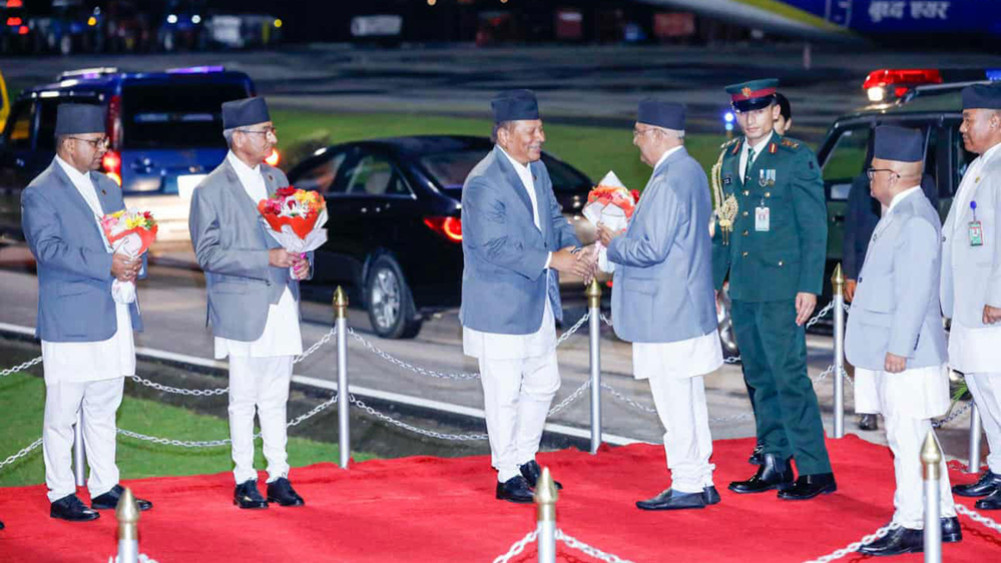
Prime Minister Oli went there to participate in the conference at the formal invitation of the President of Turkmenistan, Serdar Berdimuhamedov, and the Secretary General of the United Nations, Antonio Guterres.
We use Google Cloud Translation Services. Google requires we provide the following disclaimer relating to use of this service:
This service may contain translations powered by Google. Google disclaims all warranties related to the translations, expressed or implied, including any warranties of accuracy, reliability, and any implied warranties of merchantability, fitness for a particular purpose, and noninfringement.
Prime Minister KP Sharma Oli has returned home last night after participating in the third United Nations Conference on Landlocked Developing Countries (LLDC) held in Turkmenistan.
Deputy Prime Minister and Urban Development Minister Prakashman Singh, Home Minister Ramesh Akhtar, Culture, Tourism and Civil Aviation Minister Badri Prasad Pandey welcomed the Prime Minister in the special room of Tribhuvan International Airport. On that occasion, the Chief Secretary of the Government of Nepal, the Chief of Army Staff, the head of security agencies, high-ranking employees of the Government of Nepal and others were present. In honor of the Prime Minister, the Nepali Army offered a guard of honour.
Prime Minister Oli went there to participate in the conference on the official invitation of Turkmenistan President Serdar Berdimuhamedov and United Nations Secretary General Antonio Guterres. The conference was held in Avaza city of Turkmenistan from 20th to 23rd July (5th to 8th August). Prime Minister Oli addressed the
conference as the chairman of the Global Coordination Bureau of Less Developed Countries. During the conference, he co-chaired a high-level roundtable meeting and addressed various other events. 32 landlocked developing countries from Asia, Europe, Africa and South America participated in the conference.
It is said that the lack of direct regional access to the sea, the problems faced by landlocked countries and the benefits that can be gained from the world market were discussed in the conference. In view of the fact that the international trade of those countries has to depend on transit through other countries, the conference is focused on increasing the competitiveness of landlocked developing countries, as there are additional border crossing points and long distances from major markets, burdensome transportation processes and insufficient infrastructure, along with transportation and other transactions, the conference is focused on increasing the competitiveness of landlocked developing countries. On the occasion of the
conference, Prime Minister Oli met with the heads of delegations of various countries and high-ranking officials of the United Nations and other international organizations. Landlocked developing countries are facing the challenges of international trade, connectivity and economic development due to lack of direct territorial access to the sea.
It is believed that the conference will be fruitful in achieving the goals of sustainable development in a situation where, due to the lack of direct access, there is no significant benefit from the global market, there is no easy global transportation network, and it is difficult to develop food infrastructure. It is believed that the conference will help to solve the problems faced by the member countries by increasing investment with strategic partnership to address the challenges and assess the full potential of these countries.
Likewise, the role of the conference has become to build a mutually equal and prosperous future by supporting these countries. Earlier, the Second United Nations Conference on Landlocked Developing Countries was held in Vienna, Austria from November 3 to 5, 2014.
About 10 years ago, at the conference, there was a discussion on the issues of 'identifying international, regional, subregional and national and international trade and transit transport cooperation policies and transit transport systems in terms of partnerships and opportunities to face new and emerging challenges, including a review of the implementation of the Almaty Action Plan.
The high-level visiting team led by the Prime Minister included Secretary of the Ministry of Foreign Affairs Amrit Bahadur Rai, First Lady Radhika Shakya, Chief Advisor to the Prime Minister Bishnu Prasad Rimal, MP Surya Bahadur Thapa Chhetri, Principal Private Secretary to the Prime Minister Rajesh Bajracharya, private physician Prof. Dr. Divya Singh Shah, high-ranking government officials, media personnel and security personnel also participated.