New Executive Committee unanimously elected
We use Google Cloud Translation Services. Google requires we provide the following disclaimer relating to use of this service:
This service may contain translations powered by Google. Google disclaims all warranties related to the translations, expressed or implied, including any warranties of accuracy, reliability, and any implied warranties of merchantability, fitness for a particular purpose, and noninfringement.
The 22nd Annual General Meeting of Nepal Media Society has been completed by issuing a seven-point manifesto. The General Assembly held on Friday at Hotel Yak and Yeti in Kathmandu also unanimously elected a new working committee for the next four years (2082-2085).
Founder President Kailash Sirohia (Kantipur Media Group) and Captain Rameshwar Thapa (Annapurna Media Network) have been selected to the advisory committee from the assembly of Nepal Media Society, which is organizing media entrepreneurs and media house operators active in the field of communication as an autonomous, shared and non-profit organization. Madan Lamsal (Economic Campaign), outgoing president Shubshankar Kandel (ABC TV), vice presidents Dharmaraj Bhusal (Himalaya TV) and Mahesh Swar (Kantipur Daily), general secretary Bodhraj Tripathi (Saurya Daily), secretary Navraj Kunwar (Butwal Today Daily) and treasurer Janak Pant (TV Today) have been elected from the
assembly.
Dr. among the members. Balkrishna Chapagain (Dainik Patra Daily), Nikita Paudel (Gopikrishna TV Filmi), Vinod Paudel (Mission Today), Surendra Bahadur Singh (Gaurishankar TV) and Rajan Pokharel (The Himalayan Times) have been selected. In the
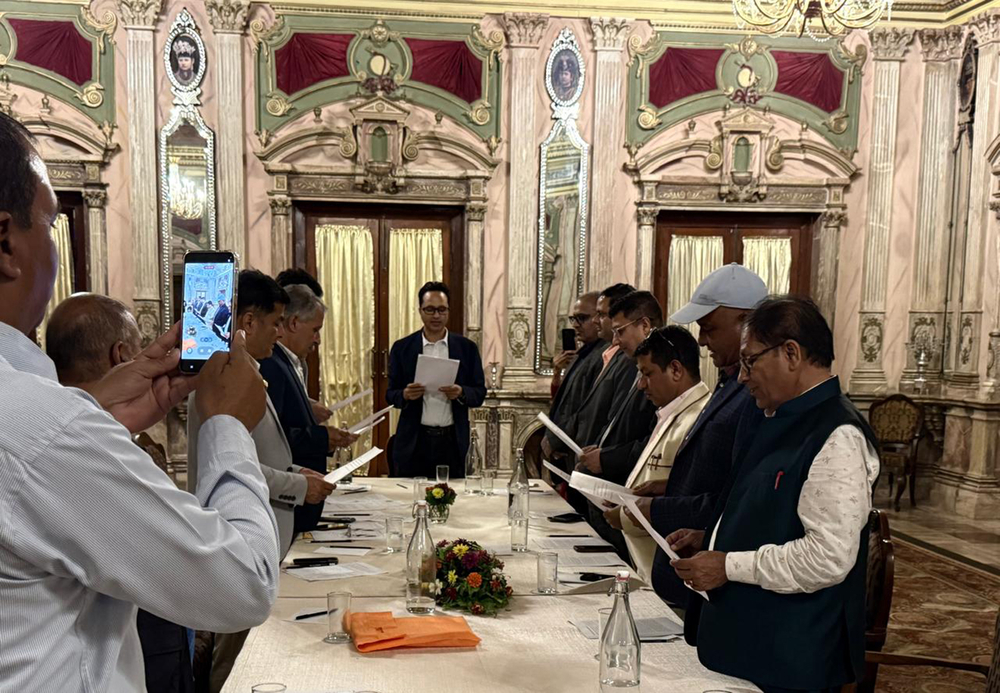
program, the founding president Sirohia congratulated and congratulated the establishment of the media society, the remarkable works done by the organization and the new working committee.
This is the Nepal Media Society's Kathmandu Declaration, 2082
The Federal Democratic Republic of Nepal established with the active participation of Pali media has passed the decade. Nepali media is facing a crisis in history even in the governance system established with its own direct participation . In such an adverse situation, the Kathmandu meeting and general meeting of Nepal Media Society, a joint organization of media entrepreneurs, has been successfully completed on July 16, 2082 at Hotel Yak and Yeti in Kathmandu by issuing the following Kathmandu Manifesto.
1. The Constitution of Nepal has guaranteed full press freedom. It has ensured the right of mass media to publish/broadcast news on any public matter . While enjoying the same rights given by the constitution Journalists and media are also facing criminal charges. Cyber law has also been misused in this . Actions contrary to Nepal's constitution and international values and sentiments regarding press freedom should be stopped .
2. The government advocating privatization in all sectors is in the opposite direction in the case of mass media. It is a sad irony that even after the establishment of the Republic, the government budget continues to be mobilized for the government mouthpiece. Especially contrary to the essence of the Advertising Act, the government advertising policy has not become private sector friendly. Therefore, the basic principle of providing a level playing field for all should be reflected in the distribution of government advertisements .
3. The proposed Media Council Bill is seen as an attempt to impose more of a regulatory body than for the promotion of the media sector . We sincerely request the sovereign parliament and the responsible parliamentarians to return to the natural process of making other related laws only after creating an umbrella law for the mass media, taking into account the government's attitude so far and the discussions held in the parliamentary committee. Media self-regulation has its own values and beliefs. We urge all parties to be clear that the government's attitude of urging self-regulation as a weapon to terrorize the media industries is a totally anti-liberal democratic authoritarian style. .
4. Since consumer rights are provided as fundamental rights of citizens in the Constitution of Nepal, according to this, firms and industries that sell all kinds of manufactured goods and services consumed by ordinary citizens should be facilitated to make it mandatory to implement and make it mandatory to make it mandatory for 3 to 5 percent of their total sales to advertise their products and services regularly through mass media. In addition, it is necessary to arrange that the brand owners or importers of ready-made food and beverages, ready-made clothes and other clothing items, mobile phones, TVs and other communication devices, household electrical appliances and other kitchen appliances imported from abroad and sold in Nepal must inform the consumers by publishing and broadcasting the price list in the mass media. This arrangement is also necessary from the point of view of natural justice. Because currently the information about such items is being broadcasted easily in Nepal through foreign media . The market in which the product is to be sold should also be promoted in the same domestic (country) market.
5. Nepali students are not going abroad after seeing the advertisements of foreign educational institutions. For the last few years, the government has tightened the advertising expenditure of educational institutions, insurance and other sectors. The policy of not allowing private educational institutions to promote their services has had a negative and conflicting effect on students, parents, schools, etc. Insurance information flow has been hindered by the strictness of advertising of insurance companies . We draw serious attention to the government of Nepal to correct such restrictive and prohibitive provisions.
6. The social network is becoming anti-social due to the confusion created by the cultivation of misinformation. The global misinformation epidemic is also seriously affecting our country and society. Rather than how to manage such a serious situation, the government and the responsible political parties have become a serious concern for a healthy democracy. On the other hand, in the name of online advertising in the network, a large amount of money has been released illegally. It is ironic that the government is indifferent to the fact that adopting such an advertising style has seriously affected the state's tax range. In this regard, we would like to draw attention to the relevant bodies to take appropriate initiatives immediately and adopt a clear legal and natural style .
7. Unhealthy competition between media organizations in the advertising market has added to the disadvantage. The conference urges all communication entrepreneurs to adhere to a code of conduct including minimum rate rates and transparency to make it dignified .
Bodhraj Tripathi
General Secretary

