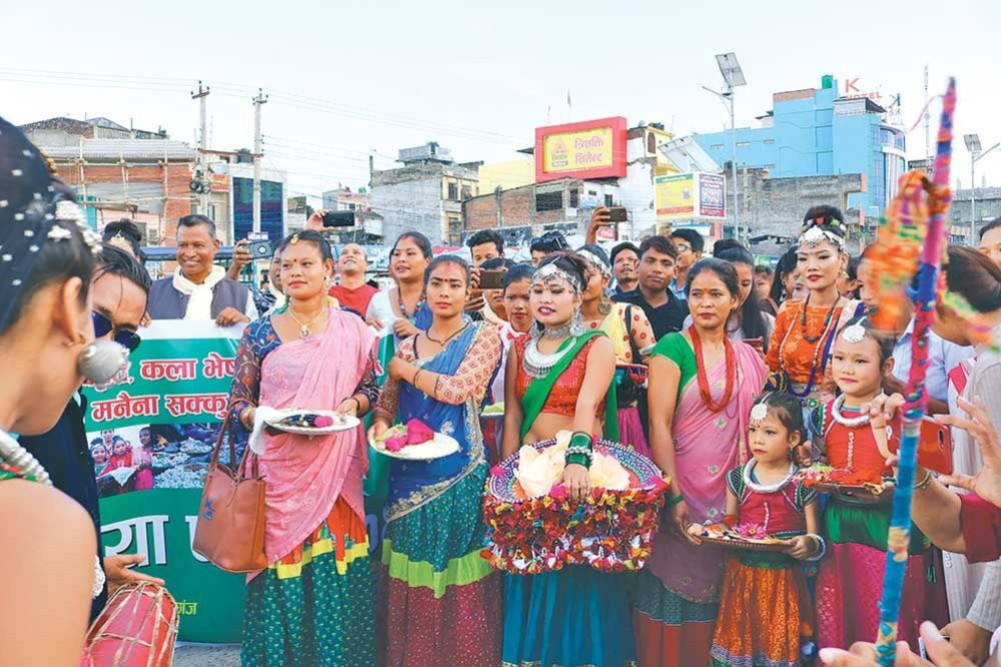
In the evening, especially children and young women wear new clothes and gather in the village square or intersection with bhuja, corn, banana, gram and cloth gurhi in dhakia.
We use Google Cloud Translation Services. Google requires we provide the following disclaimer relating to use of this service:
This service may contain translations powered by Google. Google disclaims all warranties related to the translations, expressed or implied, including any warranties of accuracy, reliability, and any implied warranties of merchantability, fitness for a particular purpose, and noninfringement.
'Gurhi' celebrated as the first festival by the Tharu community is being celebrated with joy today. The celebration of this festival has started in Kailali and other Tharu communities by organizing various programs.
Gurhi celebrated by the Tharu community is a festival with a unique cultural identity. Especially the Tharu community living in Kailali, Kanchanpur and other districts of western Nepal celebrate this festival with special importance. This festival is celebrated on the day of Shravan Shukla Panchami i.e. Nag Panchami. Budhram Chaudhary, Chairman of Ghodaghodi Nagar Bhalmansa Working Committee, informed that especially Nepalese people worship snakes on Nag Panchami, while in Tharu society 'Gurhi' is worshipped. He said that there is a popular belief that during Gurhi Puja, poisonous snakes will not come into the house, lightning will not strike the house, fire will not occur, disease and epidemics will not enter the house.
The local levels of Kailali have also given public holidays on the occasion of Gurhi Puja. How is
celebrated Gurhi?
Gurhi festival is considered to be especially related to children. Recently people of all age groups are celebrating this festival.
Tharu leader Pancharam Choudhary informed that 'Gurhi' is a symbol of a type of singing insect and it feeds on germs and mosquitoes that contaminate the environment. He says that the name of this festival is Gurhi because it is celebrated by making a gurhi (doll) made of cloth as a symbol of this singing worm. A few days before the
festival, the Tharu community cleans the house and courtyard. In the morning on the day of the festival, one washes and becomes pure. Women make 'gurhi' i.e. dolls out of pieces of colorful cloth. The boys make whipping sticks using bamboo or jute.
In the evening, the people of the village, especially the children and young women, gather in the village square or intersection, wearing new clothes and carrying bags, corn, bananas, gram and cloth baskets. The village leader (Bhalmansa) starts the worship by tying a knot in the dubo. Then the gurhi brought by the girl is kept in one place and worshiped. In this festival, which is celebrated as a symbol of love between brothers and sisters, sisters throw guria and on the order of Valmansa, brothers beat the guria with a stick and both parties rejoice. When making
jokes, they shout slogans of 'Deu Ghughari', 'Leu Ghughari'. It is called 'Gurhi Asraina'. Budhram Choudhary, chairman of Nagar Bhalmansa, said that it is believed that by beating Gurhi in this way, diseases and evil spirits in the village will escape. According to him, after beating the gurhi, the young woman distributes the pulses, chickpeas, corn, etc. that she has brought to everyone as prasad.
After killing the 'Gurhi', they do the funeral in the river, Kulo. It is believed that if this is done, the diseases and problems in the village will be washed away with the water and happiness will be obtained. Some collect pieces of cloth and tie them to the door of the house. By doing this, it is believed that the pain, suffering, snakes and scorpions in the house will be removed from the house, said Chaudhary, the chairman of Nagar Bhalmansa.