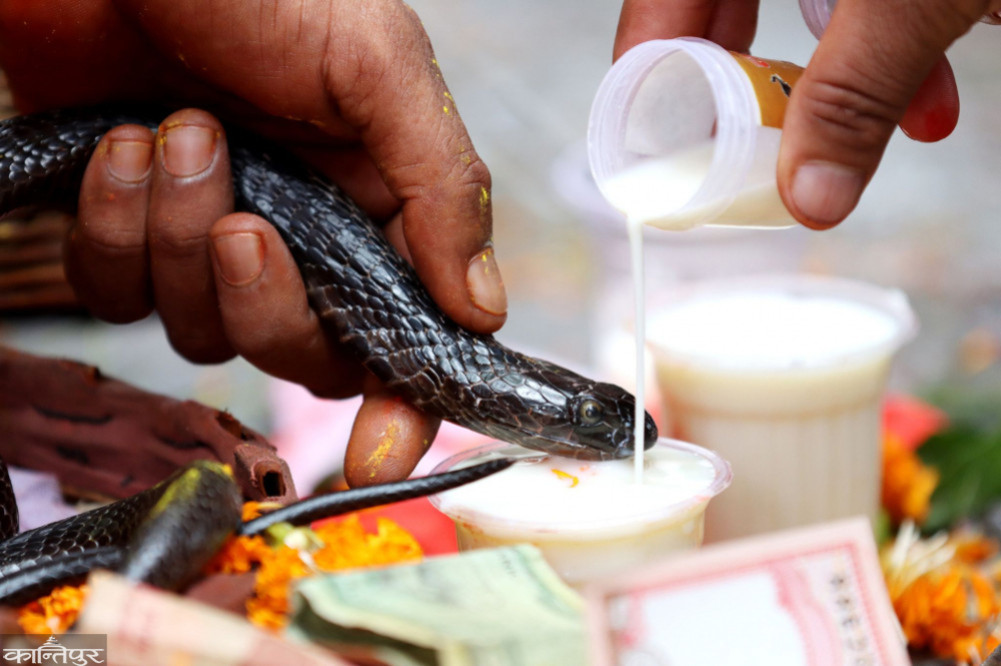
Cow's milk, Akshata, Dubo, Kheer and Roti are offered in honor of the snake.
We use Google Cloud Translation Services. Google requires we provide the following disclaimer relating to use of this service:
This service may contain translations powered by Google. Google disclaims all warranties related to the translations, expressed or implied, including any warranties of accuracy, reliability, and any implied warranties of merchantability, fitness for a particular purpose, and noninfringement.
Nagapanchami festival is being celebrated today according to tradition by worshiping the snake and hanging it on the front door of the house. This festival is celebrated every year on the fifth day of Shravan Shukla.
Prof. Dr. Devmani Bhattarai, a theologian and a member of the Nepal Almanac Jury Committee, informed that there is a religious belief that by hanging a picture of a snake in the house, snakes, snakes, and scorpions will not cause harm to the house, as well as the fear of fire, clouds, and lightning. ' The practice of snake worship started from the Vedic period. According to Vedic belief, Naga is considered the 'king' of snakes. If the snake is angry, there is a lack of water, so there is a tradition of worshiping the snake for water as well. As mentioned in the Barah Purana, Brahma's dialogue with Nagaraja took place on Shravan Shukla Panchami, and this day is also considered famous for Nagpuja, he said.
The incident of Lord Krishna oppressing Kalinag in his childhood is described in various Puranas. The statue of Buddha, who was born as the ninth incarnation of Lord Vishnu, has a snake figure in the form of a crown on his head. Matsyendranath's neck is decorated with a garland of snakes. Jain Tirthankaras also have serpentine crowns on their heads.
The occasion of Pandu's son Arjuna and Chandragupta II's marriage to Naga Kanya is mentioned in scriptures. Dr. Bhattarai said that the belief that Goddess Lakshmi resides in the house where snakes are worshiped has existed since time immemorial in our society.
Even though there are twelve names of Nagas, there is a tradition of worshiping eight Nagas of eight classes since Vedic Sanatan times. On this day eight snakes namely Ananta, Vasuki, Padma, Mahapadma, Takshak, Kulir, Karkat and Shankha are worshiped by the Brahmin priest and hung over the door of the house. On this day, it is believed that after keeping a snake in the house, one should not dig in the fields and one should not kill reptiles such as snakes and snakes.
Today, Nagpokhari and Toudah in Kathmandu, Siddhapokhari in Bhaktapur are specially worshiped at Nagdah, Kund and Nag places all over the country and offerings of cow's milk, Akshata, Dubo, Kheer and Roti are made in honor of the snake.
Scientifically, it is believed that Rishi Muni established the ritual of worshiping snakes after confirming that poisonous substances in nature are exploited by snakes, snakes and other creatures to prevent the effects of poisonous substances on humans and other species. After Naga Panchami, the traditional Vedic Hindu festival begins.