Regal Dhakal of Nepalgunj, who was killed by stomping in broad daylight, was amnesty by the President and Ranjan Koirala, who was dismembered and burnt in the forest after killing his wife, was overturned by the then Chief Justice's bench.
We use Google Cloud Translation Services. Google requires we provide the following disclaimer relating to use of this service:
This service may contain translations powered by Google. Google disclaims all warranties related to the translations, expressed or implied, including any warranties of accuracy, reliability, and any implied warranties of merchantability, fitness for a particular purpose, and noninfringement.
There are 11 types of heinous crimes such as corruption, torture, coercion, murder, explosives, kidnapping, hostage taking or missing persons, human trafficking and trafficking, money laundering and drug trafficking or dealing that are punishable by more than three years of imprisonment.
But the government has started preparing to submit a bill with amendments to the parliament to grant amnesty to those convicted of such crimes by removing the list and provisions from the law.
The draft of the bill prepared by the Ministry of Law was submitted to the Council of Ministers on July 2, removing the negative list of 11 non-amnesty offenses in the provision on amnesty in Section 159 of the Criminal Procedure Code, 2074, which was issued eight years ago along with the Criminal Code. Currently, the bill of the Council of Ministers has reached the committee.
Congress activist Regal Yograj Dhakal was sentenced to life imprisonment on 11 Baishak 2075 on charges of murdering Chetan Manandhar in broad daylight at Dhambozhi Chowk in Nepalganj on 28 June 2072.
Despite being banned by law, Dhakal was granted amnesty by President Ramchandra Poudel on the occasion of Constitution Day in October 2080, with the remaining 12 years of imprisonment being waived, which was widely opposed. Chetan's wife Bharti, who was on hunger strike against Regal's amnesty, collapsed unconscious in the courtyard of the Supreme Court on 17 October 2080. Later, the Supreme Court overturned President Paudel's amnesty decision and sentenced Regal to jail.
Suzan Koirala of Butwal, who was sentenced to life imprisonment for the crime of murdering his brother, was released after getting the remainder of his prison term waived by the President. Within 4 years of Minaha's imprisonment, he killed his ex-wife and 2 girls again on 14th June.
The then DIG Ranjan Koirala was sentenced to life imprisonment in December 2068 for murdering his wife Geeta Dhakal. He was released on 15 June 2077 after the then Chief Justice Cholendrashamsher Jabara reduced his prison sentence to eight and a half years. But later on 12th June 2079, the full bench including then Chief Justice Deepak Kumar Karki overturned the decision to reduce the prison sentence and maintained the life imprisonment, the next day on 13th June, Koirala was arrested from Baneshwar.
In the list of 11 crimes that cannot be granted amnesty, 'corruption, torture, coercion, killing by cruel and inhumane means or by taking control, killing by using acid or other flammable substances or causing bodily harm, genocide, explosives, kidnapping, hostage taking or missing persons, human trafficking and trafficking, money laundering and drugs punishable by imprisonment for more than three years. Transportation or business.
In spite of such a legal arrangement, Regal, who was convicted in the Tikapur case, to Resham Chaudhary, the guardian of the Civil Liberties Party, have received amnesty from the President on the recommendation of the government. Now, the government has prepared a draft bill by removing the list of 11 types of crimes/misdemeanors that cannot be given amnesty from the law. Experts have called it the beginning of a legal regression that leads to political regression against the rule of law and the principles of international criminal justice, and it must be stopped.
According to Law Secretary Paraswar Dhungana, the draft of the Code of Procedure as well as the Criminal Code, Civil Code, Civil Procedure Code and Criminal Offenses (Sentencing and Execution) Act has been advanced.
All these laws came into effect from 1 August 2074. Section 159 of the existing law on parole for those with good behavior has a provision that the President can grant pardons, but 11 types of heinous crimes include a negative list of offenses that cannot be used for that facility.
In section 159 of the said act, under the heading 'sentence can be pardoned', it is written in sub-section (1), "A person who has been sentenced according to the court's decision can apply to the President through the Ministry of Home Affairs to get the sentence pardoned, postpone it, change it or reduce it." It is mentioned in sub-section 3 of the section. And, sub-section 4 enumerates negative offences.
It is said that, "Despite what is written in sub-section (3), no action can be taken to pardon, postpone, change or reduce the punishment of the offender of the following crimes." In these lists, "corruption, torture, coercion, killing by cruel and inhuman means or control, genocide, explosives, kidnapping, body hostage or missing persons, human trafficking and trafficking, money laundering and The name of the crime has been specified as ``trafficking or dealing in drugs'' which is punishable by imprisonment for more than three years.
This list is not included in the proposed bill. Section 47 of the proposed bill mentions "Amendment to Section 159 of the Basic Code" and the following section 159 has been placed instead of Section 159 of the Basic Code.
Section 159, subsection (1) of the pardonable clause states, "For the sake of Nepal's freedom, sovereignty, geographical integrity, independence and national interest and for the long-term peace of the country or to strengthen mutual relations with a friendly country or in other similar exceptional cases, the Government of Nepal, the Council of Ministers may pardon, postpone the sentence imposed by any court, judicial or quasi-judicial body or administrative officer or body, after taking the opinion of the Attorney General, can recommend to the President to change or reduce it.'
Sub-section 5 of Section 159 of the existing Act stipulates that the final judgment of the case must have been passed by the courts of all levels in order to waive the pardon from the President. 6 other different conditions have been laid down in the subsequent sub-sections for granting pardon even in such a final case. In the case of persons who are considered eligible for pardon under these conditions, there are provisions from having to obtain permission from the parole (rehabilitation) and entry board established by the government to the non-forgiveness of punishments and fines suffered by the person while on parole.
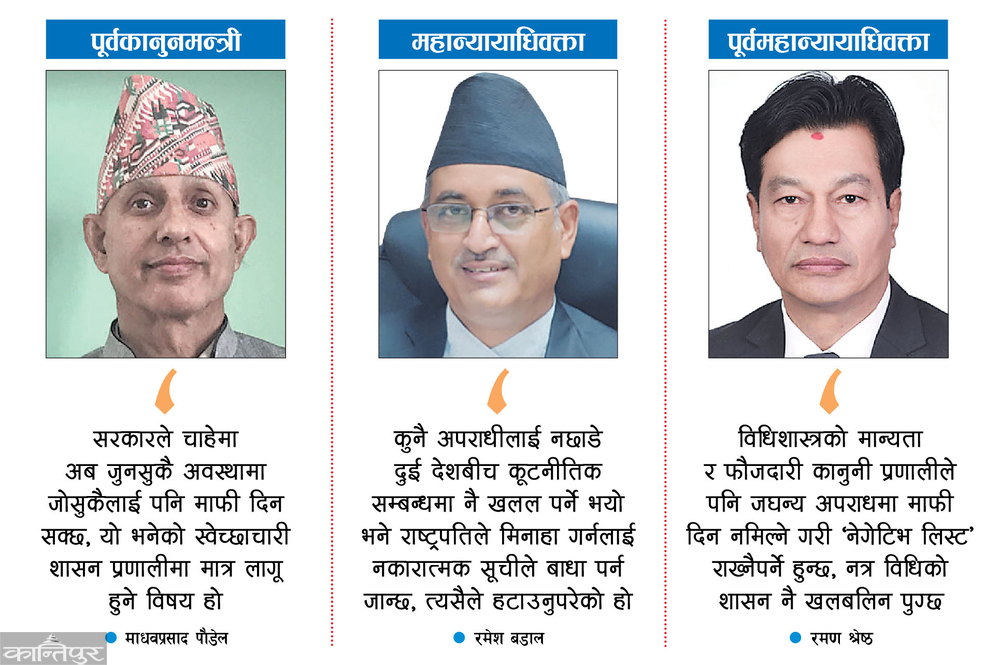
The proposed bill has completely repealed all these provisions. "This means that the government can now pardon anyone under any circumstances, this is a subject that applies only to arbitrary governance," says former law minister Madhav Prasad Paudel, "this goes against the jurisprudential recognition that the law should be applied equally and the principle of international criminal law." Hoda is about to introduce such a dubious law, it is completely objectionable in itself, if it is passed by the Parliament, it will be the beginning of legal regression,'' he says. Attorney General Ramesh Badal has defended the draft by saying that amnesty will be used as an exception and that prisoners with good behavior will be socially rehabilitated and engaged in community work.
"Anywhere in the world, the consent of the victim should not be taken when pardoning, the negative list is not kept because the government plans to grant amnesty only in exceptional cases," he said, "If the diplomatic relations between the two countries are disrupted without leaving out any criminals, the negative list will hinder the President's pardoning, so it had to be removed." They say that it cannot be removed from the law. "The recognition of jurisprudence and the criminal legal system should keep a negative list so that heinous crimes cannot be pardoned," he said, "otherwise the rule of law will be disturbed."
Corruption, torture, coercion, killing by cruel and inhumane means or by taking control, killing or mutilating or causing bodily harm by using acid or other flammable substances, genocide, explosives, kidnapping, hostage taking or missing person, human trafficking and trafficking, money laundering and drug trafficking or business punishable by imprisonment for more than three years

