The meeting led by Premkumar Rai, who was the Chairman of the Board of Directors of the Corporation as the Secretary of Tourism at the time, formed a sub-committee and started the ship procurement process. The court said, ”It seems that uncertainty and ambiguity have been created in the purchase proposal letter, and the notification has been issued with vague and confusing mixed conditions such as the purchase of a new or thousand-hour flight, built after 2014, so this is where the starting point of the corruption of the aircraft procurement process can be seen.”
We use Google Cloud Translation Services. Google requires we provide the following disclaimer relating to use of this service:
This service may contain translations powered by Google. Google disclaims all warranties related to the translations, expressed or implied, including any warranties of accuracy, reliability, and any implied warranties of merchantability, fitness for a particular purpose, and noninfringement.
The special court has held that the non-filing of a case against the then Secretary of Tourism and currently Chief Commissioner of the Abuse of Authority Investigation Commission, Prem Kumar Rai, in the widebody aircraft purchase case, is 'against the principle of equal justice'. The court has also commented that the faith in justice will be weakened when adopting a selective approach (selective prosecution) such as prosecuting someone involved in the same process and not others.
On 22 Chait 2080, the authority under which Rai is the chief commissioner filed a corruption case against 24 Nepali officials and 8 foreign nationals. In this case, the bench of special court chairman Teknarayan Kunwar and members Tejnarayan Singh Rai and Ritendra Thapa gave a verdict on 20th of November 2081. The full text of the judgment has recently come out, which states, "Selective prosecution is against the principle of general justice, such an act hurts the feeling that the law is equal for all and weakens the faith in justice." This meeting formed a sub-committee under the coordination of the then joint secretary Surya Prasad Acharya while deciding on the purchase of wide-body aircraft. The
sub-committee submitted its report on 31 July 2073. Based on that, the meeting of the board of directors of the corporation led by Rai decided on August 5 and instructed the management committee to submit a three-year action plan along with a proposal for proposal (RFP). The management committee prepared the report by forming a draft sub-committee.
The board of directors decided to purchase two A 3300-200 widebody ships on 7 August 2073 after the sub-committee submitted its report immediately. Then on 10th August, the Corporation issued an RFP. When issuing the RFP, the court also made a strong comment that "in the case of new aircraft and old aircraft, it should be such a technical structural specification and the price limit is not clarified".
"It seems that by creating uncertainty and ambiguity, the notice was issued with ambiguous and confusing mixed conditions such as the purchase of a new or a thousand-hour flight, built after 2014, so this is the starting point of the dishonesty of the aircraft procurement process," the judgment said.
But the court is of the opinion that the content that should be disclosed in the RFP is not disclosed, but rather it appears to be a collusion. There is no provision in the RFP on what the price adjustment/price escalation formula is and how it will be applied. Similarly, contrary to the provision that 'no specific brand, trademark, name, patent, design, type, origin or manufacturer's name can be mentioned' mentioned in sub-regulation (3) of Regulation 98, it was seen that specific brand, name, type and manufacturer's name were mentioned as aircraft A-330 and engine type Rolls Royce Trent 772B.'
Similarly, the court has commented that 'according to sub-regulation (1) clause (b) of regulation 236, nothing has been mentioned about the details/information/information to be kept in the request for proposal document, format of forms, evaluation method/procurement procedure/agreement/terms of agreement/procedure of legal remedy etc.'
Expressing doubts about the procurement process, the Savings Fund and the Civil Investment Fund expressed their reluctance to invest in debt, questioning the tender, memorandum and purchase agreement. Later, when Rai was the chairman of the savings fund as the supply secretary, it was decided to invest the loan.
The court has ruled that this procurement process has been completed as a continuation of the decision of the board of directors on 2 May 2073 to form a widebody procurement sub-committee.
'Bringing someone under the scope of action and completely exempting others involved in the same process is a danger of creating double standards in the justice system,' the court commented. Based on the proposal recommended by the sub-committee formed by the committee chaired by Rai, the corporation issued the Request for Proposal (RPF) on 10 August 2073. It is said in the verdict, "It seems that the process that started from the level of conducting the initial work, giving orders and giving approval, later turned into a purchase decision."
Although others involved in the procurement process have been prosecuted, the decision of the authority not to investigate Rai 'indicates that there is no uniformity towards individuals and institutions at all levels', the court commented. It has been said, "In this way, it seems that a selective approach has been adopted such as not prosecuting anyone involved in the same act and prosecuting someone."
Based on the prosecution of the authority, the then general manager of the corporation Sugaratna Kansakar, the chairman of the board of directors and the then secretary Shankar Prasad Adhikari, the then secretary Shishir Kumar Dhungana and the joint secretary Buddhisagar Lamichhane have been found guilty in the corruption case. Similarly, seven foreigners have also been found guilty. Due to the corruption of 1 billion 47 million in the purchase of aircraft, the court has decided to collect 12 million 25 million fines from the guilty.
The court held that the accused have caused financial loss to the nation by purchasing an aircraft with less capacity than the approved load capacity. In the indictment filed by the Authority, there were two main subjects - the carrying capacity of the aircraft (maximum take-off weight) and the loss in adjusting the price of the aircraft. The court held that the carrying capacity was reduced from 242 tons to 230 tons, but the payment was made for 242 tons.
The then general manager of the corporation, Kansakar, was sentenced to 2 years and 6 months in prison. According to the legal provision of additional punishment for corruption committed while holding a high position, the special officer has imposed an additional 3 months imprisonment. The then secretary officer who was the chairman of the corporation has been sentenced to 1 year and 6 months imprisonment. He has also been sentenced to an additional three months for corruption in a high position. Secretary Dhungana and joint secretary Lamichhane will be sentenced to 1 year and 6 months respectively.
The authority filed a case against 24 Nepalis and 8 foreigners including the then Tourism Minister Jeevan Bahadur Shahi in a special court concluding that there was corruption in the purchase of widebody aircraft. Among them, British citizen Deepak Sharma, president of international supplier American company AAR Corporation, German citizen Christian Neuhlen, representative of German Aviation Capital Company, Romanian citizen Oleg Calistru, financial director of AAR International, have been found guilty. AAR Company CEO John Holmes, German Aviation Capital Managing Director Ana Topa, High Fly X Chairman Paulo Mirpuri and Director Gerald Thornton have been sentenced.
Sharma's company got a contract to buy a widebody ship. German citizen Christian was also found to have colluded with 3 other companies in the procurement process. Kalistru was found to have opened High Fly X to buy the ship. John Holmes, president and CEO of AAR International of America, which initially contracted with the corporation. Although other companies involved in the purchase of the ship and their representatives were found guilty, the escrow company and its representatives were acquitted. It is mentioned in the decision of the special that the Nepalese defendant appeared and gave a statement in the court within the deadline issued by the special and the foreign defendant did not appear within the deadline.
A company with a foreign national chairman was established and two big ships were purchased on February 19, 2073 and sold to the corporation for 24 billion rupees. At that time, it has been determined that the ship was bought and sold contrary to the Public Procurement Act, 2063 and the Public Procurement Regulations, 2065. The decision of the special court also mentions the opinion that although the purchase of the flag-carrying ship, which is considered the pride of the nation, is necessary, it should be tough on corruption.
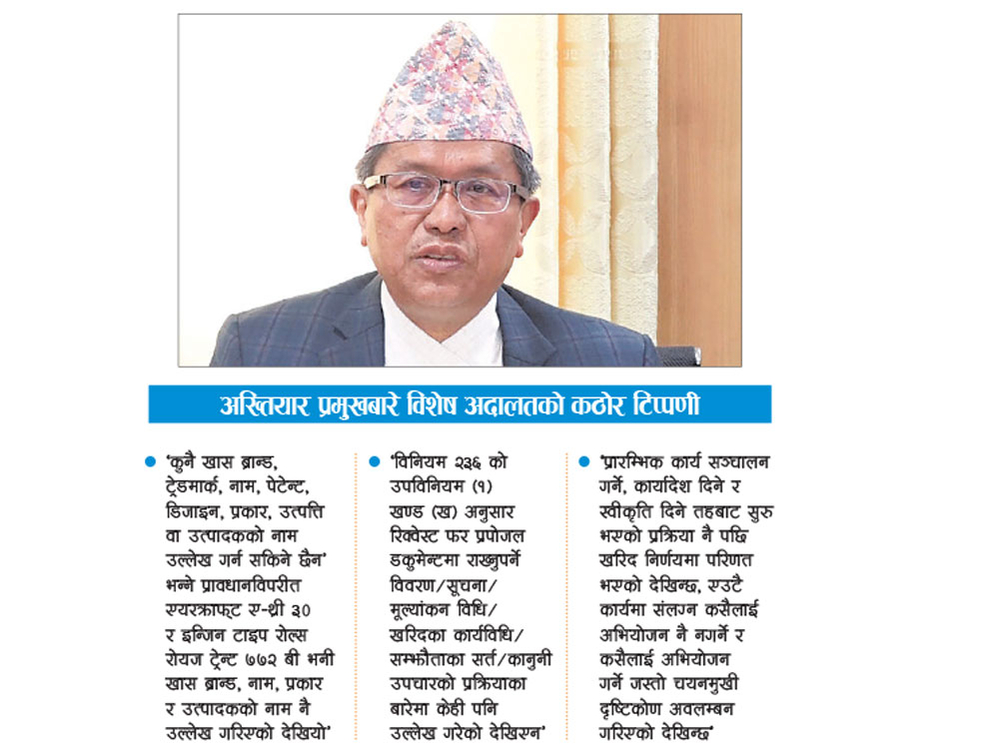
The special court's harsh comment about the head of authority
- "No specific brand, trademark, name, patent, design, type, origin or name of the manufacturer can be mentioned" contrary to the provision that the aircraft A-330 and the engine type Rolls Royce Trent 772B were mentioned as the specific brand, name, type and name of the manufacturer"
- "According to sub-regulation (1) clause (b) of regulation 236, request for Nothing seems to be mentioned about the details/information/appraisal method/procurement procedure/terms of agreement/legal remedy process to be kept in the proposal document
- 'The process that started from the level of conducting the initial work, giving orders and giving approval seems to have turned into a purchase decision later, it seems that a selective approach is adopted such as not prosecuting anyone involved in the same work and prosecuting someone'

