We use Google Cloud Translation Services. Google requires we provide the following disclaimer relating to use of this service:
This service may contain translations powered by Google. Google disclaims all warranties related to the translations, expressed or implied, including any warranties of accuracy, reliability, and any implied warranties of merchantability, fitness for a particular purpose, and noninfringement.
Kulman Ghising, the former chief executive director of Nepal Electricity Authority, who arrived in Qatar with the Bright Nepal campaign, said that leadership should be changed to give hope to Nagik who lived in despair.
Addressing the bright dialogue organized by the Qatar-based Non-Resident Nepali Association (NRNA, NCC) and the Federation of Nepalese Tribes in Doha, Ghising said that to create an atmosphere of hope in Nepal, we need to change the leadership and move forward.
'There is a lot of despair that there is nothing in Nepal. There was a crisis of confidence in the current leadership. It is dark because there is no right person in the right place. Now we have to remove the darkness and bring a new leadership to make a bright Nepal," he said, "There are opportunities in Nepal. We have a strong labor force that can handle the economic situation for the country. We have an opportunity to use their experience and capital to change the country. For that, it is necessary to change the leadership.'
He has also made it clear that Nepal has started a bright campaign to generate youth leadership. Now if the country does not have the right leadership, it will be more disappointing. If you-we can stand in one place, then the country will be formed. We can move forward with your experience and commitment," he said. Bright Nepal is the way to prosperity. It is the way to create youth leadership by uniting. This is not only a social campaign, but also a campaign to create an economic revolution. 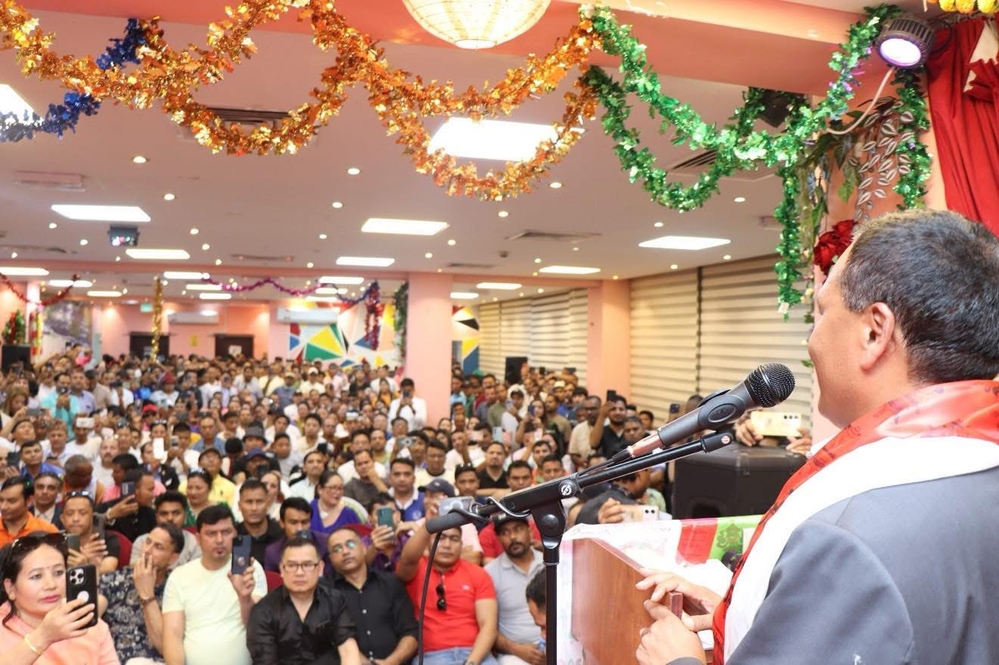
He expressed his concern that the Nepali community abroad is divided in the name of party. "When I came to Qatar through Bahrain, Oman, UAE, the Nepali community everywhere has been more divided abroad than at home in the name of party. We must rise above the party. The division in the name of party should be eliminated,' he said, 'opposition and support should be given on the basis of work.'
He expressed his belief that Nepal can be made through the struggle of Nepalese in the Gulf. The experience gathered by Nepalis from every region of the Gulf is useful for building Nepal. The remittances coming from the Gulf should be used for the development of hydropower, agriculture and tourism, he said, but the government has not rolled out the red carpet for the people who are responsible for the country's economy. Instead, he is only insulting from the time he arrives at the airport to his departure.'

