If no agreement is reached in the first meeting, the second meeting is called, even if the notice and agenda are not given
We use Google Cloud Translation Services. Google requires we provide the following disclaimer relating to use of this service:
This service may contain translations powered by Google. Google disclaims all warranties related to the translations, expressed or implied, including any warranties of accuracy, reliability, and any implied warranties of merchantability, fitness for a particular purpose, and noninfringement.
The Federal Parliament has passed a bill with a provision that only two people can make decisions in the 6-member Constitutional Council. The House of Representatives on Wednesday passed the (First Amendment) Bill regarding the Constitutional Council (Works, Duties, Rights and Procedures), which the government registered in the House of Representatives on 12 February 2079, accepting the message of the National Assembly.
The government introduced a bill to change the quorum and decision-making provisions of the Constitutional Council. The Constitutional Council, chaired by the Prime Minister, includes the Chief Justice, the Speaker, the Speaker of the National Assembly, the leader of the main opposition parties and the Deputy Speaker.
Provision has been made in the bill that all members should be present at the council meeting and decisions should be taken unanimously. But a new provision has been added on what to do if all are not present and a unanimous decision cannot be reached.
"If all the members are not present at the meeting of the council or if consensus cannot be reached on any matter, the chairman will call another meeting after fixing the date, time and place of the meeting and the secretary will send information about the date, time and place of the meeting to the members," the bill passed by the parliament states, "When calling the (next) meeting, the meeting can be called to be held 48 hours before the time of the meeting."
Before the Constitutional Council It was a binding arrangement that the meeting should be called 48 hours before the date of the meeting and the agenda of the discussion should be sent to the members. According to the new arrangement, if no agreement is reached in the first meeting, the second meeting will be called even if the notice and agenda are not given.
The National Assembly added an explanation of quorum and decision-making process to the Bill, which was also accepted by the House of Representatives. According to which, it is envisioned that there will be four situations of quorum in the council meeting. In all those four cases, the number of people present is considered to be a quorum.
In the case of the president and five members, at least four including the president and at least three members, at least three including the president and at least two members in the case of the president and at least two members, and at least three including the president and at least two members are said to constitute a quorum. Similarly, in the case where only the chairman and two members are present, the provision is made in the bill that if at least two people including the chairman and at least one member are present, the quorum is considered to be reached.
While being in the opposition during the discussion on the bill, UML had argued that the consent of the council president, i.e. the prime minister, should not be made mandatory. UML said that the Prime Minister should also have his vote as a member. The then ruling Congress, Maoist, and Unified Socialists, as the President was also the Chief Executive, took the stand that people who disagreed with him should not be appointed to the constitutional commissions. Regarding the
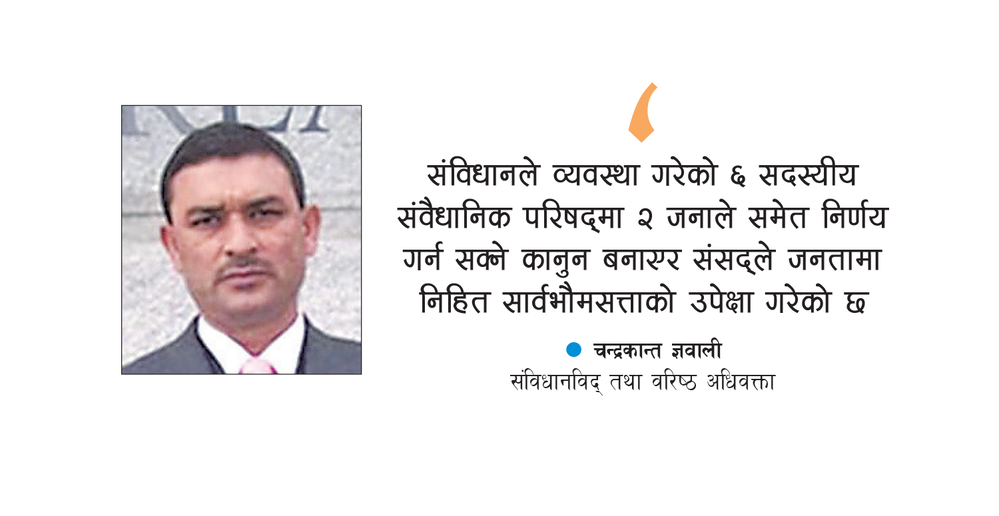
decision-making process, the National Assembly included all four situations in the bill. It has also been accepted by the House of Representatives. Regarding the decision-making process, it is stated in the bill, "In the case of the chairman and five members, at least four including the chairman and at least three members, in the case of the chairman and four members, at least three including the chairman and at least two members, in the case of the chairman and at least two members, at least three including the chairman and at least two members, and in the case of the chairman and two members, the chairman and at least one member, the decision will be made by the votes of at least two people." have done Constitutionalist and Senior Advocate Chandrakant Gyawali commented that the Parliament neglected the sovereignty vested in the people by making a law that even 2 people can make decisions in the 6-member Constitutional Council provided by the Constitution.
A council consisting of the Prime Minister, the Chief Justice, the Speaker, the Speaker, the Leader of the Opposition, and the Deputy Speaker has been formed so that the government does not become autocratic, but is reined in by the constitutional body. It is envisioned that the people recommended by them are skilled and qualified and will lead the country to constitutionalism," he said. If the law is made outside the spirit of the constitution, it will be in conflict with the provisions of the constitution and may come under judicial review.'
Defense Minister Manveer Rai on behalf of Prime Minister KP Sharma Oli in the House of Representatives on Wednesday answered the question raised on the proposal to consider the amendment made by the National Assembly. The bill was then passed by the House. After it is verified by the Speaker, it will be sent to the President for verification. After approval by the President, it will come into effect as soon as it is published in the gazette.

