”Ordinance is an emergency and exceptional measure, an ordinance cannot be issued to amend an existing law, this is the essence of our constitution, but now the government can rule not by law, but by ordinance, now there is no balance of power”
We use Google Cloud Translation Services. Google requires we provide the following disclaimer relating to use of this service:
This service may contain translations powered by Google. Google disclaims all warranties related to the translations, expressed or implied, including any warranties of accuracy, reliability, and any implied warranties of merchantability, fitness for a particular purpose, and noninfringement.
After four and a half years, when the constitutional bench was examining the writ against the appointment of 52 officers of the constitutional body, the opinions among the judges were not only conflicting, but also unclear and complicated. The decision made by the five-member bench is being criticized from the judicial circles.
15 petitions filed against 52 appointments in 12 constitutional bodies including the Commission for Investigation of Abuse of Authority, Human Rights Commission, and 15 writs were dismissed on Wednesday midnight by the constitutional bench comprising Chief Justice Prakashmansingh Raut, senior-most judge Sapna Pradhan Malla and judges Kumar Chudal, Manoj Sharma and Nahkul Subedi.
Among them, Justices Chudal and Sharma wrote the original judgment, in which they upheld all the appointments. In this context, they have given two main arguments – First, the President can bring an ordinance on the recommendation of the executive. Secondly, the ordinance brought in that way will be implemented immediately after being approved by the President.
After the Constitutional Council Act was amended through the Ordinance, the Constitutional Council meeting chaired by the then Prime Minister KP Sharma Oli recommended 38 office bearers on 30 November 2077. Since the House of Representatives was dissolved within a few days, 32 people were appointed on January 21 without a parliamentary hearing. Again, by amending the law through an ordinance, 20 people were recommended to the Constitutional Commission on 26 Baisakh 2078. They were also appointed on June 10 without a parliamentary hearing. Both the recommendations were approved by the then President Bidya Devi Bhandari.
 A meeting of the Constitutional Council was held on 30 Mansir 2077 at 9 am to recommend to the constitutional body, but then the leader of the main opposition party, Sher Bahadur Deuba and Speaker Agni Sapkota, boycotted the meeting. After that, the government issued an ordinance and amended the existing provision that the presence of 5 of the total 6 members of the Constitutional Council would constitute a quorum and the decision of 4 out of the quorum would be a majority. The ordinance also made a provision that the majority of those present, including the chairman, can make a recommendation. On the same day as the
ordinance was issued, the Constitutional Council meeting was again held at 5 pm. According to the law amended by the Ordinance, the then Prime Minister KP Sharma Oli, who was also the Chairman of the Constitutional Council, the then Chief Justice Cholendra Shamsher Jabara and the then Speaker of the National Assembly Ganesh Prasad Timilsina had a meeting to recommend the appointment of constitutional officers. Even after about 5 months, it was recommended to appoint 20 officials in the constitutional body by bringing the same ordinance again.
Prime Minister Oli dissolved the House of Representatives immediately after the recommendation both times, so none of the candidates could have a parliamentary hearing. They were appointed on the basis of the parliamentary rules that if there is no parliamentary hearing within 45 days of the recommendation, the appointment will not be hindered.
Justices Chudal and Sharma have concluded that the process of appointment in the Constitutional Commission is in accordance with the Constitution. In this regard, they are of the view that, "The members of the Constitutional Council were not excluded from the meeting as stipulated by the constitution and there was no opposition or opposition from the then leader of the opposition party in the House of Representatives." Sapkota filed a petition in the Supreme Court against the recommendation stating that he was not called and was not informed about the meeting held at 5 pm on the same day. According to the constitution, as an ex-officio member of the constitutional council, he has the right to get information about the meeting 48 hours in advance, but he argued that the meeting itself was unconstitutional because he had no information about the meeting that was held in the evening that day.
Judges Chudal and Sharma said that the recommendation should be approved as the evening meeting was a continuation of the morning meeting. Judge Pradhan also agrees with their decision. But she argued that even if the recommendation made by the Constitutional Council meeting is in accordance with the constitution, a parliamentary hearing should be mandatory before the appointment. She has issued a mandate to conduct a parliamentary hearing on the recommendation made both times within 45 days and if the hearing is approved, to count their service period from the day of appointment. But his mandate will not be implemented as he is in the minority.
Regarding the recommendation of 30 Mansir 2077, Chief Justice Raut and Judge Subedi argued that the continuation of the morning meeting cannot be considered as the evening meeting and held that the speaker has not complied with the constitutional right to be informed. Chief Justice Raut and Judge Subedi, referring to the precedent set by the Supreme Court that the members of the Constitutional Council must be properly notified of the meeting, otherwise the decision made on the basis of a quorum is not valid. On that basis, they have decided to cancel the constitutional appointment made for the first time. But their decision is in the minority.
The appointment for the second time has been approved by all the five judges of the constitutional bench. But regarding the recommendation and appointment of 32 office bearers for the first time, many comments have been made since midnight on Wednesday due to three different opinions from five judges. Judges Chudal and Sharma are also criticizing the judges' circle that there is no basis for the argument that the recommendation of the appointment is in accordance with the constitution by considering the continuation of the morning meeting to the evening meeting.
"This argument does not fit jurisprudentially because a meeting that does not reach a quorum is not included in the agenda and there is no continuation of a meeting that is not included in the agenda," said one of the judges of the Supreme Court. He also made a comment. It is a legal practice to say whether a
case is dismissed or not based on constitutional reasons, jurisprudential methodology and valid principles of justice. "But there is no argument and reason, nor is there any mention of jurisprudence," says Omprakash Aryal, one of the petitioners' advocates. "If a writ is to be issued, then an injunction can be issued. After the writ is dismissed, what is the mandate again?" Advocate Aryal says, "No legal reason has been given for the writ to be dismissed." It is said that after the writ is dismissed, a warrant for hearing will also be issued.
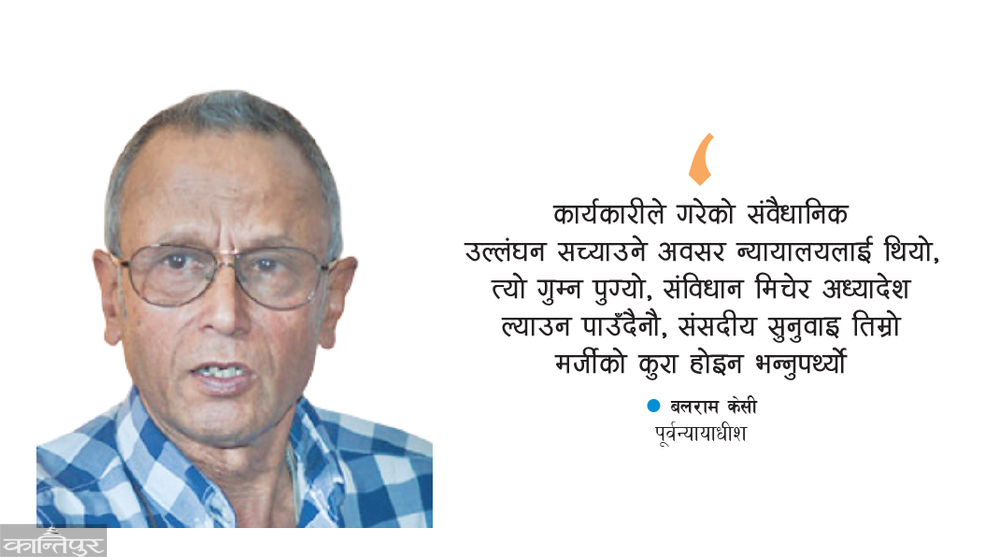
Former Supreme Court judge Balram KC also commented that the court has lost enough opportunity to correct the constitutional violations committed by the executive. "The constitutional bench cannot change the constitution and bring an ordinance. It was an opportunity to boldly say that the parliamentary hearing is not something you want," he says. told.
'The main thing is not whether the speaker was informed or not, it is whether the executive can work by altering the constitution or not,' said another writ petitioner, senior advocate Dinesh Tripathi, 'but it seems that the court has entered into this constitutional question and reached a decision to uphold the appointment by talking about a technicality, which is unfortunate for the court itself.'
Tripathi said that the Supreme Court's own jurisdiction to protect the Constitution has been eroded. This order has changed the way of the constitution, now there is no balance of power in the constitution. The situation has come where the executive can work in any way," he said, adding, "The ordinance is an emergency and exceptional work. Ordinances cannot be issued to amend existing laws, this is the essence of our constitution, but now the government can rule not through laws, but through ordinances, this is a very worrying thing.'


