With the passage of the Citizenship Bill by the Parliament on June 14, the way for the children to get citizenship through the name of the mother has been opened, but what will happen if no generation of the family does not have citizenship, not even a birth certificate? It has not come up in the debate, the Musahar, Majhi, Dalits living in Terai-Madhesh have been deprived of citizenship for a long time.
We use Google Cloud Translation Services. Google requires we provide the following disclaimer relating to use of this service:
This service may contain translations powered by Google. Google disclaims all warranties related to the translations, expressed or implied, including any warranties of accuracy, reliability, and any implied warranties of merchantability, fitness for a particular purpose, and noninfringement.
What gives a person identity? Birth certificate? Citizenship? National ID? Voter ID card? Passport? Or driver's license? There are many such people from Terai-Madhesh, who have not been able to get even one of these certificates, who are living - invisible in the eyes of the state.
From Saptari, Sirha, Mahottari, Sarlahi, Rautahat, Bara to Parsa of Terai-Madhesh, such people are often found in the villages, who have neither birth registration in the government book, nor the certainty of being registered anywhere after death. They were born, raised, toiled, sweated, but never existed in the eyes of the state. Those faces are found in fields-barns, kholsa-sides and city streets and squares of Madhesh province, who have neither formal identity nor rights to any facilities of the state. They are not even 'one vote' of the state.
A person without identity cannot call anything in the world 'his'. The state does not see him, society does not recognize him. Name, surname, address alone do not constitute his 'identity'. He remains 'unidentified' until he has a piece of paper i.e. citizenship. Living life as a foreigner in the country.
...
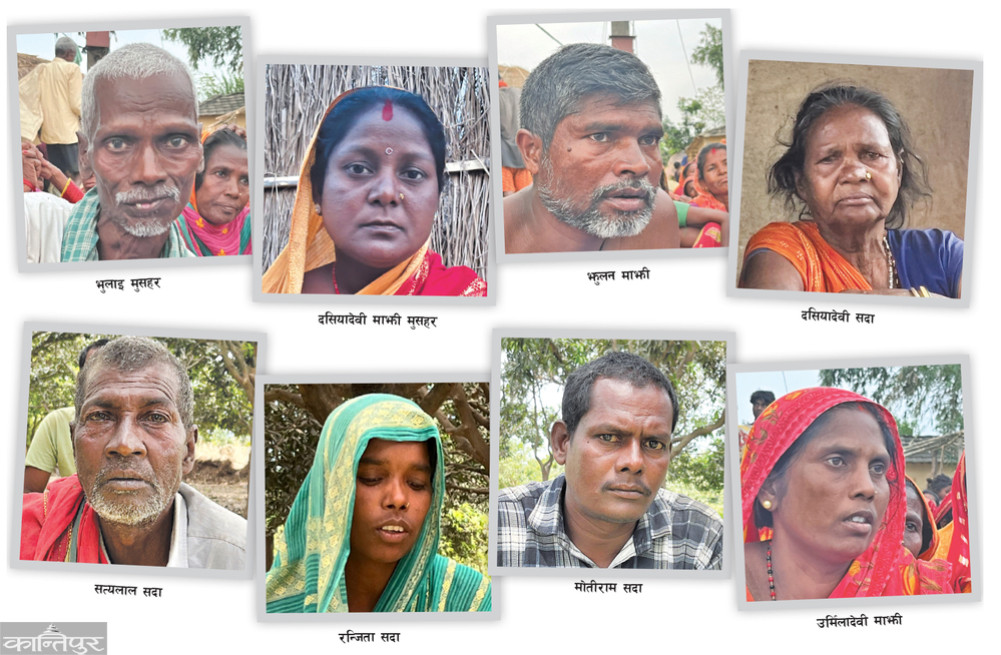
Landless Motiram Sada (45) of Siraha Golbazar-3 Jamdah Bhangbari does not have citizenship. He is not in any accounting of the state. The petition given by him to the ward for a letter of recommendation to include his name in the citizenship list is kept in the file. They are invisible to the state, their pain is also invisible. He thinks everything in the country is 'other' - from schools, hospitals, roads, laws, offices to polling booths. "We don't get to enroll in school, we don't have jobs, and we don't get service from the government," Motiram asks, "When will this country be mine?"
No one in his family had citizenship since his grandfather's time. Earlier, there was not much search for citizenship. "Nowadays, without citizenship, you cannot get any services of the state," says Motiram, "Bama passed away when we were young. No matter how many times I went to the district administration, they did not give me the citizenship because they wanted a person to do identification and proof. The ward did not even make a letter of recommendation.
No one in Motiram's family has citizenship. When you reach the settlement of elections, the leaders say - I will make you a citizen this year! Many years have passed, but what is the face of citizenship? Not able to see. He has sons aged 13, 16 and 20. They could not complete their studies due to lack of birth registration, now they work in Delhi-Punjab. They cannot even send money through official 'channels'. Citizens are also required there. Sons say, 'I wish I could go to work abroad', they are sad. However, a passport had to be made to go abroad and citizenship was required to make a passport.
Why didn't Babu-Baje become a citizen? "Our father, Baraju all came here to earn a living by living as herdsmen. Plow the field, graze livestock! At first he took a small loan, and in the name of paying it, he lived as a herdsman. That debt would be irreparable even if it passed from generation to generation. Always had to work as a moneylender. Sahu did not allow him to get citizenship,” says Motiram.
...
Nepali Citizenship (Second Amendment) Bill-2081 has been passed by the House of Representatives on June 14. Along with this, the way for the children to get citizenship through the mother's name has also been opened. However, what will happen if there is no citizenship in any generation of the family, not even a birth certificate? Not even in the debate. Because of this, many Nepalis are still forced to live uncivilized lives.
Part-2 of the Constitution, Article-10 of the Citizenship Act (1) provides that no Nepali citizen shall be deprived of the right to obtain citizenship. However, the government does not seem to have taken any initiative to make them citizens when the Musahars, Majhis, Dalits of Terai-Madhesh, who have been living as vagrants in Terai-Madhesh for generations, have been deprived of citizenship. The complaints of the landless and stateless people are that the district administration offices turn them back directly saying "Go to the Ministry of Home Affairs, not from here".
Geologist Jagat Deuja says, 'The landless are a class that has been deprived of government services. Those without citizenship are at an even greater disadvantage. The government is providing land through the Land Problem Solution Commission. Landless people without citizenship cannot even participate in the application process. Whoever has to get land, he is in a state of deprivation. Not having citizenship is a social injustice. The inability of many landless citizens to become citizens is not just a legal matter. It is also related to procedural facilitation and the understanding and thinking of the issuer of the citizenship certificate.' "I have 1 daughter and 1 son, they say that citizenship should be made, but how can they be made?," says Satyalal, "If children do not have their own citizenship, it will not be possible to make them. The wife is also stateless. We suffer, we work hard, we were born and raised in this soil. However, we did not get to be citizens of this soil. We are very sad to be uncivilized.'
Ranjita Sada (35) of Golbazar-3 Jamdah Bhangbari also has her own story of not having citizenship. My parents passed away when I was young, I have no relatives. I grew up in other people's houses. None of my ancestors will have citizenship. There was no one to identify them", says Ranjita, "the district administration ran several times. Not here, if you go to the Ministry of Home Affairs, where is the Ministry of Home Affairs? How can we uneducated people know? Ranjita got married to Ahinder Sada. He also has neither birth certificate nor citizenship. Ahinder says, "The administration refused to grant citizenship because the name and address were not disclosed. What kind of people are we, who will listen?'
More than a thousand families in Sirah alone do not have citizenship. Most of the non-citizens belong to the Musahar community, who are Dalits in the social hierarchy and have been squatting in landlords' houses for generations. Harwacharwa was abolished by law, but still working in the same way in the house of Sahu-Mahajan has become their life-work. For generations, they were neither allowed to get birth certificates nor citizenship. Today's new generation does not work in the house of Sahu-Mahajan, some of them are educated, but there are many who drop out.
'Some are still out of school,' says Arun Sada, a land rights activist in Siraha. The state has created a land problem resolution commission and is collecting the tax through the local level. However, there is a legal provision that requires mandatory red parts when the landless submits an application. There are thousands of families who have neither birth certificate nor citizenship. They have been living on open, public land, but they are wandering around without registering the land and even submitting an application.' There is no toilet in the house. 8 people have to live in that small hut. There is a forest nearby. There is fear that the elephants that sometimes enter the settlement from the forest will destroy the house. There is another sorrow in his life - no citizenship. Not only her, mother-in-law and father-in-law also did not have citizenship. Therefore, Dasia's three sons, daughter-in-law and grandchildren have not been granted citizenship.
Dasia's husband passed away. She tried hard to get citizenship, but she couldn't. She says, 'We are suffering from not being able to get the birth certificate and citizenship of our son, daughter-in-law and grandchildren. We are landless. Now the government has opened applications for registering land to the landless, but we could not even register the application for citizenship.'
Bhawani Ghimire, president of Sarlahi's Bhoomi Adhikar Manch, took the initiative to make Dasia a citizen, but she was returned to the district administration twice, but she was turned away as 'not enough proof'. She says, "There is also a problem for families who do not have citizenship to register landlessness. It seems like there is no state for the poor.'
'Those without citizenship are also deprived of land rights,' says Jagat Deuja. When deprived of land rights, housing and other rights should also be deprived. Every local level should prepare the details of the families of the landless communities who do not have citizenship and make a position to get citizenship and participate in the process of land distribution," he says.
...
The large family of 35-year-old Jhulan Majhi of Sakhuwa Prasauni Rural Municipality-3, Kauwavan, Parsa has to live in a small hut. He has no birth certificate, no citizenship. Citizenship is also required to submit an application somewhere. There is no evidence of the place where he lived.
Jhulan Majhi is very sad to be deprived of even the most basic rights like citizenship, he is shocked. Fishing was the ancestral occupation of fishermen. However, these days the rivers and streams have dried up, and fish cannot be found. Livelihood has changed, life has become more difficult. Jhulan says, 'Livelihood is very difficult and painful. No toilets, no roads, no electricity, no water. The state has not provided us with anything. Proof is also needed to go abroad to work, that proof is citizenship, but we don't have it.'
Urmiladevi Majhi of Kauwavan is 38 years old. She is also sad that the state has not given her citizenship. She says, 'We are landless. We have built small huts on other people's land. The husband is a wage earner. That too is not found every day. It is very difficult to manage household expenses with a small salary. If you had citizenship, you would have received government grants and facilities. Children could be sent abroad for education and earning. But, we are in an unfair situation.'
Kauwawan's Bhulai Musahar reached 60 There is provision for Dalits who have reached the age of 60 to get social security allowance. However, Bhulai could not take it. Because of the same citizenship, which he does not have. They say, 'My father Pachu Musahar, Baje Purnamasi Musahar - none of them had citizenship. Even the land we live in is not in our own name.'
Dashiyadevi Majhi Musahar came to Kauwavan after getting married. She is also living an uncivilized life. Our father-in-law also does not have citizenship. Neither does the husband. Without them, we have not been able to make it for myself and our children,' she says, 'Nowadays it is difficult to get married in the Terai. When they started saying why give daughters and daughters to those who do not have citizenship. This problem will increase in the future.'
Parsa's Dalit education activist Manoj Ram says, 'Dalits being deprived of birth registration and citizenship is a great pain. Dalits without citizenship are also deprived of basic rights including education, health, land, social security, which is injustice.'
'Citizenless Nepalis are in most districts of Terai-Madhesh. Dalits, landless and squatter communities are the most deprived of citizenship. They are inside the state, but without identity according to the existing constitution and laws', land rights activist Biswas Nepali says, 'How can people realize that there is a state if they have to live and die without identity even in the life they get once? Isn't this a violation of minimum human rights? The system is a democracy-republic, but should people remain identityless and uncivilized? The state should give birth registration and citizenship on the basis of birth on Nepali soil.
Sanchitadevi Sada (30), daughter of Srinarayan Sada of Dhanauji-4 Bhararia Musahari tol of Dhanusha, sons Jayakumar Sada (28) and Ashok Sada (26) also do not have citizenship. Sanchitadevi got married and had three children. But neither the birth certificate, nor the citizenship. The reason is that when the citizenship team came to the village in 2063, Shri Narayan Sada and his wife Panchidevi kept the age low when they became permanent citizens.
Sreenarayan says, "According to the citizenship, I look just 36 years old, we uneducated people did not know anything at that time. Looking at the citizenship, the age difference between the eldest daughter and me was only 6 years. It is not even agreed to correct the citizenship. It is not even agreed to make the children's citizenship. Due to this problem, even the last generation has been affected.
There is a large herdsman settlement in Dhanauji. They live in very narrow and cramped village blocks and barren land, all are landless. Jitendra Sada, the leader of the settlement, says, "Most Harwacharwa do not have citizenship. It was not allowed to build before, there is no land. There is no place to build a house. No matter how much we say, the state will not listen to the suffering of the poor.'