We use Google Cloud Translation Services. Google requires we provide the following disclaimer relating to use of this service:
This service may contain translations powered by Google. Google disclaims all warranties related to the translations, expressed or implied, including any warranties of accuracy, reliability, and any implied warranties of merchantability, fitness for a particular purpose, and noninfringement.
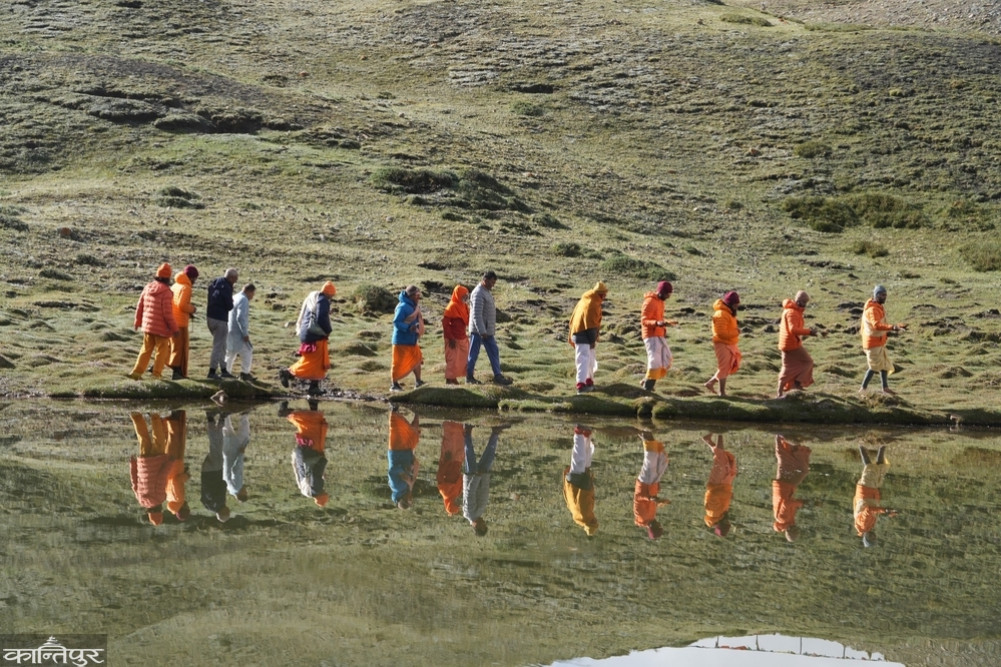
The origin of Kaligandaki is considered to be Damodar Kund in the Himalayan region of Mustang district. The river Kaligandaki flowing from there merges with the river Trishuli at Devghat. After Trishuli and Kali get mixed, the name of the river is Narayani. In this way, the last point of Kali is Devghat. From the last point Devghat to Mohan Damodar Kund, the Kaligand trek has been completed.
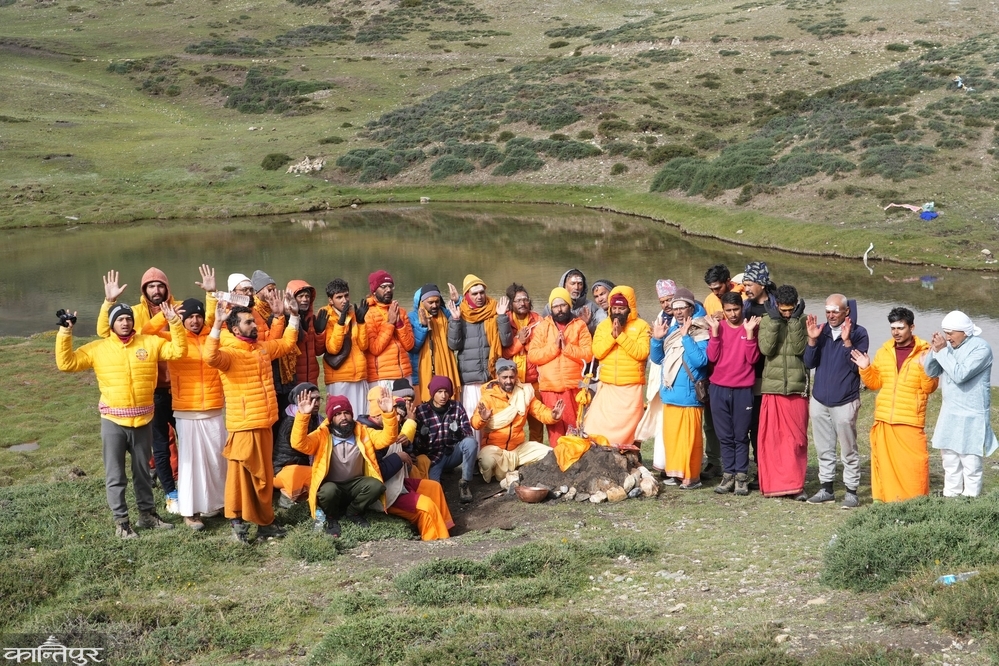
In the organization of Mahesh Sannyas Ashram of Tanahun Devghatdham, the trekking team that left Devghat on June 22 reached Damodar Kund on June 15. The next day after performing religious rituals at Damodar Kund, the team returned to Devghat on Wednesday evening. On Thursday morning at Mahesh Sannyas Ashram, the padayatra team discussed the importance of Kaligandaki and the current situation by holding programs including 'Gandaki Vimarsh'.
Under the leadership of Swami Ramananand Giri, president of Mahesh Sannyas Ashram and vice president of Nepal Sant Samaj, 60 people were participating when the walk started from Devghat. Phanindra Paudel informed that the team reached 78 members by passing through Tanahun, Nawalparasi (East of Bardghat Susta), Palpa, Gulmi, Syangja, Parbat, Baglung, Myagdi and reaching Damodar Kund in Mustang.
"While walking along Kaligandaki for 25/26 days, we tried to gather good information about the condition of the river, surrounding social life and religious and natural areas," said coordinator Poudel in the "Gandaki discussion" program on Thursday morning. Paudel said that among the residents below Ramdi on the Syangja-Palpa border, the Kaligandaki-Tinau diversion will disrupt the future of the river and the bio-social life.
 Paudel told that when the hydropower project on Ramdi till Mirmi dried up the water, the surrounding shrines and agricultural system were affected. "Although there is a condition that the hydropower project must release a certain amount of water, it was seen that the water was completely blocked without complying with it," he said. He said that there is a discussion of building a high dam for water travel in the above section and if that happens, the risk of flooding of 107 monasteries will increase .
'From Galeshwar down the river, there has been an increase in utilization-oriented activities . Shaligram found in Kaligandaki is very important from religious point of view . Shaligram is kept to make the temple divine. It is Kaligandaki who gave the deity to the temple. But when we saw the condition of Shaligram and Kaligandaki, we were emotional," said Poudel.
He said that they were sad when they saw that Shaligram was placed to make the road and they picked up as much Shaligram as they could and sent it back to the river. ``Seeing Shaligram at the place where the road is being built makes my heart hurt . We collected as many Shaligrams as we could and returned to the river womb . This trip turned out to be similar to the Shaligram rescue trip . "The Shaligram rescue journey went on for about 72 kilometers over Kagbeni," he said.
Paudel also said that three forms of Kaligandaki were seen from Damodar Kund to Devghat. From our spiritual and religious point of view, we saw three forms of Kali, Lakshmi and Saraswati in this river. In the upper section, this river is very swollen. Its sound and rumbling is such that it is difficult to hear us speak, that is Kali Rup,' he said .
He said that Kaligandaki, taking the form of Lakshmi, is trying to enrich the government and society through 10 hydropower projects. After that, the Kali will flow calmly in the lower section, he said. Gandaki discussion program held at Devghat Mahesh Sannyas Ashram on Thursday after the
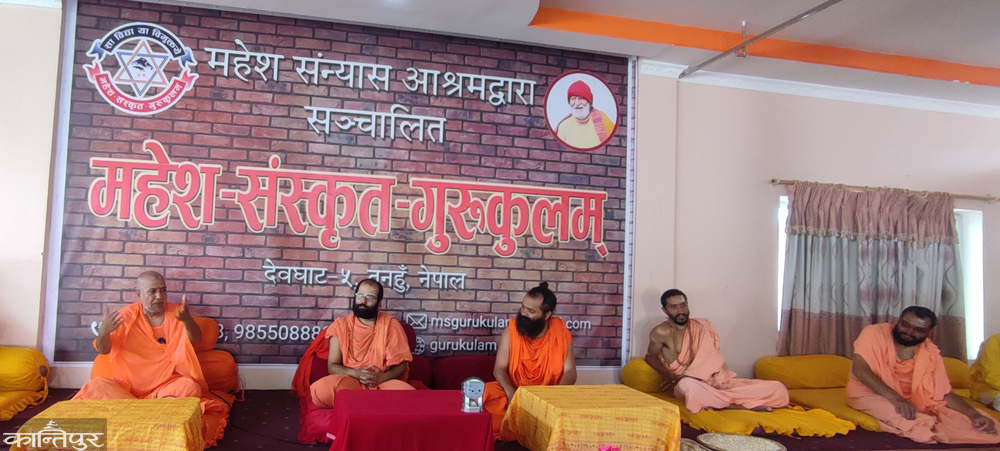 padayatra. Photo: Ramesh Kumar Paudel/Kantipur
'In the upper section we cannot hear the voice of Kali, in the lower section there is no voice of Kali, it is quiet . That is knowledge, and knowledge is Saraswati . That's why we saw Kali in three forms," said Poudel. He said that although the generation of yesterday understood and worshiped the importance of Kaligandaki, the tendency to exploit it now is evident from the crushers on the banks.
'Kaligandaki river is the source of civilization. The social life here is rich. We found a society that is always ready for hospitality and hospitality. When we walked, the road seemed long. But if you go by transport, you will find amazing geography, climate and society within 275 km. Tourism can flourish, Paudel said.
Swami Ramanananda Giri, president of Mahesh Sannyas Ashram, said that it is their aim to protect the religious and cultural importance of Kaligandaki. Giri said that Kaligandaki is the central river of the South Asian region and it is also the basis of this civilization. He said that even though the walk has been completed, there is still a lot of work to be done to protect the river. "Every devotee who met and policy-making officials of the municipality have been told. It will also give results, otherwise the campaign should continue," he said.
Swami Gnananand, the central president of Nepal Sant Samaj and head of Harihar Sannyas Ashram in Devghat, said that if Saraswati does not pay attention in time, Kaligandaki will also suffer like Bagmati or some big rivers of India.
He said that every municipality in the coastal region should pay attention to prevent the river from smelling bad and the general public should be alerted. The river and its civilization are being exploited to the point of non-existence. There is no environment to bring Sanatani from all over the world who understand the importance of Shaligram. "The rulers here do not understand that the protection of religious heritage is also connected with economic progress," said Swami Gnanananda Saraswati.