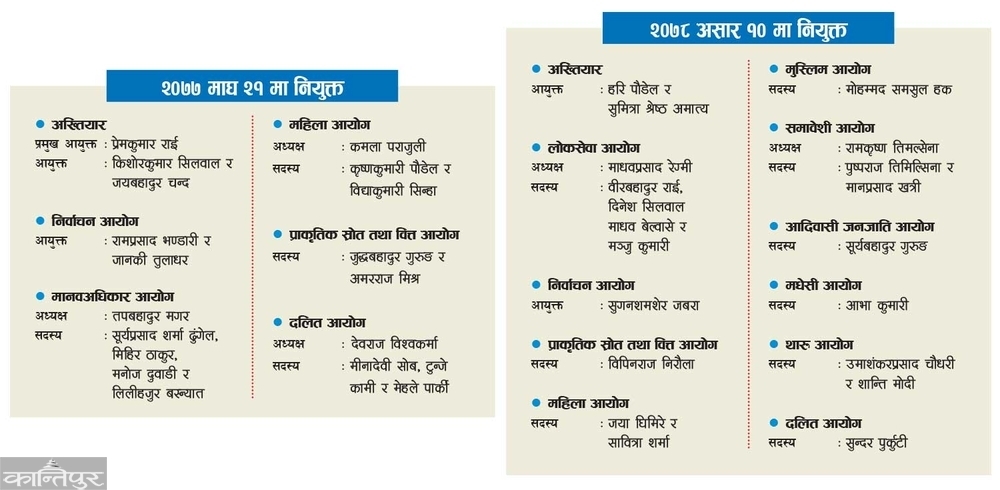
The appointment of 32 officials on 21 January 2077 based on the ordinance brought by the government led by the then Prime Minister KP Sharma Oli was approved by the majority of the constitutional bench (Sapna Pradhan Malla, Manoj Kumar Sharma and Kumar Chudal).
We use Google Cloud Translation Services. Google requires we provide the following disclaimer relating to use of this service:
This service may contain translations powered by Google. Google disclaims all warranties related to the translations, expressed or implied, including any warranties of accuracy, reliability, and any implied warranties of merchantability, fitness for a particular purpose, and noninfringement.
The Supreme Court has finally settled the dispute regarding the appointment of 52 constitutional officers pending for four and a half years on Wednesday midnight. On the basis of the ordinance brought by the then government led by KP Sharma Oli, the appointment of 20 officials on 10 June 2078 was unanimously approved, while the appointment of 32 officials on 21 January 2077 was approved by the majority.
Judges Sapna Pradhan Malla, Kumar Chudal and Manoj Sharma ordered that the appointment of 32 officials four and a half years ago will be upheld. A bench of Chief Justice Prakashman Singh Raut and Justice Nahkul Subedi ruled that the appointment should be quashed, which fell in the minority.
Thus the writ against the appointment has been dismissed. "Kumar Chudal and Manoj Sharma's decision is to cancel the writ, and Sapna's husband also agrees," Chief Justice Raut, who entered the bench after 12:07 PM, said, "Me and Nahkul Mr. have different opinions."
Noting that they had been in discussion since 10 am on Wednesday morning to deliver the decision and after 14 hours of hard work, they came to the bench at midnight, Chief Justice Raut said to the media persons, writ petitioners, advocates and civil society members who sat in the Supreme Court for hours before delivering the decision, 'We have caused you a lot of trouble, we are sorry for that.' The bench took 48 days to pronounce the decision.
Justices Chudal and Sharma mentioned that the president can bring an ordinance on the recommendation of the executive and the ordinance brought in such a way is considered to be implemented after the confirmation of the appointment. They have also submitted that the members of the Constitutional Council were not excluded from the meeting as provided by the Constitution, and the members of the Constitutional Council did not raise any opposition from the then opposition leader of the House of Representatives.
In addition, it is said that, "It is seen from his writ petition that the then Speaker of the House of Representatives, a member of the Constitutional Council, was informed of the meeting on 30 November 2077 at 9 am, the meeting held at 5 pm on 30 November 2077 was a continuation of the meeting of the same morning and there is such a practice, even though the then Speaker of the House of Representatives, a member of the Constitutional Council, is the writ petitioner, the request to participate in the meeting of the Constitutional Council is not a demand, but a demand that 'not to do so in the future' It is considered that the writ petition should be dismissed as there is no need to issue a writ as per the petitioner's demand in the writ petition presented for the reason that he is not currently a member of the Constitutional Council, he is not currently a member of the Constitutional Council, and the situation has changed. It is considered that the writ petition will be dismissed. As requested by the writ petitioners, the ordinance, the decision to recommend the appointment of the Constitutional Council, the rules of the Parliament, etc., should not be annulled by the sending order. In the case that the appointment has already been made, it does not seem necessary to issue an injunction to stop the appointment," said Malla, "I agree with the opinion of Honorable Judges Manoj Kumar Sharma and Kumar Chudal as long as the writ petition is dismissed. But as I have a different opinion on issuing a mandate, I have expressed that different opinion separately.''
Judge Malla has issued a mandate in the name of the government that they should be heard and appointed within the next 45 days because they have not been appointed in accordance with the ordinance. But since his opinion is in the minority, the appointment of 52 constitutional officials will continue as before. Chief Justice Raut and Judge Subedi said that the Constitutional Council has decided to issue a writ against the recommendation made on 30th of November 2077 as not in accordance with the Constitution.
The bench of Raut and Subedi took the decision to cancel the appointment as the legal provision to inform the members 48 hours before the council meeting was not followed. In the order of the minority judges, it is said, 'The recommendation of 30th of November 2077 and the appointment made based on it are contrary to the Constitution of Nepal and the mentioned legal system, so the said recommendation and the decision of the appointment shall be nullified by the order of transmission.' Prior to the recommendation of the officials, the then KP Sharma Oli-led government had brought an ordinance and amended the Constitutional Council Act.
After the decision of Chief Justice Raut and Judge Subedi was in the minority, the appointments of that time continued. The then Chief Justice Kalyan Shrestha's opinion was also in the minority in the decision of the five-member constitutional bench on 16 Chait 2072 in the writ filed against Khilraj Regmi for making the Chief Justice the chairman of the Council of Ministers against the constitutional system.
After the then Oli government brought another ordinance and amended the Constitutional Council Act, it has been recommended for the appointment of 20 more people on 26 Baisakh 2078. According to the recommendation of the council, they were appointed on 10 June 2078. Chief Justice Raut and Judge Subedi also approved the appointment at that time.
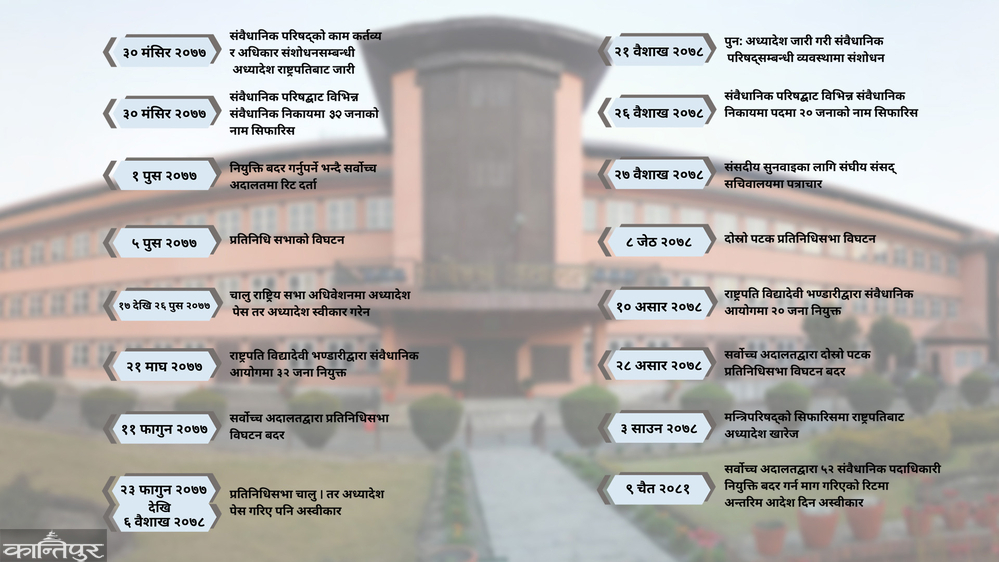
Regarding the reasons for rejecting the appointment, they said, "In the decision of the first recommendation, the notice of the meeting was not properly given, the previous law was applied until the date of the appointment and the quorum of the meeting was not reached, and the recommendation of the appointment was sent to the Parliament Secretariat for anti-parliamentary hearing only after the dissolution of the House of Representatives, so there was no such situation in relation to the second appointment." From 1 January 2077 to 10 July 2079, 15 writs were filed. The Supreme Court has been criticizing that the writ has been delayed for a long time without hearing it.

