We use Google Cloud Translation Services. Google requires we provide the following disclaimer relating to use of this service:
This service may contain translations powered by Google. Google disclaims all warranties related to the translations, expressed or implied, including any warranties of accuracy, reliability, and any implied warranties of merchantability, fitness for a particular purpose, and noninfringement.
The Supreme Court, which has been under consideration for four and a half years, finally resolved the dispute regarding the appointment of 52 constitutional officers on Wednesday midnight and gave a majority decision to uphold it.
Chief Justice Prakashman Singh Raut said to the media persons, writ petitioners, advocates and members of the civil society who had been sitting in the Supreme Court for hours before delivering the verdict, saying that they had been discussing this decision since 10 am and after 14 hours of hard work, they came to the bench at midnight. Mr. Manoj Sharma's decision is to cancel the writ, Mr. Sapna also agrees to it," Chief Justice Raut, who entered the bench after 12:07 p.m., said, "I and Mr. Nahkul have different opinions on that. It has been approved unanimously, while the appointment of 32 officials made on 21 January 2077 has been approved by the majority.
After 11 consecutive days of hearing in the pending case for four and a half years, the bench took 48 days to pronounce its decision twice. Even in such a long period, the bench failed to pronounce the decision till midnight.
Justices Sapna Pradhan Malla, Manoj Kumar Sharma and Kumar Chudal were in favor of Sadar's appointment while Chief Justice Raut and Nahkul Subedi dissented.
'The honorable judge Dr. ruled that the writ petition will be dismissed. Mr. Manoj Kumar Sharma and Dr. A separate opinion has been expressed as he could not agree with the opinion of Mr. Kumar Chudal and the opinion of the Honorable Judge Mr. Sapna Pradhan Malla, who agreed with the said opinion and ruled that the order should be issued,' Chief Justice Raut and Subedi have said .
The government amended the law through an ordinance and decided by majority against the practice of the Constitutional Council and recommended to the President for the appointment of 32 officials on 21 January 2077 and 20 officials on 10 June 2078. Based on that recommendation, then President Bidya Devi Bhandari appointed 52 officers of the Constitutional Commission.
Supreme Court Chief Justice Raut, Justices Malla, Sharma, Chudal and Subedi were appointed by the constitutional bench four and a half years after the appointment of the constitutional officers on Wednesday night.
The then Speaker and member of the Constitutional Council Agni Prasad Sapkota, Senior Advocate Dinesh Tripathi, Advocate Omprakash Aryal filed a petition demanding to cancel the appointment saying that the recommendation of the Constitutional Council was unconstitutional. 15 writs of similar nature were filed in the Supreme Court. After the debate on that writ was over on June 1, the decision on the appointment was set for June 28, but the date of the decision was moved because there could not be sufficient discussion between the judges.
KP Sharma Oli was the prime minister in the then CPN-led government. In November 2077, he brought an ordinance on the Constitutional Council to appoint constitutional officers. The Constitutional Council, chaired by the Prime Minister, consists of six members, namely the Speaker, the Chief Justice, the leader of the main opposition parties, the Speaker of the National Assembly and the Deputy Speaker. The immediate legal system was that if five people attended the meeting, it was considered a quorum. But Oli amended the same arrangement through an ordinance. He arranged for the meeting to be held if the majority of members including the chairman are present and the majority of members including the chairman can take decisions from the meeting. On that basis, the meeting of the Constitutional Council attended by Prime Minister Oli, Chief Justice Cholendra Shamsher Jabara and Speaker of the National Assembly Ganesh Timilsina recommended the appointment of 32 constitutional officials for the first time on December 30, 2077. Based on this, President Bidya Devi Bhandari appointed 21 Jan 2077.
For the second time, the appointment of 20 constitutional officers was recommended on May 30, 2078. Who was appointed by President Bidya Devi Bhandari on 10 June 2078. In this way, 52 people were appointed to the constitutional body in two phases in the same style. The same trend was observed during both these appointments. It should be recommended to the parliamentary hearing committee by the constitutional council sitting according to the law. The appointment was recommended. But before the hearing process started, the Prime Minister dissolved the Parliament . Oli dissolved the House of Representatives for the first time on December 5, 2077 and for the second time on May 8, 2078. As a result, the parliamentary hearing of those 52 constitutional officers could not be held.
15 writs were filed in the Supreme Court from December 1, 2077 to July 10, 2079 demanding the cancellation of the ordinance and cancellation of appointment with the argument that the constitution was falsified. The then Speaker and Constitutional Council member Agni Prasad Sapkota, Senior Advocate Dinesh Tripathi, Advocate Omprakash Aryal filed the writ. After 4 years of filing the writ, the trial started in the bench.
The Constitutional Council chaired by the Prime Minister consists of the Chief Justice, the Speaker, the Speaker of the National Assembly, the leader of the main opposition parties and the Deputy Speaker. Cholendrashamsher Jabara was the Chief Justice when it was recommended to the Constitutional Commission. It was alleged that he supported the recommendation by asking for participation in the Constitutional Commission and did not hear the writ against the appointment. During Jabara's tenure, the writs were kept on 'not to be seen' even though they were brought up for hearing three times. 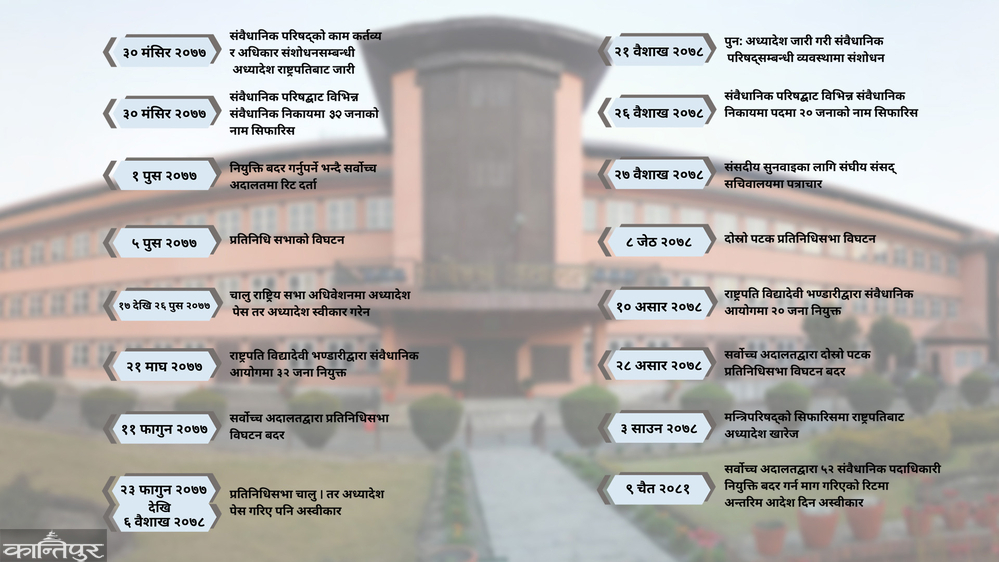
When Deepak Karki became the permanent Chief Justice after Jabara, Pesi went up for hearing four times . At that time, show cause, interim order not to be issued and other orders were issued . After that, during the time of Harikrishna Karki, who became the leader of the constitutional bench, the writ was once raised for hearing but was not heard. Even when Vishwambhar Prasad Shrestha was the Chief Justice, he did not go to see the writ four times . During the tenure of the current Chief Justice Raut, the writ for the final hearing has been started after the third time for hearing.
After the debate was over on 1st of June, the decision on the appointment was set for 28th of June, but the date of the decision was moved due to insufficient discussion between the judges. According to the order of the Supreme Court on 28th of June last, the Supreme Court has given the judgment on this case in the constitutional bench of Chief Justice Prakashman Singh Raut, Judges Sapna Pradhan Malla, Manoj Kumar Sharma, Kumar Chudal and Nahkul Subedi.

