Conclusion of the investment board that a factory can be opened within 5 years within 1.5 billion, 7 lakh tons can be produced and exported annually, but the process is limited to paper.
We use Google Cloud Translation Services. Google requires we provide the following disclaimer relating to use of this service:
This service may contain translations powered by Google. Google disclaims all warranties related to the translations, expressed or implied, including any warranties of accuracy, reliability, and any implied warranties of merchantability, fitness for a particular purpose, and noninfringement.
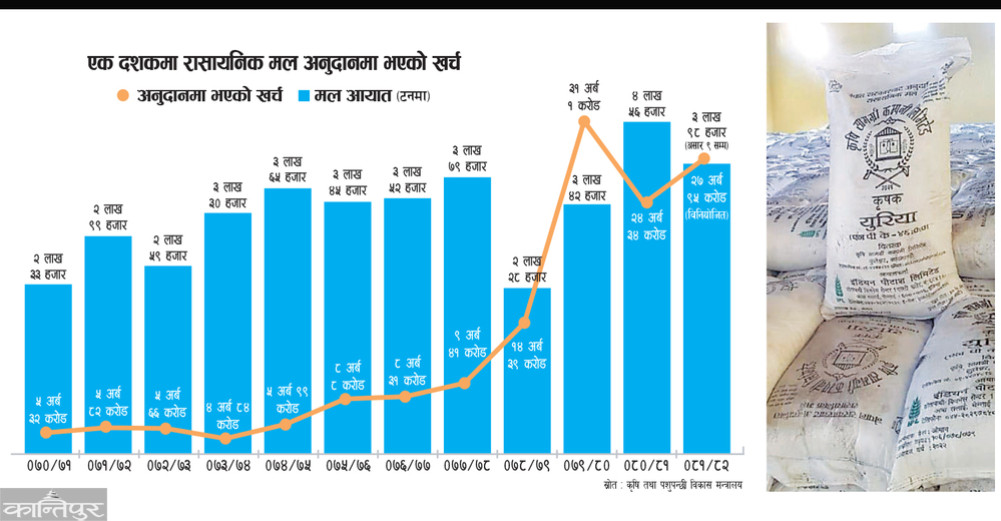
In the last one decade, the government has spent about one and a half billion rupees on the subsidy of chemical fertilizers alone. This is enough money to open a fertilizer factory in the country. About 700,000 metric tons of fertilizer can be produced annually from the factory, which will be prepared at a cost of one and a half billion, and the problem of farmers not getting fertilizer when they need it can be eliminated.
It is not that the government is not interested in opening a fertilizer factory in the country. A study was conducted in 2041 to open a urea fertilizer factory in collaboration with the Japan International Cooperation Agency (JICA).
Since then, the government has been keeping the issue of opening fertilizer factories in its policies and programs and budget. Several studies have been conducted to open the factory. But the subsequent process has not progressed. On the other hand, when the government does not import fertilizer on time, there is almost always a loss of fertilizer in the plantations.
According to former Agriculture Secretary Yogendra Kumar Karki, a study conducted by JICA four decades ago showed the possibility of urea fertilizer production. The government did not proceed with the process of opening the factory as it was unable to raise investment for the fertilizer factory. "It could have been operated through a single government or public private partnership model," said former secretary Karki, "Operating a factory is also a matter of pride, but it has not worked yet."
He said that when there is a government, there is talk of opening a fertilizer factory, and there is a tendency to sell it without changing the government. The Ministry of Agriculture claimed to open a fertilizer factory after the contractor could not import fertilizer due to the Covid epidemic. The then Agriculture and Livestock Development Minister Ghanshyam Bhusal conducted a feasibility study to open a factory in Nepal.
The working group formed under the coordination of then Agriculture Secretary Rajendra Bhari submitted a report in October 2077. The report concluded that it is possible to open a fertilizer factory in Nepal and recommended a more detailed technical study.
For the fertilizer factory, the task force suggested that biomass technology from city waste or technology that uses electricity and coal could be used. It was the squeeze of the task force that it was not possible to open a factory based on natural gas. The working group said that such a technology is not suitable as it has to depend on India for importing natural gas and also has to build a pipeline.
We studied based on the report prepared by JICA and the Indian consulting company Infrastructure Development Corporation (IDEC). The preliminary study showed that 500,000 tons can be produced annually,' said former Agriculture Secretary Bhari, 'We submitted a preliminary report to the minister with suggestions for further study.' The then Industry, Commerce and Supply Minister Lekhraj Bhatt and Agriculture Minister Padmakumari Aryal were members of the working group.
The task force submitted a report to the then Prime Minister KP Sharma Oli in Chait 2077, in which it was suggested that a fertilizer factory based on natural gas technology could be established and operated. It was concluded that the initial investment for setting up a natural gas based chemical fertilizer factory would be 1 trillion 3 billion rupees.
Apart from natural gas, the working group also said that there is an option to open a chemical fertilizer factory based on water electrolysis technology or thermocol technology. It is mentioned in the report that for the establishment of a chemical fertilizer factory based on water electrolysis technology, it will cost 1 trillion 89 billion rupees.
After the 'briefing' of the high-level working group, the then Prime Minister Oli indicated to submit the report in the Cabinet meeting. After that, the cabinet meeting of Chait 2077 approved the study report on the establishment and operation of chemical fertilizer factory, 2077 and gave permission to the Ministry of Agriculture to proceed with the process.
It was the decision of the cabinet meeting to entrust the investment board to establish the factory in the public-private partnership (PPP) model, to prepare and implement the procedure and to build the infrastructure. Coincidentally, even now Oli is the Prime Minister and Paudel is the Finance Minister.
Agriculture and Livestock Development Minister Ram Nath Adhikari said that he is waiting for the investment board's feasibility study report on the operation of the fertilizer factory. The government has given the responsibility of carrying out the entire study and carrying out the process to the investment board. "There is no way to say anything until the board publishes the report," he said, "We can proceed after the report of the investment board." "If there is more indigenous production, it can be sold in India as well." At present, the government is only able to provide an average of 4.5 million tons of fertilizer annually. According to that joint secretary, if 1.1 million to 1.2 million tons of chemical fertilizers are available for all crops in Nepal, no crop will be in short supply. Despite providing an average of 7 lakh tonnes of fertilizer, there are no complaints from the farmers.
Investment Board has said that the Feasibility Study Report of Fertilizer Factory has been prepared. Chief Executive Officer Sushil Gyawali informed that the 63rd meeting of the board held under the chairmanship of Prime Minister Oli on 13th June decided to proceed after reviewing the report.
The board has received the report prepared by Germany's DIAG Industries GmbH. Alternatives have been presented, including a fertilizer factory based on natural gas technology and water electrolysis technology," he said. "There is a committee consisting of representatives from the ministries of finance, agriculture, industry, and energy, and we will decide which option to go for after discussion in the committee." The factory can produce 7 lakh tons of fertilizer annually. Gyawali said that the issue of which model to open the factory is also under discussion. There can also be a PPP (Public-Private Partnership) model under government control. The government itself can also invest, we will decide through discussion," he said.
The government's expenditure on fertilizer import is increasing every year. The price of urea fertilizer is around Rs 80 per kg, but due to government subsidy, farmers get it at around Rs 14. In 2078/79, the government allocated 14.39 billion rupees for the subsidy of chemical fertilizers.
This amount was 31 billion 1 crore in 2079/80. In 2080/81, the grant was 24 billion 34 crores. It was increased to 27 billion 95 crores in 2081/82. This is for 5.5 lakh tonnes of fertilizer. So far, 398 thousand tons of fertilizers have been imported. A subsidy of 28 billion 82 crore rupees has been set aside for the next financial year with the goal of purchasing 6 tons of fertilizer.