As Nepalis who go to India as seasonal workers have migrated with their families in recent years, the stay of children and women is becoming risky, due to family separation, children are becoming orphans.
We use Google Cloud Translation Services. Google requires we provide the following disclaimer relating to use of this service:
This service may contain translations powered by Google. Google disclaims all warranties related to the translations, expressed or implied, including any warranties of accuracy, reliability, and any implied warranties of merchantability, fitness for a particular purpose, and noninfringement.
A narrow room on the third floor of an old house in the streets of Chennai city, in this room three sisters play, shout, laugh, scream. Born in Dadeldhura in Far West, they were 11, 9 and 7 years old. A younger brother of 4 years cannot speak, see or stand properly.
They lie on a single mattress in the middle of the room. These three sisters, who are playing with their brother, overstepping, jumping, lose their composure at once, when their mother Rupavati (name changed) starts scolding them.
In search of manual labour, Rupavati arrived in South India with her husband and young children, about three thousand km away from her home in Dadeldhura. As most of the people from the hilly areas of western Nepal go to different states of India with their families in search of work.
Rupavati, who was met in Dera one evening last March, dug up the painful story of her and her children when the family came to India in search of a job. Due to her husband's torture, she has been living separately with her children. Wearing a flowery blue kurta and a gray salwar, she said, "These clothes were also kindly given by the neighbors here."
She rents a room with her children. For them, a corner of the room is the kitchen. Another corner storage space. And the rest of the floor is sleeping space. She has enrolled her three children in government schools. She earns Rs 10,000 per month by washing dishes and mopping floors in other people's houses. 6,000 room rent and water, electricity bills can be paid. The rest feeds Kapikalam, rice, salt and oil to the children.
...
It is an ancient tradition to reach India as a local seasonal worker from the far west and hilly areas of Karnali. Earlier, domestic men went to India as agricultural labourers, janitors, wage earners, cooks and cleaners. Women, children and old people waited at home. Those who went to India used to return home to farm during the dry season, celebrate festivals like Dasaintihar and bring in food crops. Life was going well.
However, in the past few years due to climate change, there has been a decrease in agricultural production and problems in living, the migration of families from the West Hills to India has increased, as pointed out by the report "Nepal: Human Security and Gender Equality Based Approach Promotion Project for Migration and Adaptation to Climate Change" published by the Ministry of Labor and the International Organization for Migration last December.
'Gradually, the direct and indirect effects of climate change began to be seen in livelihoods. The agricultural production in the village began to decline," said Sanjay Sharma, the chief researcher of the report. "Instead of earning a living by farming or doing agricultural labor in the village, many families started migrating with the idea of eating delicious food by working in the city or abroad, some went abroad with their families."
is one such family, that of 32-year-old Rupavati. Belonging to the Dalit community, she faced suffering and discrimination from a young age. Got married at the age of 20. There was a house, but no land to eat. He worked as an agricultural labourer. There were no other opportunities for gainful employment. "Working in the fields of the big caste, we started feeding ourselves with the grains we got for that," she remembered. He used to get wheat, rice, millet and other grains from the moneylenders for doing agricultural work. If you need cash, you would take a loan from the moneylender and repay it by working in the fields.
However, when unpredictable weather systems such as prolonged droughts and heavy rains were observed, agricultural production began to decline. Their demand as agricultural laborers also began to decrease. "There was no rain on time, there was not enough snow, and the drought caused the crops to fail. The moneylenders began to farm less. If they were to work by themselves, we stopped getting work," said Rupavati. 2022' has also shown that drought has affected farming throughout the country. 65.4 percent of the households participating in the nationwide survey who have been living in the same place for 25 years have said that they are facing drought. Geographically, farmers in hilly areas are more affected. Similarly, 87 percent of the households said that they felt a change in the rainfall cycle.
Kantipur's on-site reporting In Bajhang alone, more than 125 Dalit families who lost their homes due to landslides after incessant rains in 078 years have migrated to India after four years of rehabilitation.
Due to similar problems, like other neighbors, Rupavati and her husband decided to leave the village and go to India. After asking for a ransom of eight thousand rupees, they locked the house and left with their four children. This is from 1979. On the fourth day after leaving home, he reached the state of Karnataka where his relatives were staying. Getting a job in an unfamiliar city was not easy. "We stayed with our relatives until we got work, but that was also easy and they would also stay in the tent," said Rupavati. A few months later, Rupavati's husband got a job as a watchman at a construction site. They also got a small house to fit their family of six.
However, the situation took the opposite form than expected. Her husband started drinking, quarreling and making noise at home. After the neighbors complained, the employer asked them to leave the place. Within two months of starting their work, they started working. With the help of relatives, they started to find a camp. Her husband, who was addicted to alcohol, started harassing her every day.
To run the household, Rupavati used to wash dishes and sweep the floor (sweeping) in another's house. However, the husband used to take away the money he had earned and spent it by drinking alcohol. "Otherwise, they would beat them like a murderer, they would chase their children, they would pick up and throw even the youngest, they would have forced physical relations, they would beat them randomly," she said.
After selling the dera's goods and eating them, the children would be given sacks and sent to the streets and public places to collect empty bottles, paper and bottles. Even after selling it, he used to drink alcohol. When that was not enough, he would send his son and daughter to ask for it. Then she left her husband in Karnataka and came to Chennai.
...
Naveen Joshi, who is working in the campaign against human trafficking in New Delhi, says that among those who come to India for labor like Rupavati, the family break-up and children's problems are increasing because of it. "Since farming in the village does not make a living, there has been an increase in the number of families moving to Bangalore, Mumbai, Chennai and other cities in India," he said.
According to him, until a decade ago, the victims who were sold in India were mostly from districts around Kathmandu. "Most of the people we have rescued now are from the Terai region and the western hills," said Joshi. According to the records of 'Kin India', an organization working in Nepal-India campaign against human trafficking, 642 Nepalis were rescued from 2018 to 2024, including 600 women and children.
Nepali children in India have been victims of violence as parents cannot give time for care. Last December, a 6-year-old Nepalese girl was raped and murdered in Bangalore. She was alone in the Dera as Baa had gone to work.
It was publicized in the Indian media that a worker from Bihar took advantage of it and raped and killed her. "This came out and it became known, how many are not known, how many are lost here, if we go to file a complaint, we do not get much help from the police administration here," said Arjun Rokaya, who lives as a doti and works as a chowkidar in Chennai.
Children become orphans due to family separation abroad. Rokaya said that last March, he collected a donation of 25,000 baht from the Nepali workers and arranged accommodation for five Nepali children who were neglected by their families and relatives.
"It's okay to stay with relatives for a while when parents don't look after them, then they start complaining," he said.
...
Chennai is the first choice of Nepali workers as it is considered safer among other cities in India. However, due to language, culture, extreme heat and other reasons, daily life is somewhat uncomfortable compared to Hindi speaking cities. As soon as you reach Chennai, it becomes difficult for parents to find time to eat, live, and take care of their children.
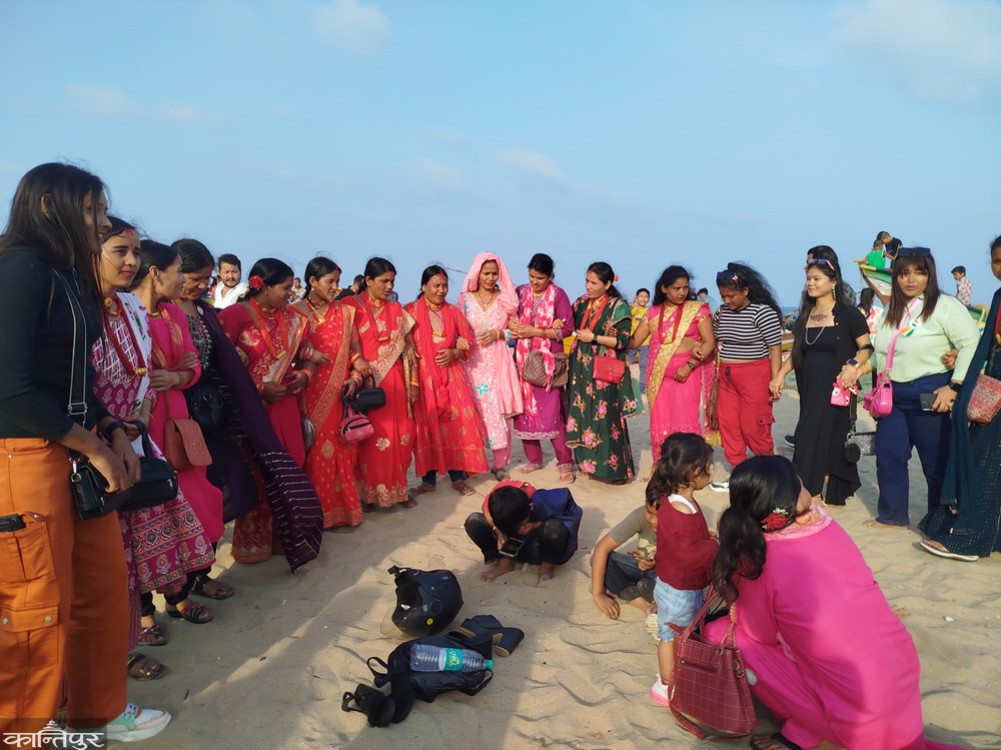
'However, once or twice a year, we gather together with relatives and friends on the occasion of Dasaentihar,' said Birendra Rokaya, who is working as a doti in Chennai. He lives in Chennai with his wife and three children. He works as a watchman. A wife cleans another's house.
Likewise, the seafront Marina area in Chennai is a public place where Nepalis gather and stroll. Nepalis living in different parts of Tamil Nadu also gather here on January 26 every year. They share sorrows and joys. "On that day, India celebrates the Republic Day, all of us who work there get a day off, on this occasion we also do a cultural program," said Rokaya.
Their complaint is that the Nepali government has neglected the Nepalese working in India. "The state has made policies and laws to go to the Gulf countries to work in the informal sector, but we don't even keep the data of people coming to India. When there is a problem, India doesn't listen, its own country has ignored it," said Kishore Poudel, who works in Chennai.
...
Nepali children are facing more risks in new places and environments, says Bam Bahadur Baniyan, vice president of the National Child Rights Council. But we have not been able to study how and how many people are at risk, what is the solution. Children-centered budget program is not a priority of the government," he said. "Even if we get information that Nepali children are found stranded or in dangerous places somewhere in India, there is a situation where organizations have to give up and rescue them to Nepal."
Joshi, who has been working in the campaign against human trafficking, said that no study has been done regarding Nepali children in India. According to Census 078, about 7 lakh Nepalis have gone to India in search of work. But it does not distinguish how many children there are. Nepalis living in India claim that the number of people who come and work here is more than the census data.
'I don't have to suffer untouchability here'
India is not only an employment opportunity for Nepali workers, but also a place where they can live with self-respect. A 45-year-old Dalit woman who lives in Dadeldhura and has been working as a domestic worker in Chennai said, 'I am in my own country, I have to endure long distances, I have not faced discrimination like untouchability here.' She came to Chennai with her husband 12 years ago. It was difficult to get a job at first due to not knowing the local language. After staying for six/seven months, she got mixed up with the environment here. She was shocked when she got the job of sweeping the house and washing the dishes.
'I started working in the house of a Tamil bahun here, casteism and chaupadi were considered a nuisance there, so what is the custom, it is better to ask if I belong to this caste, whether it is acceptable to work while menstruating,' she said, 'but here they do not follow such a custom, I used to wash the dishes for worship.'
She washes dishes and sweeps in three houses from 7 am to 8 pm. Bharu earns 30,000 per month. "If you go to Nepal, the upper caste will pay you, where can you see money like here," she said. Sociologist Meena Poudel says that there are various reasons why Nepalis leave the country. "There are not only political and economic reasons for families to migrate like this, they also go abroad (including India) to avoid gender, caste and social discrimination," she said.