Mention that for successful implementation of employer pay mode, collaboration between government, recruiting agencies (manpower) and regulatory bodies should be strengthened
We use Google Cloud Translation Services. Google requires we provide the following disclaimer relating to use of this service:
This service may contain translations powered by Google. Google disclaims all warranties related to the translations, expressed or implied, including any warranties of accuracy, reliability, and any implied warranties of merchantability, fitness for a particular purpose, and noninfringement.
Top officials from countries that send and receive workers to the Gulf region have concluded that there is no room for compromise in the 'employer pay' model.
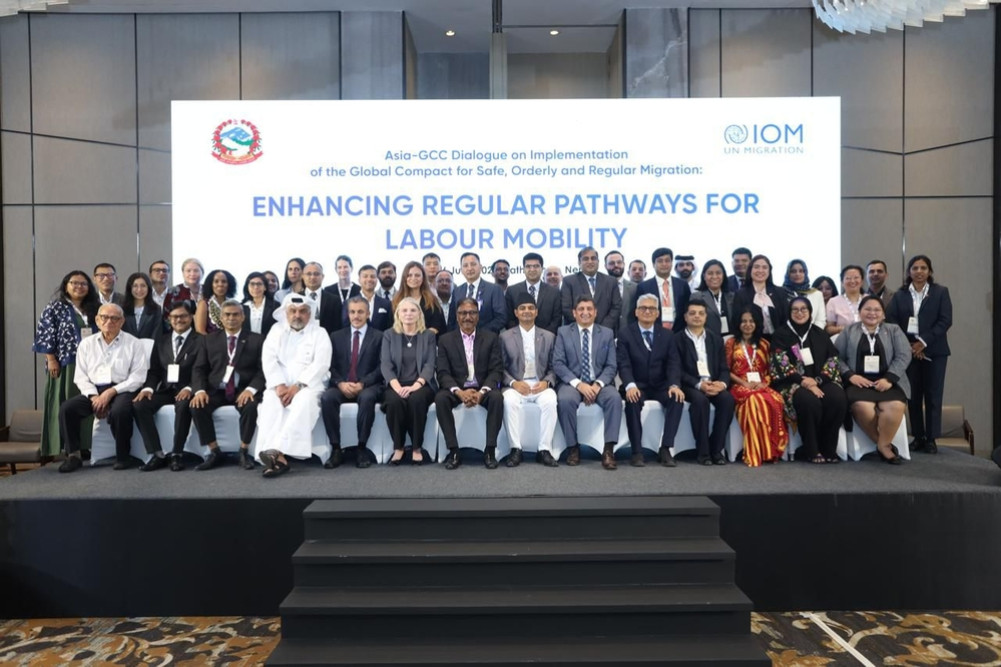
In collaboration with the Ministry of Labour, Employment and Social Security and the International Organization for Migration (IOM), the 'Asia-Gulf Dialogue' held in Kathmandu on June 11 and 12 concluded to implement the employer pay model in order to end the wrong practice of charging fees from workers. The dialogue was attended by top officials from 25 Asian countries, including major destinations in the Gulf that recruit workers and send workers.
'To end the wrong practice of charging fees from the workers, the employer should convert the principle of bearing all expenses into a universal binding standard,' Labor Secretary Krishnahari Pushkar said, 'The recruitment process for the workers should be transparent, fair and free. There is no place to compromise on this.
At present, representatives of Asian and Gulf countries concluded in Kathmandu on measures to promote safe, orderly and regular migration routes to ensure the rights, rights and future of more than 25 million workers from Asia, including 1.5 million Nepalis in the Gulf region alone. According to the Ministry of Labour, it will be further discussed at the International Migration Review Forum in 2026. The dialogue concluded that the development of regular labor migration routes, fair labor recruitment process, skill development and coordination of policies to promote access to social security is necessary.
According to Labor Secretary Pushkar, for the successful implementation of the employer pay model, cooperation between the government, recruiting agencies (manpower) and regulatory bodies should be strengthened. "Nepal is promoting Government-Government (GTUG), Government-Business (GTB), Business-Government (BTUG), Business-Business (BTUB) cooperation model of fair recruitment," he said, "These models are fair recruitment, exchange of information and recruitment of workers according to international standards."
Nepal has been making tickets and visas free for a decade. The policy is that the workers going to Khadi will be allowed to pay a service fee of only 10,000 rupees. The United Arab Emirates (UAE) and Malaysia have a zero cost duty policy. However, although there are different models, only a few employers are implementing the 100% employer pay model under BTB. Most of them are five-star hotels in the Gulf, large companies and manufacturing companies in Malaysia. Workers going to Korea and Israel are paying for the ticket themselves. In the
dialogue, the Ministry of Labor informed that Nepal is building a technology-based e-immigration system, giving priority to the digital transformation of the immigration management system. "Strict monitoring, easy access to justice and protection of victims should be done to end problems such as exploitation, non-payment of wages, violation of contract agreements from the admission process to the workplace," Secretary Pushkar said, "For this, an e-immigration system based on technology is being built. This technique is not only an administrative reform but also a structural transformation. It will remove middlemen, increase transparency and strengthen accountability.
Stuart Simpson, Deputy Regional Director of IOM's Asia-Pacific Regional Office, said that this effort to make migration routes between the two regions more fair and orderly will help in policy making.