After the Supreme Court stopped the 'Parliamentary Zone Infrastructure Development Programme', which is being promoted by MPs, the budget is being allocated by forcing the MPs to recommend the project.
We use Google Cloud Translation Services. Google requires we provide the following disclaimer relating to use of this service:
This service may contain translations powered by Google. Google disclaims all warranties related to the translations, expressed or implied, including any warranties of accuracy, reliability, and any implied warranties of merchantability, fitness for a particular purpose, and noninfringement.
Contrary to the order of the Supreme Court, the state governments are making the parliamentarians who are in the legislative role participate in the project selection process. The provincial governments are making recommendations for projects by setting separate budget limits for MPs elected through direct and proportional systems.
After the court stopped the 'Parliamentary Area Infrastructure Development Programme', which has been the focus of MPs since the project selection process, the state governments have been asking the MPs for a list of projects and allocating the budget.
The Supreme Court issued an interim order on 6 August 2080 not to implement the Parliamentary Area Infrastructure Development Program while reminding the role of Union and State MPs. In the order, it was mentioned that ``in the name of parliamentary area infrastructure development program, the MP allocates funds in the name of the infrastructure development of his parliamentary constituency.''
Contrary to the order of the Supreme Court, the provincial governments allocated the budget for the parliamentarians in a roundabout way in the budget of the financial year 2080/81. The provincial governments are doing their homework to allocate budget for the projects of MPs in the next year's budget as well. MPs are running to include as many projects as possible in the budget. State governments are bringing the budget on June 1.
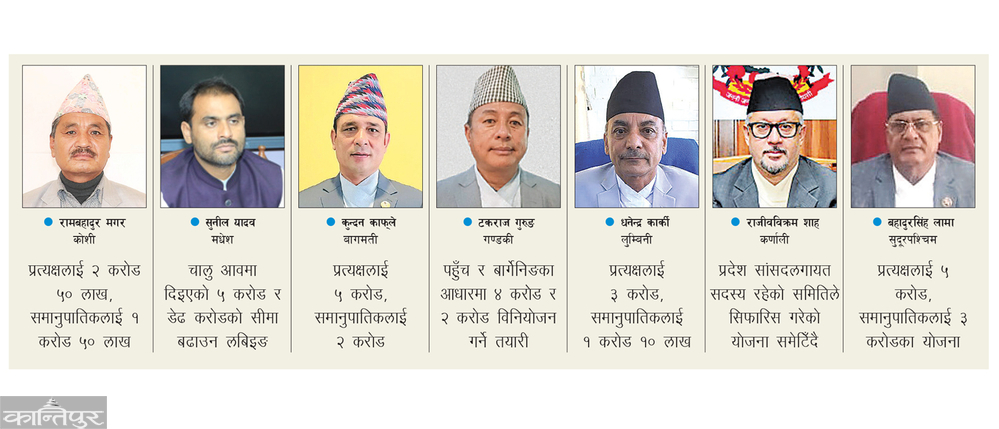
Koshi province has prepared to allocate 1 billion 955 million rupees in the plan of parliamentarians in the coming financial year. 25 million rupees are going to be allocated for directly elected MPs and 555 million rupees for proportional ones. There are 56 directly elected MPs and 37 proportionally elected MPs in the 93-member state assembly. In the current financial year, one and a half crore was allocated for direct and Rs. 50 lakh for proportional.
According to an official of the Ministry of Economic Affairs and Planning, the Ministry of Physical Infrastructure Development has prepared to allocate 12 million 12 lakh 13 thousand rupees for the project of direct parliamentarians and 67 lakh 50 thousand rupees for the project of proportional parliamentarians. The Ministry of Water, Irrigation and Energy will allocate 37 lakh 50 thousand rupees to direct MPs and 22 lakh 50 thousand rupees to proportional members. The Ministry of Social Development is preparing to provide Rs 50 lakh to direct MPs and Rs 30 lakh to proportional MPs.
The Ministry of Tourism, Forestry and Environment is going to allocate 37 lakh 50 thousand rupees for direct parliamentarians and 22 lakh 50 thousand rupees for proportional parliamentarians. Similarly, the Ministry of Industry, Commerce, Agriculture and Cooperatives is preparing to allocate 12 lakh 50 thousand rupees to direct MPs and 7 lakh 50 thousand rupees to proportional members. This amount is going to be allocated to projects recommended by MPs.
MP's pressure to increase budget
Proportional MPs of Madhesh province have demanded to give budget like directly elected MPs. Proportional MPs have met Chief Minister Satish Kumar Singh and asked him to allocate the same budget as directly elected MPs in the next financial year. Directly elected MPs are also insisting on allocating more budget than the current financial year.
The government of Madhesh state has included projects worth 50 million rupees for direct MPs and 15 million rupees for proportional MPs in the current financial year. The state government is preparing to include the MP's projects in the budget for the next financial year 2082/83. "The parliamentarians are meeting in groups and individually and are pressuring to increase the budget," said an official of Chief Minister Singh's secretariat, "The Chief Minister is preparing to keep the same budget as before."
MP's projects have been included in the budget since the last financial year. There is pressure on Chief Minister Singh to increase the budget that MPs get in the coming year as well. Finance Minister Sunil Kumar Yadav presented the principles and priorities of the next year's budget and program in the state assembly meeting on Sunday.
Bagmati state government has made a 'political agreement' to include the project of direct and proportional MP in the budget of the next financial year. According to the agreement, projects up to 50 million rupees for directly elected and 20 million rupees for proportional parliamentarians will be budgeted. For that, the list of projects mentioned by MPs in their letterpads has been submitted to the government by the respective parliamentary parties. Compared to the current fiscal year, a budget of one crore rupees less is being allocated for proportional MPs next year. The Bagmati government, which brought a budget of 64.54 billion for the current financial year, has prepared to increase the size of the budget for the coming year.
ministerial 'ceiling'
In Gandak, separate budget 'ceiling' has been given to ruling party and opposition MPs. The ministry has given a 'ceiling' of Rs 10 lakh to Rs 25 million to direct. Half of it has been assigned to proportional parliamentarians.
Among the 9 ministries, the Chief Minister and Council of Ministers Office, the Ministry of Economic Affairs, the Ministry of Agriculture, Land Management and Cooperatives, and the Ministry of Health will not have separate arrangements for MPs. The Ministry of Physical Infrastructure Development and Transport, the Ministry of Energy, Water Resources and Drinking Water, the Ministry of Social Development, Youth and Sports, the Ministry of Industry and Tourism, the Ministry of Forestry and Environment have given a ceiling of Rs 500,000 to Rs 250,000.
The directly elected MPs in Gandaki will get projects worth about 42 million rupees from 5 ministries and proportionally about 23.5 million rupees. Gandaki has 36 direct and 24 proportional MPs. Rajeev Gurung (Deepak Manange), elected from Manang, is under suspension as he is in jail.
The state government is prepared to not spend 5 million rupees on physical infrastructure, 10 million rupees on energy, water resources and drinking water, and 5 million rupees on social, tourism and forestry projects. The relevant ministry informed the parliamentarians to recommend the project so that it stays within this 'ceiling'. As the budget is allocated for the infrastructure that connects people like roads, bridges, suspension bridges, there is an interest in the physical ministry from the ward to the provincial leader.
Only 59 MPs will get projects worth more than 1.16 billion rupees from the Ministry of Physical Infrastructure. According to a member of parliament, directly elected members of the ruling party are preparing to cover projects worth 25 million rupees. Of the projects they will get, Rs 1 crore will be multi-year projects. Apart from that, 3 schemes of 50 lakh rupees will be given to the directly elected MPs of the ruling party. It is prepared to give projects worth 15 million rupees to proportional MPs of the ruling party by making 3 projects of 50/50 lakhs.
An official of the ministry informed that they are ready to give a project worth 2 crore rupees to directly elected MPs of the opposition. Out of that, MPs will be able to choose up to 1 crore multi-year projects and up to 2 projects of the remaining 1 crore. It is prepared to give a project worth 1 crore rupees to the proportional MP of the opposition.
An MP will get projects up to 50 lakh rupees from the Ministry of Energy, Water Resources and Drinking Water. This ministry has prepared not to allocate budget for projects worth less than 1 million. MPs will receive budget for up to 5 projects from the Ministry of Water Supply. MPs directly elected from the Ministry of Social Development, Youth and Sports will have a budget of Rs 30 lakh for projects at most. Proportional MPs will get projects worth Rs 1.5 lakh by doing up to 3 projects of Rs 5 lakh each.
A limit of 80 lakhs has been set by MPs directly from the Ministry of Industry and Tourism and a limit of 10 lakhs has been set in the Ministry of Forestry. Proportionate MPs will get only one project of Rs 5 lakh in forest, and up to Rs 40 lakh in industry and tourism. Gandaki state government has prepared to bring a budget of around 30 billion in the next financial year. The government had brought a budget of 32 billion 978 million rupees in the current financial year.
In the current financial year, the then ruling party MPs got around 20 million projects. Apart from party leaders and officials, the then opposition UML and some MPs of the Maoists did not even get a project worth 1 crore.
UML MP Nirmala Thapa expressed her anger in Parliament saying that there is a drought of projects in her constituency Syangja-2 (2). UML's MP Krishna Prasad Pathak had warned that the budget booklet would be 'burned' and 'burned' if the budget allocation was not improved. After that, Chief Minister Surendraraj Pandey called the UML MPs to their residence and assured them that they will allocate the Abanda budget.
At the time of bringing the budget for the current financial year, Chief Minister Pandey had to focus on sustaining the government. 2 MPs of RPP, who gave vote of confidence to the Chief Minister, planned about 28 crores in the current financial year. Deepak Manange, who was elected independently, demanded a project worth 1 billion for a vote of confidence. Later, around Rs 35 crore was allocated for the project in Manang.
proportional MP dissatisfied
The Lumbini government has given directly elected members of the provincial assembly the right to choose projects worth 30 million. Apart from that, MPs have also been asked to select projects for special grants to the municipality. MPs on the proportional side have been given to choose projects at the rate of 11 million. Directly elected provincial MPs have been asked to cover education, health and agriculture sector projects. The criteria for recommending a maximum of 10 projects from other areas has also been made. A project should be worth at least 25 lakh rupees.
In Lumbini last year, the budget was allocated by asking the direct members to recommend projects at the rate of 27.7 million rupees and proportionally to the parliamentarians at the rate of 1 crore rupees. MPs on the proportional side are dissatisfied with the fact that separate project selection limits have been set for MPs elected by direct and proportional systems. They are claiming that they should get the budget directly. Lumbini has 35 proportional MPs. On the other hand, the people's representatives of the local level, who have been given authority to the state parliamentarians, are objecting to the project of special subsidy. They are asking the state government not to interfere with their rights.
The people's representative of the local level has submitted a memorandum to Lumbini Chief Minister Chetnarayan Acharya and has warned that if the budget is allocated without the coordination of the local level, they will not cooperate in the implementation. People's representatives at the local level say that if MPs are allowed to choose projects, more budget will be allocated to feed the workers and its achievement will not be seen. Projects worth 75 lakh rupees go towards special grants in every municipality.
Integrated recommendation in Karnali
In Karnali, the budget is being allocated only for the projects included in the project bank. A district-level project proposal selection and recommendation committee was formed under the leadership of directly elected senior members of the Provincial Assembly for the integrated recommendation of the project. In the committee, there will be state assembly MP, district coordination chief, deputy chief, local level chief and deputy chief member and chief member secretary of the relevant subject office. The
committee recommended the project to the state government last May. Now the MPs are putting pressure on the ministers to include the projects of their constituencies in the budget. "Parliamentarians come to the ministry with plans," a minister said, "how to reconcile their plans!" Citizen leader Durga Prasad Sapkota says that there is a risk of the budget being wasted due to the pressure of MPs.
By the financial year 2079/80, about 6.52 billion budget was allocated in the name of Constituency Infrastructure Development Program and Infrastructure Special Program. After the Supreme Court blocked the implementation of the Infrastructure Development Fund, in the financial year 2080/81, 96 million rupees were allocated for direct parliamentarians and 16 million rupees for proportional parliamentarians.
MP's plan to increase the budget
The government of Sudurpaschim Province has prepared to allocate a budget of five crores for directly elected MPs and three crores for proportionally elected MPs in the next financial year. A budget of 2 billion 23 million is going to be kept for them. There is nothing that says that projects below this lakh cannot be kept. We have submitted the projects as desired,' said a member of parliament of the ruling Congress.
In the budget of the current financial year, the state government included projects worth 4 crores for directly elected MPs and 20 crores for proportional MPs. The MPs recommended the project in Tajbiji without any criteria.
- Parbat Portel (Viratnagar), Ajit Tiwari (Janakpur), Subas Bidari (Makwanpur), Anup Poudel (Kaski), Ghanshyam Gautam (Butwal), Krishna Prasad Gautam (Surkhet) and Arjun Shah (Dhangadhi)

