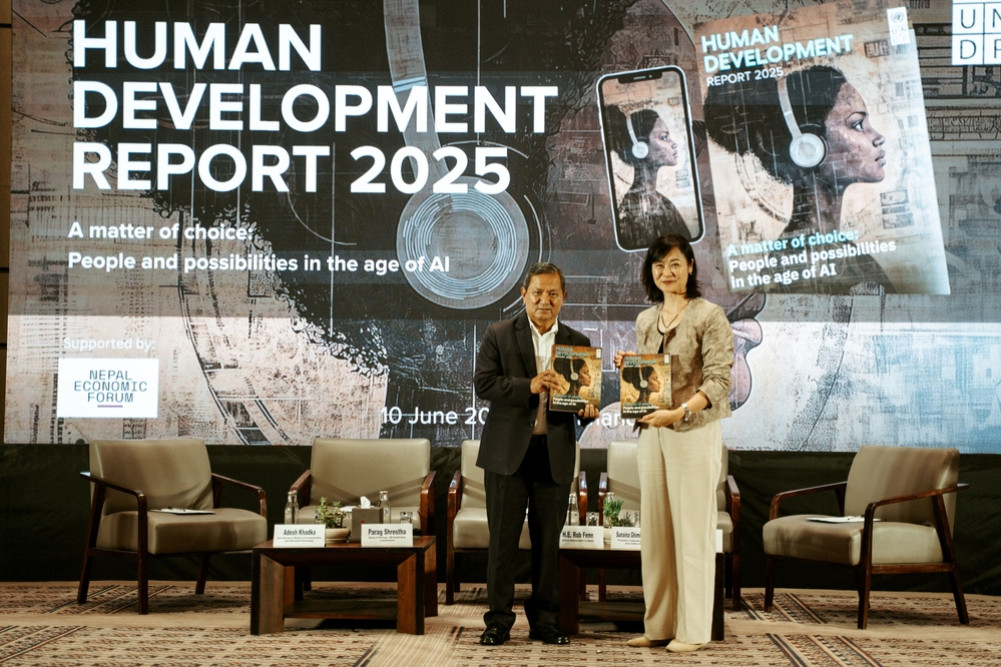
Sri Lanka ranks first in South Asia at 89th position, Maldives at 93rd, India at 130th, Bhutan at 125th, India and Bangladesh at the same 130th position, and Nepal at 145th position.
We use Google Cloud Translation Services. Google requires we provide the following disclaimer relating to use of this service:
This service may contain translations powered by Google. Google disclaims all warranties related to the translations, expressed or implied, including any warranties of accuracy, reliability, and any implied warranties of merchantability, fitness for a particular purpose, and noninfringement.
Nepal has improved by one place in Human Development Index (HDI) this year. The Human Development Index Report 2025 published by the United Nations Development Program (UNDP) has shown that Nepal is ranked 145. Out of 193 countries in the world, Nepal was ranked 146th last year, but this year it has improved by one place. In 2022, Nepal was ranked 150th.
Nepal has got 0.622 points (score) in HDI in 2025. In 2024, Nepal got a score of 0.605. During that period, the average life expectancy of Nepalis is 70.4 years. The Human Development Report of 2025 has shown that Nepal's Human Development Index has improved over the last 35 years.
The report pointed out that although poverty is decreasing during that period, the gap between the rich and the poor is widening. The report shows that Nepal has not improved relatively in the human development index due to low per capita income, gender and material inequality.
The 2025 Human Development Report focuses on 'A Matter of Choice: People and Possibilities in the Age of Artificial Intelligence - AI'. The report warned that global human development progress affected by the Covid-19 pandemic is still slowing down. The report also shows the possibility that the use of AI can play an important role in empowering human development, promoting inclusion and establishing a just society.
report In a public event, Minister of Communication and Information Technology Prithvisubba Gurung said that Nepal has prioritized the development of the Information Technology (IT) sector. According to him, AI, data center establishment, digital economy and other sectors have been given priority.
'How AI can be effectively used in fields like education, health, agriculture and how it can make Nepal's productivity and civil service delivery competitive at the international level is also being studied,' he said, 'a policy has been taken to increase the use of AI in the research and development sector.' In which the goal is to expand opportunities equally to all nations regardless of geography or economic status.
Nepal's position in the human development index is the product of continuous investment in human capital and digital transformation in recent years, said Radhika Aryal, secretary of the Ministry of Communication and Information Technology. "The progress in the Human Development Index, albeit small, reflects the continued investment in our human capital and the growing role of digital innovation in health, education and public service delivery," she said. However, during the digital transformation, everyone has not been given the same opportunity.'
Sri Lanka ranks highest in South Asia, ranking 89th on the Human Development Index. Maldives is 93rd, India is 130th, Bhutan is 125th, India and Bangladesh are in the same 130th position.
Nepal was ranked 142nd in Human Development Index in 2020. It was ranked 147th in 2019, 147th in 2018, 146th in 2015 and 145th in 2016. The index of Nepal, which was very weak in the past, has improved somewhat this year. It has been analyzed that the progress made in the last 5 decades has come to a standstill after the Covid epidemic. UNDP notes that the impasse is related to decent employment for youth, local and social inequality, economic growth and trust in institutions.
According to the report, collaboration is indispensable not only between the three levels of government, but also with the private sector, civil society, the international community and the general public. The federal government should pay more attention to transparency, accountability and integrity. The report points out that public participation and voice can be further promoted by provincial and local governments to increase planning and service delivery by civil society to revive hope and confidence.
The report concludes that the inability to act collectively in the areas of climate change, digitalisation, poverty and inequality has hindered human development. Political polarization threatens to further undermine trust in people and institutions around the world, the report said.