The judges of the constitutional bench deliberated for 6 hours on Wednesday but could not reach a decision, as none of the judges gave an opinion, the order is yet to be written, according to an officer related to the bench.
We use Google Cloud Translation Services. Google requires we provide the following disclaimer relating to use of this service:
This service may contain translations powered by Google. Google disclaims all warranties related to the translations, expressed or implied, including any warranties of accuracy, reliability, and any implied warranties of merchantability, fitness for a particular purpose, and noninfringement.
The five-member constitutional bench, headed by Chief Justice Prakashman Singh Raut, discussed the petition against the appointment of 52 officials of the constitutional body on Wednesday. Judges usually deliver judgments after extensive deliberations in chambers. But that was not the case on Wednesday. After the office hours, Supreme Court spokesperson Achyut Prasad Kuinkel told the media, "The decision has been decided on June 18."
The writ against the appointment made to the Constitutional Commission by amending the law through an ordinance has been pending for four and a half years. The court did not start the hearing on 15 petitions filed against the appointment of 32 officials on 21 January 2077 and 20 officials on 10 June 2078, bypassing the parliamentary hearing, until 30 January. Prior to that, Paci had been moved to 'unwatchable/not available' for 10 times. On January 30, it was kept in 'watching' for continuous hearing.
The constitutional bench, which heard only once in January, February and March, accelerated it in Baisakh. After the hearing on 3 Baisakh, the bench kept the writ for daily hearing from 7 Baisakh. But the daily hearing lasted only for four days. Then after the hearings on 28th and 30th Baisakh and 1st June, the constitutional bench decided to deliver the decision on 28th May.
Lawyers, media persons and civil society were anxiously waiting for the decision in the Supreme Court throughout the day on Wednesday. Members of the constitutional bench along with Chief Justice Raut, judges Sapna Pradhan Malla, Manoj Kumar Sharma, Kumar Chudal and Nahkul Subedi gathered to discuss in the chamber as soon as the sitting started. According to the Supreme Court officials, there was a discussion between them about what decision to pronounce. However, since the constitutional bench could not reach a conclusion, there are many speculations in the legal circles. A
is usually a decision delivered by the previous bench on a fixed date. The date of judgment may also be shifted due to special reasons. According to Kuinkel, the spokesperson of the Supreme Court, the judges, who deliberated for 6 hours, said that there was not enough time.
Even though the constitutional bench took almost a month to pronounce the decision, it seems unnatural to move the decision because there was not enough time for discussion. "The case has not been cleared for so long and there was not enough time to discuss it, the work has not sent a good message, it seems that all this is being done to meet someone's expectations, which is not good for the court itself," said Omprakash Aryal, one of the writ petitioners.
On the one hand, Aryal said that there is plenty of room to suspect that the judiciary is being guided somewhere by the fact that the hearing of the case takes years and the discussion is not completed even after the hearing is allotted a month to decide. "Since a few days ago, the opposition had given me a message that there would be no decision on 28th of June, but it happened without saying so."
Advocate Aryal expressed doubt that the decision will come even on June 18. "If one of the judges of the bench is absent, it can be moved again and if it is the same, the bench itself can be dissolved," he said. First one month passed, now almost another month is going. Even after that, if there is no decision, it will be impossible to say when the case will be finished, this is very unnatural and incompatible.' A former judge of the Supreme Court said that if the court postpones the date of the decision by citing technical reasons on a matter of such great interest and carrying serious constitutional meaning, a former judge of the Supreme Court said. "Even if the opinion had been expressed, the court should have given a decision on the date it was given, this is in the interest of judicial religion, otherwise the court will be under suspicion," he said.
According to an official related to the court, no one has given an opinion regarding the appointment of the constitutional officer, so the order is yet to be written. If there is no consensus among the judges, the majority opinion will prevail.
When appointing the constitutional body both times, the KP Sharma Oli-led government amended the Constitutional Council Act through an ordinance to make the recommendation process more convenient. By amending the legal provisions, the presence of 5 out of 6 members of the Constitutional Council will constitute a quorum and the decision of 4 out of the quorum will be a majority. The ordinance also made a provision that the majority of those present, including the chairman, could make a recommendation.
After the issuance of the ordinance, then Constitutional Council Chairman Prime Minister Oli, members then Chief Justice Cholendra Shamsher Jabara and then Speaker of the National Assembly Ganesh Prasad Timilsina held a meeting and recommended officers to the Constitutional Commission. The then main opposition party leader Sher Bahadur Deuba and Speaker Agni Sapkota were absent from the meeting.
The then Prime Minister Oli dissolved the House of Representatives within a few days of recommending the office bearers from the Constitutional Council on 30 November 2077 and 21 Baisakh. The then President Bidya Devi Bhandari gave them the appointment on the basis of the parliamentary rules that there is no parliamentary hearing within 45 days of the recommendation. From 1 January 2077 to 10 July 2079, 15 writs were filed against the recommendations and appointments made in the Constitutional Commission. All those writs have been heard in the constitutional bench.
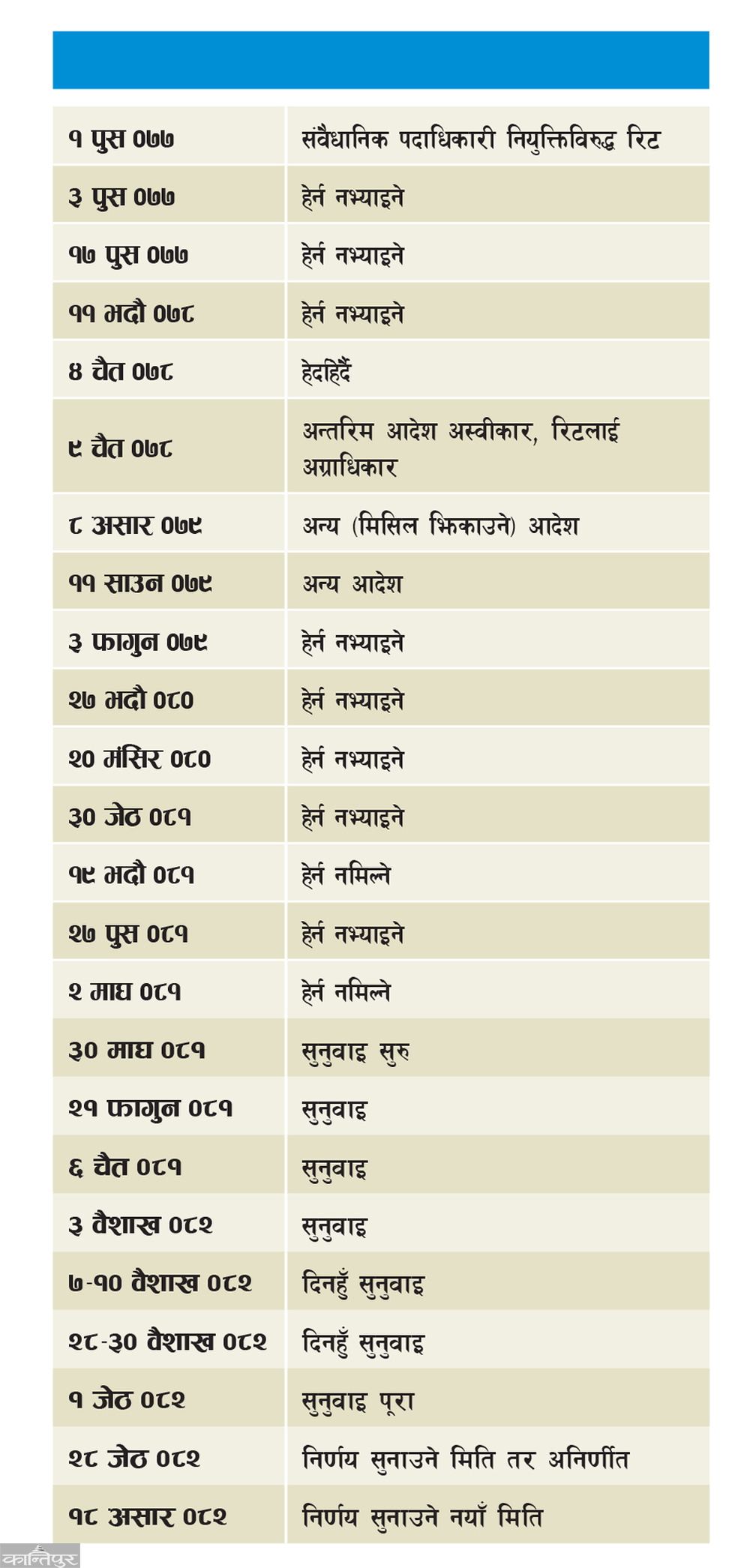
4-and-a-half-year cycle
1 Jan 077 : Writ against the appointment of constitutional officers
3 Jan 077 : Unseen
17 Jan 077 : Unseen
11 Aug 078 : Unseen
4 March 078 : Unseen
9 March 078 : Interim order denied, writ preferred
8 June 079 : Other (missile firing) orders
11 July 079 : Other orders
3 February 079 : Unseen
27 August 080 : Unseen
20 November 080 : Unseen
30 June 081 : Unseen
19 August 081 : Unseen
27 Jan 081 : Unwatchable
2 Jan 081 : Unwatchable
30 Jan 081 : Hearing started
21 February 081: Hearing
6 March 081: Hearing
3 May 082: Hearing
7-10 May 082: Daily hearing
28-30 May 082: Daily hearing
1 May 082: Hearing complete
28 May 082: Judgment date but undecided
18 June 082 : New date for judgment

