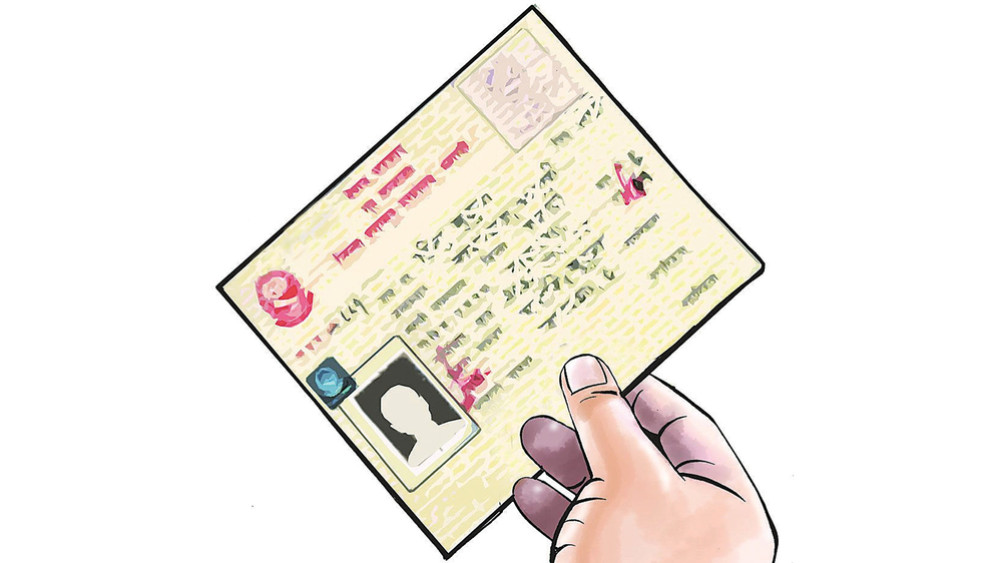
If the father's identity is not revealed and he is not in contact, the person who wants to get citizenship should 'self-declare'
We use Google Cloud Translation Services. Google requires we provide the following disclaimer relating to use of this service:
This service may contain translations powered by Google. Google disclaims all warranties related to the translations, expressed or implied, including any warranties of accuracy, reliability, and any implied warranties of merchantability, fitness for a particular purpose, and noninfringement.
The bill introduced by the government to provide legal arrangements so that citizenship can be granted only through the name of the mother has been unanimously passed by the state system and good governance committee under the House of Representatives. The bill, which was brought to address issues related to citizenship orders issued by the court, was passed with provisions to grant citizenship only in the name of the mother.
Chairman Ramhari Khatiwada said that the bill to amend the Nepal Citizenship Act 2063 was unanimously passed by the committee meeting on Tuesday. The bill provides for the provision of citizenship through the name of mother or father.
"Even if the father's name is mentioned in the birth certificate or certificate of educational qualification or any other certificate of a person, if he self-declares that his father has not been identified and is not currently in contact, it will be considered that the father of such a person has not been identified and he will receive the citizenship of Nepal on the basis of descent according to sub-section 5," the bill says.
It is written in sub-section 5 of the bill, "A person who was born abroad to a Nepali citizen mother and resides in Nepal, a foreign citizen or a person who does not have a passport and whose father is not identified, can get recognized Nepali citizenship if he declares himself as prescribed."
When taking citizenship from the mother's name, if the father's name is not written, there is a provision to 'self-declare'. In the passed bill, provision has been made to keep the father's palace empty for citizenship and the district administration or the subordinate area administration office that grants citizenship will take the mother's 'self-declaration letter'.
If the father is not found, there is a provision that women should self-declare. If they self-declare that they have a foreign father, they will be naturalized, and if they self-declare that they have a Nepali father, citizenship will be granted to their descendants under the mother's name," he said. The system of being able to take it from the mother's name is new. That is why the system of self-declaration has been put in place.
If the self-declaration made in relation to the father is found to be false, there is a provision of both punishment and fine. If the father self-declared as a native and took the citizenship, but later found to be a foreigner, there is a provision in the bill that such citizenship will be converted into a naturalized one.
Human rights activist and advocate Mohana Ansari said that the provision of self-declaration when women take citizenship for their children is against the provisions of the constitution. "It is against the spirit of the constitution to have a woman self-declare to get the citizenship of her children under her own name, it is a discriminatory system," she said. This system will be against the system of equality.'
He says that such arrangements violate the constitution and international treaties. She says, "Discrimination should be ended, but the Citizenship Bill has maintained it." He said that since the name of both the mother and the father should be in the citizenship, if it is the father's name, then the mother's name is not necessary and if it is only the mother's name, then the system of having to go to the administration to self-declare about the father is not correct.
Congress General Minister Bishwa Prakash Sharma said that the identity of the mother has been respected by bringing the new law. One of the problems in the past was that our citizenship bill did not recognize the mother who is easily recognized by the society. The mother had to be identified, but the father was easily identified by our law. That is why the law that has come now has tried to identify the mother easily. Mother or father are the same, it has been presented the essence of not allowing one to be deprived of the right to citizenship while receiving guardianship," he said. Congress MP Hridayram Thani said that the issue of possible disputes related to part or custody in the name of the mother should be taken into consideration while making laws.
This bill has also made arrangements to grant citizenship without such practice if the father's name is not mentioned in the citizenship. "If a person submits an application stating that he does not want to mention the name, surname and address of his father in the Nepali citizenship certificate, the Nepali citizenship certificate given to such a person shall be given without mentioning the father's name, surname and address in the place where the father's name, surname and address should be mentioned," the bill states.
Citizenship is granted from District Administration Office and Area Administration Office. Since there is no head of the staff office at the branch officer level in the area administration office, there is a problem of not getting the citizenship on time, and this problem will be solved after the passage of this bill and its implementation as a law.
There are 77 local administration offices across the country. Naib Subba is working at the head of that office. After this bill is implemented as a law, a legal arrangement has been made to grant citizenship to Naib Subba, who is working as the head of the local administration office,' said Suraj Kumar Dura, secretary of the committee. The
bill also provides for minor identity cards. If necessary for legal work or other purposes, the administration office has to issue an identity card for minors and on that basis they can get citizenship after reaching 16 years of age.
There is a provision to get an identity card in the name of mother or father. Now the report of the bill will be submitted to the House of Representatives and passed and from there it will be sent to the National Assembly. After it is passed by the National Assembly, it will be verified by the Speaker and sent to the President for verification. After the approval of the President, the bill will be implemented as a law.