We use Google Cloud Translation Services. Google requires we provide the following disclaimer relating to use of this service:
This service may contain translations powered by Google. Google disclaims all warranties related to the translations, expressed or implied, including any warranties of accuracy, reliability, and any implied warranties of merchantability, fitness for a particular purpose, and noninfringement.
China has suggested Nepal's former president Bidya Devi Bhandari to take initiatives for left unity. Bhandari, who is on a week-long visit to China, has been honored by UML as a senior leader, and China has made such a suggestion.
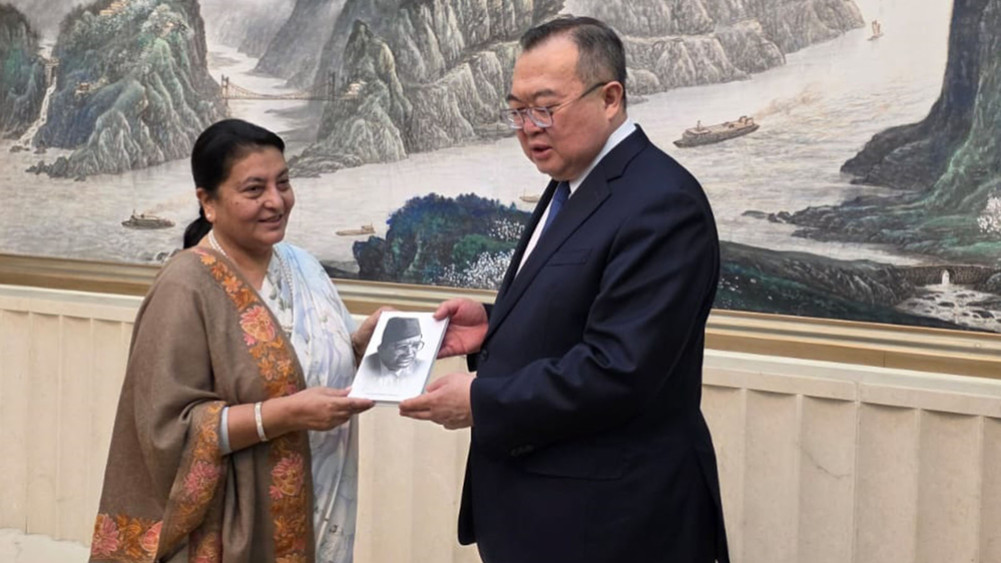
Even though UML said that Bhandari visited China as a former president, the Chinese Communist Party (CPC) addressed him as a senior leader of UML. In a meeting with Bhandari in Beijing last Saturday, CPC foreign department chief Liu Qianchao suggested that it is necessary for the left-wing power to unite for political stability in Nepal. "He suggested that it would be better for former president Bhandari to take the lead for left unity," said a member of the visiting team. Earlier, during the visit of Maoist leaders to China, CPC leaders had been suggesting to unite the left.
When the conflict between the then presidents of the Nepal Communist Party, KP Sharma Oli and Pushpa Kamal Dahal, was at its peak, Bhandari even tried to reconcile. In July 2077, when the conflict between Oli and Dahal escalated, Bhandari, who was in the role of the president, tried to reach an agreement but was not successful. In February 2077, the order of the Supreme Court returned the UML and Maoists to a state of unity. In the
meeting, Liu said that it is necessary to intensify cooperation such as the Belt and Road Initiative (BRI) and improve the common future of the two countries . "Inter-party exchanges play an important role in the development of China-Nepal relations," Liu said, "CPC is willing to strengthen exchanges with all political parties in Nepal, deepen exchanges and mutual learning at the government level, and promote practical cooperation in various fields through political parties as well as new channels." Bhandari went on a visit to China on May 10. UML foreign department head and secretary Raghuveer Mahaseth, permanent committee member Karn Thapa and others are in his team. Leader Thapa said that China has honored former President Bhandari as a special leader of Nepal. "High-level meetings were held," he said, "due to political instability, long-term development work cannot proceed." As a special leader, their suggestion was to strengthen the system.
Liu said that he wanted the implementation of the BRI between Nepal and China to be quick. Mentioning that she is in favor of advancing the BRI project, Bhandari recalled the agreement reached in Baisakh 2076 as the President. On the invitation of Bhandari, Chinese President Chin Fing visited Nepal in October 2076. "He (Bhandari) insisted on the implementation of cooperation when he was the president," Thapa said, "The visit is a message in terms of politics, and a new faith in the new era in terms of the relationship between the two countries." The leaders of Nepal, Malaysia, Pakistan, Sri Lanka, Thailand and other countries participated. At the conference, Bhandari said that CPC's historical experience and contemporary practices have helped in the economic and social transformation of Nepal.
Bhandari addressed the civilization exchange dialogue in Dunhuang, Gansu Province, China. On Friday evening, she also met with Chi Bingxuan, Vice Chairman of the Standing Committee of the 13th National People's Congress of Gansu Province and Chairman of the Chinese Association for International Understanding. Bhandari is scheduled to return home on Monday.