We use Google Cloud Translation Services. Google requires we provide the following disclaimer relating to use of this service:
This service may contain translations powered by Google. Google disclaims all warranties related to the translations, expressed or implied, including any warranties of accuracy, reliability, and any implied warranties of merchantability, fitness for a particular purpose, and noninfringement.
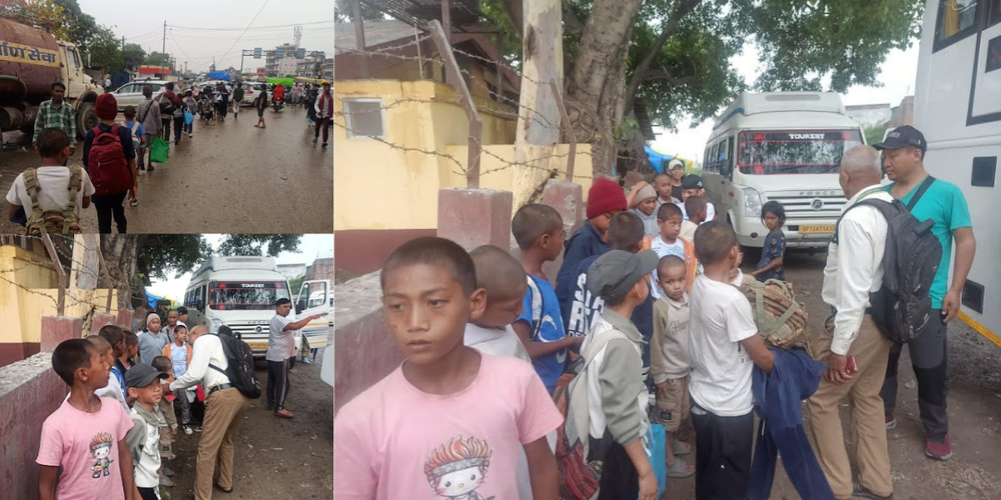
19 Nepali minors who were illegally and illegally taken to the Indian state of Karnataka have been rescued from the Sunauli/Belhia border crossing.
Those minors who were taken without their parents to study in various Buddhist monasteries in Karnataka, India, were rescued by the initiative of 'Kin India', an organization active in India against trafficking and exploitation of women and children, and the Indian security agency SSB.
Navin Joshi, director of Kin India in Delhi, India, said that as soon as the information was received that some Nepalese children were being illegally taken to India by bus to be educated, they were immediately rescued in cooperation with the Indian security agency SSB.
"Incidents of Nepali children being illegally brought to India to study in various Buddhist monasteries in India have happened many times before," Joshi said, "we have rescued such Nepali children from being persecuted many times before." Nepali children have even committed suicide.
He said that there is a provision that documents should be obtained from the government level if any child is to be taken to another country without parents. The rescued children are from Sindhuli, Sindhupalchok, Makwanpur and other districts. After returning them from the border, SSB handed them over to the Nepal Police. They are 10 to 16 years old.
The information officer and DSP Suraj Karki of District Police Office Rupandehi said that preparations are being made to send those children who are currently kept in District Police Office Rupandehi home under the care of their respective parents.
"They were taken to India after agreeing with their parents to educate them in a monastery," said DSP Karki, "but since they were taken without completing the process, we are arranging for the children to reach their parents." There is a legal provision that if children are to be taken abroad from Nepal without parents, they must have a document with permission from the Ministry of Home Affairs through the Child Welfare Officer of the local municipality, the Chief District Officer of the respective district.
Milan Dharel, the former director of the National Child Rights Council, said that institutions teaching abroad should be listed in the Ministry of Education of Nepal and that there are provisions to fulfill many conditions regarding the protection and fulfillment of children's rights.
"Many Nepali children taken to different monasteries in India for teaching have committed suicide because they could not bear the harsh discipline there and were not contacted by their parents," Dharel said.