If teachers are involved in political activities, parliamentarians agree to dismiss them if they participate in political activities
We use Google Cloud Translation Services. Google requires we provide the following disclaimer relating to use of this service:
This service may contain translations powered by Google. Google disclaims all warranties related to the translations, expressed or implied, including any warranties of accuracy, reliability, and any implied warranties of merchantability, fitness for a particular purpose, and noninfringement.
The ruling and opposition parliamentarians have agreed on a law in which public school teachers can be dismissed if they become members of a political party or party-affiliated organization, engage in political activities, or participate in political activities.
This provision has been made in the report prepared by the sub-committee under the Education, Health and Information Technology Committee of the Parliament, concluding the quarterly discussion on the School Education Bill.
sub-committee coordinator and MP Chavi Lal Bishwakarma submitted the report to the committee chairman Ammar Bahadur Thapa on Sunday. A consensus has been reached in the sub-committee on matters other than the conduct of private schools and Early Child Development (ECD) classes. Bishwakarma said that the pending matter will be decided by the committee.
Similarly, an agreement has been reached on the establishment of an autonomous educational quality testing authority to regulate school education independently. The sub-committee concluded that an authority should be formed instead of an educational quality testing center under the Ministry of Education. In the
report, it is mentioned that there will be an authority to determine the standards of the overall educational quality test of the school education system, development of standards, national achievement test of students' learning and institutions related to school education, to test the performance of schools. In the original bill, it was mentioned that the old center will remain.
There was an arrangement for the joint secretary of the Ministry of Education to be the head. But on the recommendation of a 3-member committee formed under the chairmanship of the Public Service Commission, the government has suggested to appoint a chief education examiner. If the report of the sub-committee is passed by the parliament through the committee, the chief education examiner will be appointed for 4 years from an expert with experience in this field. The authority will measure the quality of school education.
The sub-committee has removed the provisions of the original bill to have an education development and coordination unit (former district education office). It is mentioned in the report that there should be an education and human resource development center at the federal level to work in coordination with the central, provincial and local levels.
The work and duties of the center under the ministry have been set to coordinate with the education monitoring bodies of the province and the local level in relation to school education to implement the national policy, plan and standards of education.
In the original bill, the government proposed to revive the former education department. The parliamentarians have reached a consensus that the central bodies of education including the National Examination Board, Curriculum Development Center, and Teachers Service Commission will remain as they are now.
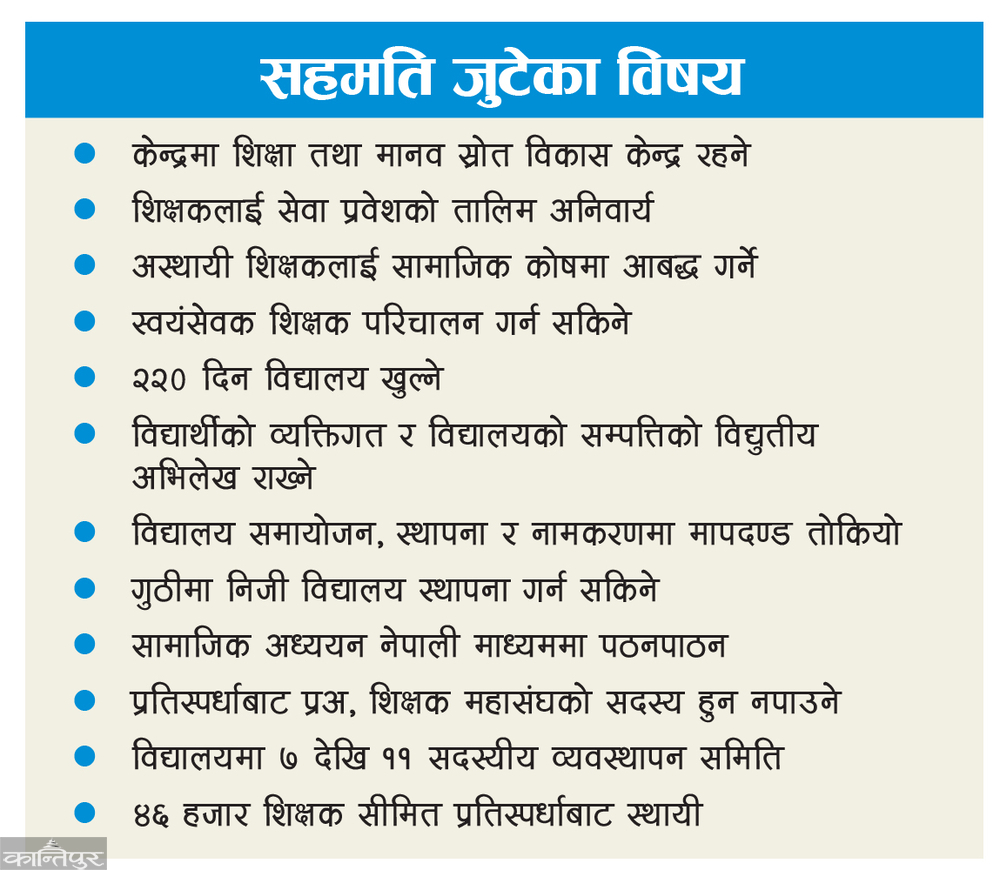
The bill has been finalized by the subcommittee by adding some new clauses. The parliamentarians have proposed a new arrangement for teacher induction training, school opening for at least 220 days in an academic session, joining temporary teaching staff to the social fund, mobilizing volunteer teachers, keeping electronic records of students' personal and school property.
"In order to increase the teaching skills and capacity of the teachers, to develop the latest thinking towards the teaching profession and to assimilate the innovations in the teaching profession, the provision of compulsory service entry training and in-service training will be arranged by the teacher training institute of the provincial government," said the report of the sub-committee.
teachers have been pointing out that there is a lack of induction and in-service training. It is recommended to implement a system where schools can mobilize volunteer teachers with the permission of the local level.
It has been arranged that the local level can establish and operate even residential schools by ensuring the needs and resources. In the original bill, it was said that only centers of special nature and residential schools could be established. The sub-committee has pointed out that the medium of instruction should be Nepali, Sanskrit, mother tongue or English, and mathematics, science, computer subjects, English and social studies should be taught through Nepali or mother tongue.
Although there is no agreement to allow the currently operating private schools to be operated under the company model or to be transferred to a non-profit Guthi, the arrangement to establish a private school in Guthi has been kept open. "A person who wants to establish and run a school under Guthi must register with the Guthi registration body," the report states.
Standards are also set for school transfers, mergers, class or grade reductions, closures, or name changes. "The school mapping report prepared on the basis of geographical conditions and population location, if there are no students in the specified number of classes, if the distance between schools is less than two kilometers or thirty minutes walking distance at the basic level, and if the distance between schools is less than 5 kilometers and less than one hour walking distance in the case of secondary schools, if the infrastructure specified for operating the respective level or class is not complete, it is found suitable to operate as a large or residential school with more than 2 thousand students in each school," said the criteria. Currently, the local levels have been adjusting schools on their own saying that there is a shortage of students. The Educational Quality Testing Authority may also recommend amalgamation, reduction of classes or levels, adjustment or integration of schools while testing the performance of schools. The
sub-committee has also decided the rules regarding the naming of the school. If any school in operation at the time of commencement of the Act is named after a foreign person, institution, place or foreignness, the name shall be changed to reflect Nepaliness within three years of the commencement of this Act. The name of the natural, cultural place, person or monument of Nepal should be reflected in the report submitted by the sub-committee.
It is said that the Ministry of Education will arrange to develop an electronic record system for the purpose of keeping an integrated record of immovable property of public schools. It has been arranged that the appointment of Principal in the school will be done on the basis of competition. A provision has been made that the Teacher Service Commission should prepare a district-wise list in the case of basic schools and a province-wise list in secondary schools through competition.
Under the coordination of the head of the education branch of the local level, it has been arranged that the educationists and the representative of the management committee can appoint the principal from the list for a period of 5 years. It is mentioned that the Principal should be appointed through this process within 6 months of the vacancy. A provision has also been made that if the PM appointed under the performance agreement does not work according to the agreement, an inquiry committee can be formed and he can be removed from the post. "If the central, state and local governments bear the responsibility of the PRA and establish separate posts, the commission will have to fill the posts on the basis of competition," said the report.
While the principal is working in the post, the teachers are also barred from taking membership of the umbrella organization Nepal Teacher Federation. "Members of the Principals' Federation are not entitled to hold any office and represent the Federation and the School Management Association formed in accordance with this Act," the report states. The management committee has also arranged for the union to be at the central level. It is arranged that there will be 7 members in the basic schools and 11 members in the secondary schools. Ward members will also be represented.
The lawmaker of the sub-committee has proposed that the provision of not giving jobs and other facilities to the members of the teachers' federation and the school management association should be put into law. Now, the officials of the federation are taking job benefits. The teacher's performance evaluation will be done by measuring the learning achievement of the students in the subjects taught.
An 11-member sub-committee chaired by Member of Parliament Vishwakarma has prepared a report after discussion on a quarterly basis. The MP of the sub-committee said that the Ministry of Education was not ready to make the ECD class 2 years and keep it within the school structure. An agreement has been reached regarding the relief grant, special and 46,000 former Umawi teachers working in public schools and making them permanent through limited competition. The report mentions that 60 percent of teachers will be appointed through internal competition and 40 percent through open competition. If they fail in the examination, it is proposed to leave with benefits and to fill the posts of teachers through open competition.
Agreed topics
-Education and human resource development center at the center
-Training for teachers to enter service mandatory
-Association of temporary teachers with social fund
-Volunteer teachers can be mobilized
-220 day school opening
-Keeping electronic records of students' personal and school property
-Standards set for school adjustment, establishment and naming
-Private school can be established in Guthi
- social studies teaching in Nepali medium
- due to competition, not being a member of the teacher's federation
- management committee of 7 to 11 members in the school
– permanent

