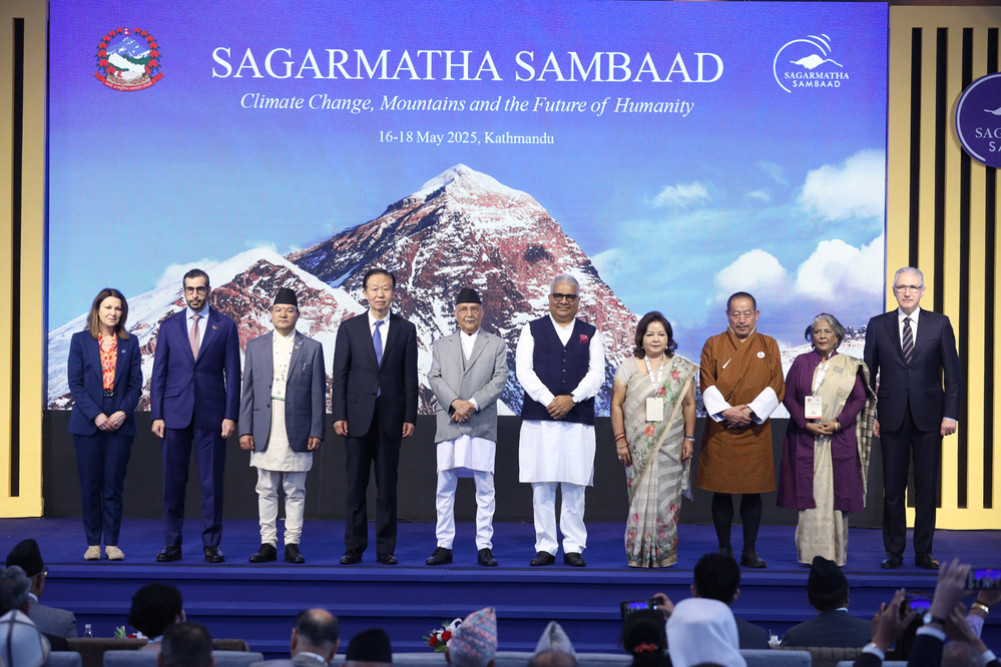
The biggest polluters should provide the most support to sensitive countries through finance, technology, capacity building. - KP Sharma Oli, Prime Minister
We use Google Cloud Translation Services. Google requires we provide the following disclaimer relating to use of this service:
This service may contain translations powered by Google. Google disclaims all warranties related to the translations, expressed or implied, including any warranties of accuracy, reliability, and any implied warranties of merchantability, fitness for a particular purpose, and noninfringement.
The 'Sagarmatha Dialogue 2025' has started in Kathmandu with the main theme of 'Climate Change: Mountains and the Future of Humanity'. The dialogue will discuss the agenda of connecting mountains to island nations to prevent climate change, giving priority to green economy, finding ways to avoid, reduce and address the harm of climate change, raise voice for climate justice and the future of humanity, and increase global and regional partnerships.
In the opening of the three-day dialogue organized by the Government of Nepal, which started on Friday, the main speakers have pointed out that the role of rich countries in climate change is greater. Due to climate change, poor countries have to suffer more, and they have emphasized that financial justice should be provided.
Addressing the opening program, Prime Minister KP Sharma Oli said that countries with more air pollution should contribute the most through finance, technology and capacity building. 'Those who pollute the most should contribute the most,' said Oli, 'they should support sensitive countries through finance, technology, and capacity building.' He emphasized on the cooperation of everyone as climate change is the biggest challenge at present and no country is untouched by its effects. But we cannot do these things alone. "No country can do it alone," he said, "Climate change is an emergency for the whole world and its solution must come from the world." While addressing the
program, Foreign Minister Arju Rana Deuba said that since climate change is not only a single country's problem, it requires commitment, cooperation and coordination. She said that in 'Sagarmatha Dialogue 2025', there will be a comprehensive discussion about the current situation of climate change and the challenges it is causing.
Our efforts alone are not enough to deal with this common problem. That is why Nepal has organized the Everest Dialogue to create a common platform for collective cooperation and coordination,' she said, 'This conference will be important to collectively advocate for the current situation in which Nepal is suffering unimaginable damage from climate change and to raise the voice of climate justice raised by Nepal on world platforms.' have made a verbal commitment. India's Environment, Forest and Climate Change Minister Bhupender Yadav thanked Nepal for starting a visionary dialogue on a serious issue like climate change and said that the mountains are showing signs of danger and there is a need for cooperation among all.
'Science clearly says, our mountains are signaling danger,' he said, 'Glaciers are melting rapidly as a result of global warming caused by human activities. Therefore, this dialogue is not just for discussion, but a call to take common and concrete steps. Although India's role in the crisis created due to climate change is minimal, India is serious about climate action and is also contributing according to the current needs.
Chinese National People's Congress Standing Committee Vice President Xiao Jie mentioned that China's priority is to cooperate with Nepal in the areas related to Mount Everest and China's participation in this dialogue is a symbol of friendship between the two countries.
This dialogue is a symbol of China-Nepal friendship. "China and Nepal share the border of Mount Everest," he said, adding, "This program provides an important new platform for regional and international stakeholders to share concerns about climate change and for joint action."
Likewise, President of COP-29 and Minister of Ecology and Natural Resources of Azerbaijan, Mukhtar Babayev commented that the climate problem is increasing rapidly and he has taken these problems seriously. "People in many parts of the world see mountains and mountain communities as distant and different," he said, "they don't realize that these problems affect them too." But I understand that climate problems are increasing rapidly.'
He also said that he supports joint action on climate change. "Melting glaciers and rising sea levels are serious warnings," he added, adding, "This has threatened about 10 percent of coastal areas from South Asia to Saharan Africa."
The opening program was addressed by United Nations Secretary General Antonio Guterres through video conference. Guterres said that solving the global challenge of climate change requires everyone's initiative. I am aware of the impact on the Himalayan region. Rivers flood when snow melts. It will affect many lives. The climate will lead to migration," he said. "That is why we have gathered here today. We should learn more from Nepal's initiatives for climate change. On the first day of the
dialogue, in addition to the opening session, the impact of climate change was discussed in the topic session 'Beyond Mountains: Linking Mountains to Ocean'. In the session, experts discussed the need for a 1.5 degree target for glacier conservation, connecting glaciers with islands, food security and climate-resilient agriculture and community-led climate initiatives in mountain areas. On the second day of the program, topics including green economy will be discussed.
The government decided to hold the Everest Dialogue about 6 years ago with the aim of attracting the attention of the world community about the effects of climate change in Nepal. However, the dialogue could not be held on the scheduled date due to the covid epidemic and the change of power.
The government aims to develop dialogue as an international forum every two years. According to the government, more than 150 foreign guests from different countries are participating in the first edition of the dialogue starting from Friday.