Till April of the current fiscal year, the government has spent 11 trillion 46 billion 59 billion while earning 9 trillion 42 billion 88 billion, while in the last 10 months of the previous year, the government's finances were in a deficit of 1 trillion 92 billion.
We use Google Cloud Translation Services. Google requires we provide the following disclaimer relating to use of this service:
This service may contain translations powered by Google. Google disclaims all warranties related to the translations, expressed or implied, including any warranties of accuracy, reliability, and any implied warranties of merchantability, fitness for a particular purpose, and noninfringement.
The direct impact of the economy not running has been on the government income. According to the data of the Comptroller General's Office, the government finances are in a deficit of about 2 billion rupees as of May 30 due to non-collection of revenue as per the target.
Due to lack of increase in demand in the market, lack of expansion of significant investment and low capital expenditure of the government, it has affected the government finances. Due to slow economic activity, the government has not been able to collect revenue as per the target. During this period, the government has spent 11 trillion 46 billion 59 billion 15 million while earning 9 trillion 42 billion 887 million. In the 10 months of the previous year, government finances were in a deficit of about 1 trillion 92 billion.
Imports have started to increase in recent months, but their growth rate is only 12 percent. Despite the high growth in exports, the government's income from them is low. If the scope of taxation has not been expanded, the size of the informal economy is increasing rapidly.
The government's sources of income have shrunk due to the decrease in foreign grants and aid. Mandatory obligations such as social security allowances, salaries, pensions are constantly increasing. In this way, due to the increase in government expenditure, the government financial deficit is increasing.
With only two months left for the end of the current financial year, the government has spent 1 trillion 18 billion 31 crore rupees. This is 33.58 percent of the annual target. After the formation of this government of Congress and UML coalition, there will be political stability in the country, but the government has repeatedly claimed that economic development will get priority and capital expenditure will increase, but the results have not shown the expected improvement.
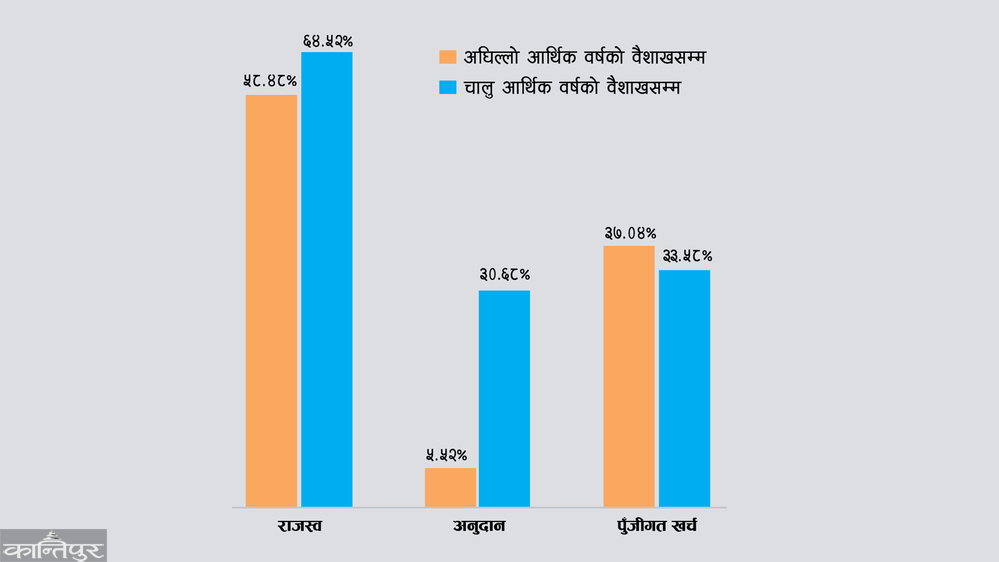 In the 10 months of the previous year, the government spent 1 trillion 9 billion 28 crores, or 36.18 percent of the annual target. The capital expenditure till April is about 92 billion less than the government's monthly target.
Economist Dilliraj Khanal says that due to the failure to improve the institutional and structural problems of government finances, the expected achievements in terms of capital expenditure and revenue have not been achieved. "The main reason for not increasing capital expenditure is the lack of responsibility and accountability," he says.
He believes that this situation has come about even though the legal provisions for increasing capital expenditure, decisions and commitments made in the past have not been fully followed. "The process of implementing policies and being accountable was not done properly," he says, "It was as if it was done and the work was done. In order to solve this problem of the economy, it should be improved as a whole, not isolated." This year, the government has allocated 3 trillion 52 billion 354 million rupees towards capital expenditure. Experts say that despite the government's efforts, the expected improvement in capital expenditure has not been achieved. But current expenditure is increasing. In the 10 months of the current financial year, about 7 trillion 64 billion rupees have been spent. This is 66.98 percent of the annual target. During the same period of last year, 745 billion 56 crore rupees, ie 65.3 percent of the annual target, were spent on current expenditure.
Experts argue that the government has not been able to deliver results as claimed by looking at the revenue, capital expenditure, foreign aid and subsidy collected in the 10 months of the current financial year (from July to April). For the last 31 months, foreign exchange reserves have been setting new records. External indicators of the economy, including the balance sheet and current account, have continued to strengthen. In such a situation, experts have been saying that if the government expenditure and income can be improved, the economic activity will become sustainable. But despite the improvement in government finances compared to last year, it seems that it is not enough to keep the sluggish economy running.
From July to April of the current financial year, the government has collected 9 trillion 15 billion 66 crore rupees in revenue. This is 64.52 percent of the annual target. Revenue collection has increased by about 11.5 percent during the same period of this year as compared to May of last year. The revenue collection till April is about 2 trillion 15 rupees less than the monthly revenue collection target of the government.
The government had set a target of collecting revenue of 11 trillion 30 billion 70 crore rupees by Baisakh of this year. For the current financial year, the government has set a target of collecting only 14 billion 19 billion 33 million revenue from revenue. The revenue collected in all the previous months of this year is less than the monthly target of the government.
Although the revenue collection is on the way to improvement, the Ministry of Finance official admits that the target has not been met. They say that it is impossible to meet the revenue collection target with normal performance. Due to the increased leakages in the tax administration and lax control, there has been a decrease in compliance with the tax laws, so the revenue has not increased as per the target. "The main thing is the lack of government management, lack of revenue administrative capacity, increasing leakage," says a finance official. This year, the government has set a revenue collection target of more than 30 percent. This is challenging in itself, experts argue.
The spokesperson of the Ministry of Finance, Shyam Prasad Bhandari, says that the increase in revenue collection is positive compared to the past. ``The three months of April, May and June will increase both in terms of expenditure and income, so there is no need to panic, only 19/20 is different from last year,'' he says,
'If you look at the capital expenditure, this year is less than last year in terms of percentage, but it is more in amount.' There is neither significant progress nor deterioration in the overall public finance indicators.' This year, 71.96 percent of the budget allocated under the heading of financial arrangements has been spent. Under the heading of financial arrangements, the government allocated 3 trillion 67 billion 284 million 45 million for the current financial year. In 10 months, the government has received 16 billion 531 rupees in foreign grants. This is 30.68 percent of the annual target.
After it was determined that the income and expenditure targets would not be met, the government reduced the current fiscal year's budget by 1 trillion 67 billion. Of the 18 trillion 60 billion budget allocated, 16 trillion 92 billion has been maintained after the half-yearly review.
In the budget presented by the then finance minister Varshman Pun, the budget was revised by finance minister Bishnu Paudel, showing reasons including many programs without guaranteed resources, projects were selected across Hachuwa and thousands of projects were also kept at the center.
The retained budget is only 90.99 percent of the total amount initially allocated. With the reduction in size, current expenditure has remained at 10 trillion 29 billion 30 million (90.24 percent of initial allocation) and capital expenditure at 2 trillion 99 billion 50 million 9 million (85 percent of initial allocation). Last May, the previous government allocated current expenditure of 11 trillion 40 billion 6644 million and capital expenditure of 3 trillion 52 billion 364 million.

