The decision of the Council of Ministers to allow the sale of demarcated land in accordance with the proposal sent by the Ministry of Land Reforms as 'because of verbal instructions from the Prime Minister', when the illegal decision was refused to be implemented in writing, Director General of Land Reforms Keshar Bahadur Baniyan was prosecuted and executed by Jit Bahadur Thapa.
We use Google Cloud Translation Services. Google requires we provide the following disclaimer relating to use of this service:
This service may contain translations powered by Google. Google disclaims all warranties related to the translations, expressed or implied, including any warranties of accuracy, reliability, and any implied warranties of merchantability, fitness for a particular purpose, and noninfringement.
It has been seen that the then Prime Minister Madhav Kumar Nepal gave instructions and decided to purchase land in the name of Patanjali at a limited discount and to give approval to illegally sell it to a housing company within two months of purchase. In the year 2066, Patanjali Yogpeeth and Ayurveda Company of Indian yoga guru Ramdev purchased 593 ropani land in Banepa of Kavre and sold 353 ropani to Housing Company.
Nepal, who was the Prime Minister from 11th June 2066 to 22nd March 2067, made a decision from the Council of Ministers on 18th January 2066 to allow Patanjali to purchase the land within the limits, but less than two months later, on 6th March 2066, another decision was made by the Council of Ministers to approve the sale. Plotting has been done on the said land.
After the Nepal Council of Ministers approved the purchase of 815 ropani land, Patanjali bought 593 ropani 5 annas 3 paise in Nasikasthan, Sanga, Mahendrajyoti and Chalal Ganesthan areas of Banepa. Then Shaligram Singh, the then Nepal head of Patanjali, sold 353 ropani 15 annas to Kasthamandap Housing Company on 11 Asar 067.
When Patanjali was allowed to buy and sell demarcated land, the Cabinet led by Nepal had Dumbar Shrestha as Minister of Land Reforms, Madhav Ghimire as Chief Secretary and Chabiraj Pant as Secretary of Land Reforms. A written fact has been found that Minister Shrestha was instructed by the then Prime Minister of Nepal to proceed with the proposal to sell Patanjali's land.
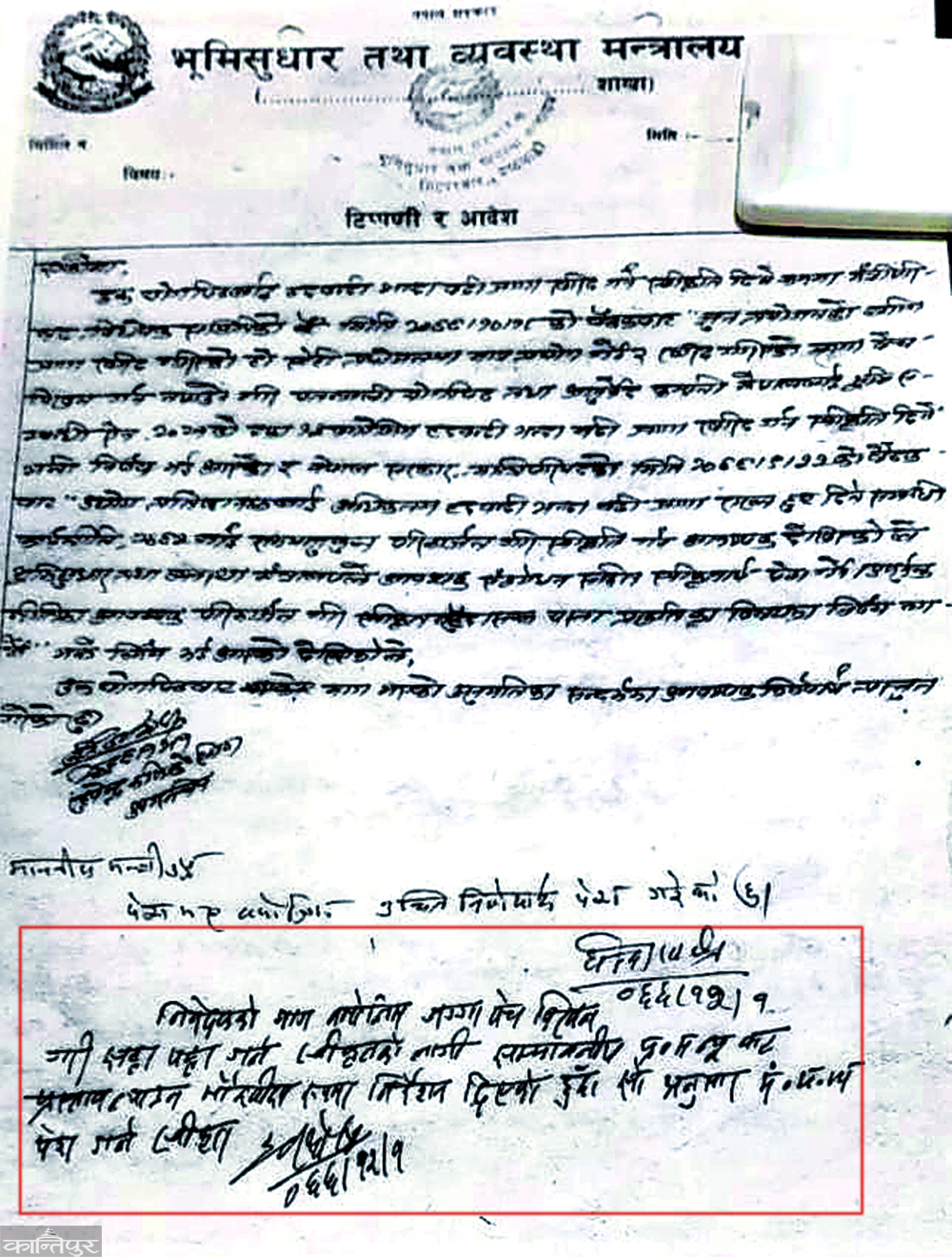 The then Land Reforms Minister Dumbar Shrestha's sadar letter on 1 Chait 2066 said that the comment raised before sending the approval proposal to Patanjali to sell the demarcated land to the Cabinet was "according to the verbal instructions of the Prime Minister (Madhav Kumar Nepal)".
In the proposal submitted by Shrestha to the Council of Ministers, it is mentioned that the Prime Minister of Nepal received instructions to bring the proposal.
President Singh of Patanjali Nepal addressed to Minister Shrestha on 17 February 2066 asking for permission to sell the land purchased with limited discount. The then deputy secretary of the ministry, Hupendramani KC, raised the comments and approved the file step by step, which reached the cabinet through Secretary Pant and Minister Shrestha. In the file that was raised to send the approval proposal for land sale to the Council of Ministers, the Secretary of the Ministry, Pant said, "I have submitted it for a proper decision as submitted" and sent it to Minister Shrestha.
In the comment written by Minister Shrestha approving the proposal sent on 1 Chait 2066, it is mentioned that 'as per the request of the petitioner, it is approved to submit the proposal to the Council of Ministers as he was instructed orally to bring a proposal from the Honorable Prime Minister for approval to sell and lease the land'. Based on that, the decision made by the Council of Ministers on 6th of Chait said, "Patanjali Yogpeeth and Ayurveda Company Nepal will be given permission to sell and sell land in excess of the limit." Later, instructions were given to the Land Management Department and the Malport Office for the implementation of the decision.
An officer of the ministry says, 'It is illegal and abuse of office to take such a request directly from the ministry to the decision-making process based on the fact that someone in the department.'
On the same day that the Council of Ministers approved the land sale, the then Chief Secretary Ghimire sent a letter to Secretary Pant to implement the decision of the Council of Ministers. After receiving the letter, Secretary Pant wrote a letter to the Land Reforms Department through the Deputy Secretary and asked them to implement the decision made by the Council of Ministers.
However, the then director general of the department, Keshar Bahadur Banian, said that the decision of the council of ministers was against the law and returned the file to the ministry saying that it could not be implemented. Later on 26 March, the Council of Ministers again asked to implement the previous decision. Similarly, Baniyan was removed from the position on March 27, accusing him of challenging the decision of the Cabinet. In his place, another Joint Secretary Jit Bahadur Thapa was made Director General of Land Reforms Department. On the day he appeared in the department, Thapa decided to proceed with the land sale process as per Patanjali's wish.
Kantipur wrote an investigative news on June 6, 2081 about this land embezzlement case that happened a decade and a half ago. After the news was published, investigations were carried out by mechanisms including the Public Accounts Committee of the House of Representatives, the Commission for Investigation of Abuse of Authority and the Central Investigation Bureau of the Police.
The authority has taken a statement from the then Prime Minister of Nepal as the 'chief decision-maker' who joined the illegal decision-making process and made the sale of demarcated land. According to authority sources, during the interrogation, the former Prime Minister of Nepal has made a statement that 'the decision of the Council of Ministers does not fall within the authority's jurisdiction and the ministries and departments will be responsible for it'.
The authority summoned the former Prime Minister of Nepal to his office in Tangal last March and took a statement. The then secretary Pant, the head of Patanjali Nepal, Shaligram Singh and others who were involved in this case, have also been summoned to the authority and their statements have been taken. As the statements of all the accused have been taken, the authority has started preparing to file a case in the Patanjali case. The then Land Reforms Minister Shrestha passed away on 30 October 2081 while he was still under investigation.
Some top officials of the Council of Ministers, Ministries and Land Administration who are involved in the case of Lalita Niwas land in Baluwatar are also involved in the embezzlement of Patanjali's demarcated land. Even though the then Prime Minister Nepal Lalita was involved in the residence case, no case was filed against her. The petition against the immunity granted to him is still pending in the Supreme Court. In the Patanjali case, another irregularity from the Council of Ministers, Nepal is seen as the main decision-maker.
According to former secretary Sharda Prasad Trital, this is sheer corruption. "The fact that the Prime Minister illegally intervened and pressured the Minister to bring this proposal is evidence for filing a corruption case," he says, "If the decision that the Prime Minister instructed to bring a proposal to allow the sale of restricted land is mentioned in the decision submitted by the departmental minister to the Council of Ministers, what other evidence is needed to make the chief decision-maker a defendant?"
In Lalita Niwas too, a case was filed against the chief decision officer for misappropriation of government land. "That fate should not be repeated in Patanjali, if the same fate is repeated, no matter how much those in power do illegal things, the case will only be on the employees," he says.
Even though the government formed a committee at the staff level of the ministry in October 2080 to investigate irregularities in the Patanjali case, the report is still kept secret. In Nepal, Patanjali Yogapeeth and Ayurveda Company is registered as a non-profit trust. Patanjali Yogi Ramdev, Balkrishna Acharya, Shaligram Singh, Rajendra Singh and Umesh Sarraf are the directors registered in the company registrar's office on 20 December 2014. Shaligram Singh has been working as the Hartakarta of the company and it seems that the transaction was done through him when land was bought and sold in 2066.
...
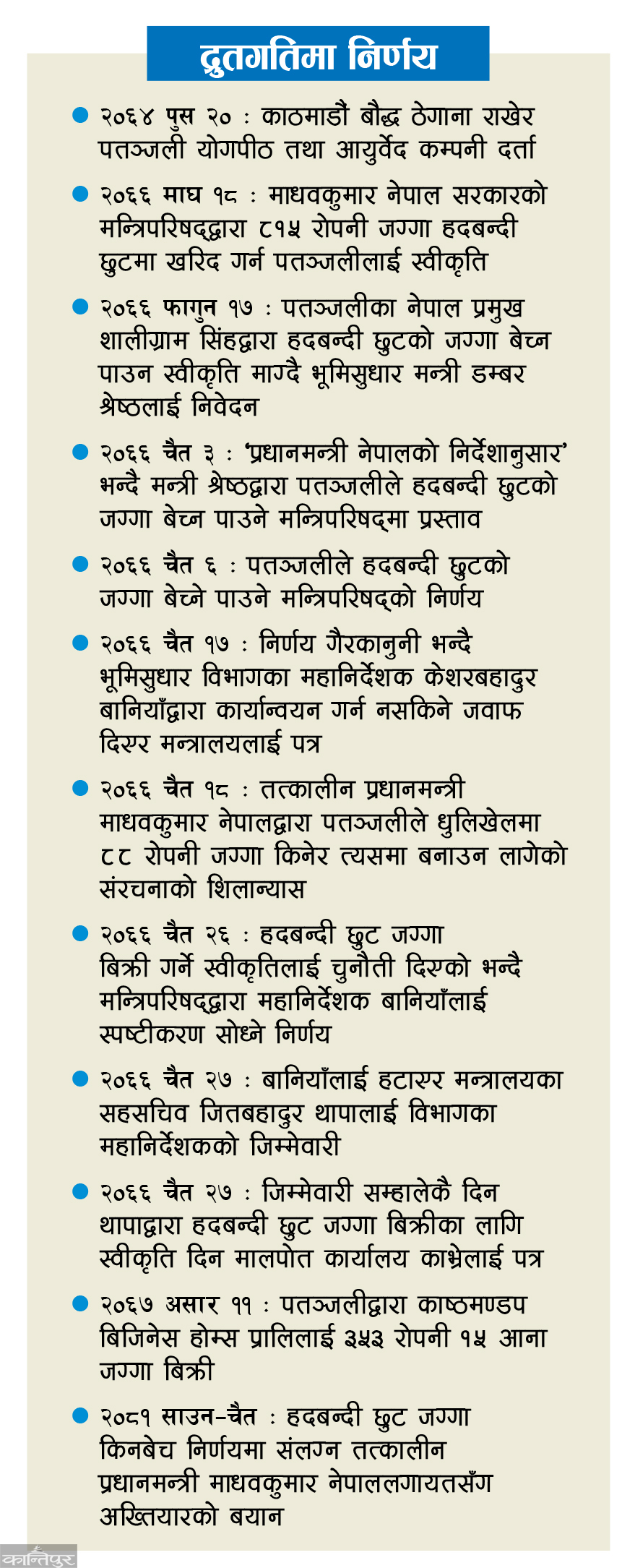
Fast decisions
- 2064 Jan 20 : Registration of Patanjali Yogpeeth and Ayurveda company with Kathmandu Buddhist address
- 2066 Jan 18 : Madhav Kumar's approval to Patanjali to purchase 815 plantations of land with limited exemption by the Cabinet of the Government of Nepal
- 2066 February 17 : Petition to Land Reforms Minister Dumbar Shrestha by Shaligram Singh, head of Patanjali Nepal, seeking approval to sell land with limited exemption
- 2066 Chait 3: "According to the directives of the Prime Minister of Nepal", Minister Shrestha proposed to the Cabinet that Patanjali be allowed to sell land with limited exemption
- 2066 Chait 6: The decision of the Council of Ministers to allow Patanjali to sell land with limited exemption
- 2066 Chait 17: Director General of Land Reforms Department Keshar Bahadur Baniyan gave a letter to the ministry saying that the decision was illegal
- 2066 Chait 18: The then Prime Minister Madhav Kumar Nepal laid the foundation stone of the structure that Patanjali is going to buy 88 ropani land in Dhulikhel
- 2066 Chait 26 : By the Council of Ministers for challenging the approval to sell restricted land Decision to seek explanation from Director General Bania
- 2066 Chait 27: By removing Bania, Jit Bahadur Thapa, the joint secretary of the ministry, and the responsibility of the director general of the department
- 2066 Chait 27: Thapa's letter to Land Port Office Kavre to give approval for the sale of demarcated land on the day he took charge
- 2067 June 11: Patanjali to Kasthamandap Business Homes Pvt. Ltd. 353 Ropani 15 Anna land sale
- 2081 July-April : Delimitation exemption land Statement of the authority with the then Prime Minister Madhav Kumar Nepal and others involved in the purchase decision