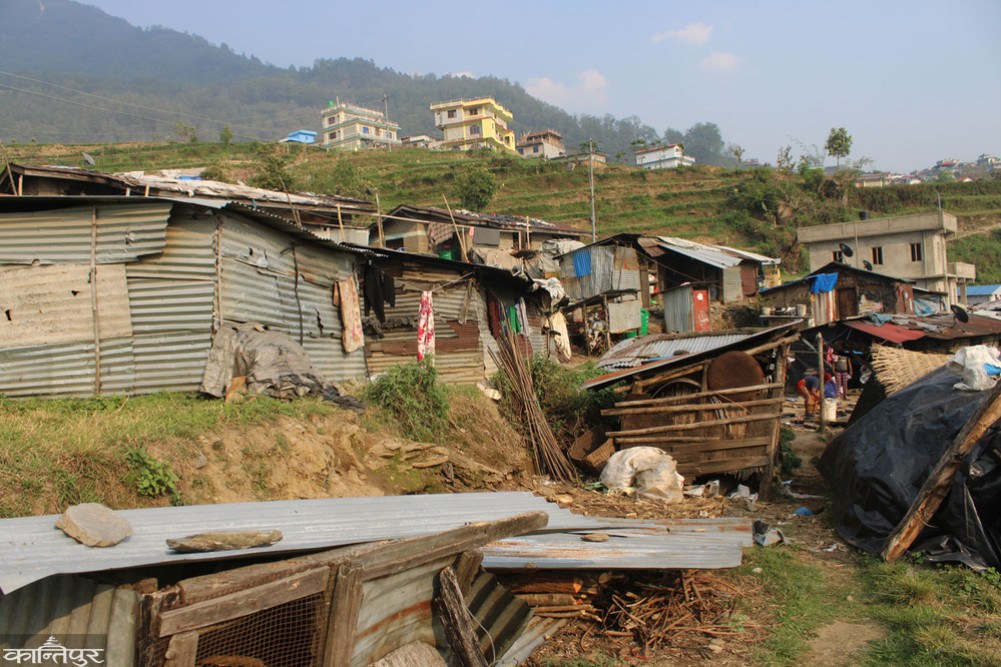
In Barpak, where there are about 1,400 households, the problem of 24 houses of the Dalit community is getting complicated
We use Google Cloud Translation Services. Google requires we provide the following disclaimer relating to use of this service:
This service may contain translations powered by Google. Google disclaims all warranties related to the translations, expressed or implied, including any warranties of accuracy, reliability, and any implied warranties of merchantability, fitness for a particular purpose, and noninfringement.
Even Tripal, which was found in relief covered with rusted tin roofs, has aged 10 years. The same is true of blowing off roofs in Baisakh winds. With her one-year-old granddaughter in her arms, 70-year-old Kamala Kami stays awake all night under the shelter of the poles placed on the roof.
Kamala spent 10 years in a house with a dilapidated roof and iron fence. She says, "It was not even found in old age, during the wind and rains, it shivers all night and shines brightly."
In Barpak, which is the epicenter of the 2072 Baisakh 12 earthquake, wealthy families have built houses at their own expense. But 19 poor families of the Dalit community are spending day and night in dilapidated houses even 10 years after the earthquake.
The health of senior citizens and children is sometimes seen as a problem due to the stay of Tahoro. Locals living in Tahro are changing the roof tripal and zinc fixing every year, hoping to build a new house in a safe place.
"This cold makes us very sick, tin dew falls on the bed during winter, we cannot handle rain water as it is made of zinc," Kamala said, "At this time, we have to stay inside the roof, eat food!, stay in the dryer." "There is no way for us to earn, we have to take care of the moneylender's farm," she said. We are living on government land, when will you move out of here? He has to live with pain.'
Poornima Sunar of Barpak Dalit settlement has replaced her roof four times in the 10 years since the earthquake. He is saddened by the hail making a hole in the zinc. "We have a family of 10 people living in the same tahora, because of lack of land, we couldn't separate ourselves from our in-laws," she said. Experts have already said that the house above is unfit to live in, and that the land is not safe either.
The plan of building a new house was left incomplete when the Dalit slum residents at Barpak entrance had a disagreement. After the earthquake destroyed the houses and tore the roofs in the settlement, they left Thatathal and are living on the government land in the name of Agriculture, Watershed, Animal Office at Barpak entrance. The then National Reconstruction Authority prepared to build a 'Earthquake Memorial Living Museum' on the seven ropani ruins of the Dalit settlement.
The authority also withdrew from the plan to build a museum due to differences of opinion among the locals. Some of the locals refused to leave that area, while others stayed in the public land, refusing to return to the ruined land. Those living on public land claim that the old settlement is geographically unfit to live in.
The local Suk Bahadur Wik says that since the government has already decided to give the public land by mortgage, it should be implemented accordingly. The cabinet meeting on 9th July 1980 gave consent to grant admission in exchange of 6 ropani 10 annas 3 paisa land of former Barpak gauis. It was the decision of the Council of Ministers to acquire the land of 15 rich people in the name of Earthquake Memorial Park Gorkha.
In this regard, the locals have given their consent to the land that will be acquired in the name of Earthquake Memorial Park. "The demand is that the decision of the Council of Ministers should be implemented, we cannot return to the above settlements, we will not back down from our stand to give land to the place where we are living as squatters," Suk Bahadur said.
As the settlement problem is getting complicated, the residents of the community are divided into two parties. Suk Bahadur, who was adamant about getting government land, was close to the Maoists until 2074. After getting a ticket from the Maoists for the post of municipal chief, he became angry and joined the Congress.
He made most of the locals who were living on government land join the Congress. The locals living in the former settlement are from the Maoists. The settlement problem has also turned into a political revenge when local people are divided.
However, the locals living in the old place have objected to the decision of the Council of Ministers. With the discussion of building a museum, half of the families have handed over the red parts of the ruined land to the authority. The victims here, who are in the list of beneficiaries of earthquake victims, have also received Rs 50,000 as the first installment.
Even in the year 2056, after the settlement was at risk of landslides, the locals left the area for a few months. After the landslide of 056 and the earthquake of 072, some locals have been making a collective demand to build a house on the government land they are currently living in, saying that the settlement is unfit to live in.
In Barpak, where there are about 1400 households, the problem of 24 houses of Dalit community is getting complicated. 5 out of 24 families have built their houses in Garigaon, the old settlement. Krishna Bahadur Sunar, who has built a house and lives in Garigaon slums, said that he could not leave Tatathal under any circumstances. "We have said hundreds of times that we will not leave the old settlement under any circumstances," he said. "The study of the geologist has said that the settlement in Garigaon is unfit to live in, it has no future," he said. The process has been stopped after a dispute was seen between them.'
Bishnu Bhatt, Chairman of Barpak Sulikot Rural Municipality, did not want to respond to this issue. On Baisakh 12, the 7.6 magnitude earthquake that passed through the epicenter of Barpak killed 72 people in Barpak alone. Most of the 1,400 houses that were damaged in Barpak alone have been rebuilt.