In the report prepared by the sub-committee under the Public Accounts Committee of the Parliament, the names and responsibilities of the high-level officials who made policy decisions regarding the construction of the airport, the contract process and the increase in costs were not mentioned.
We use Google Cloud Translation Services. Google requires we provide the following disclaimer relating to use of this service:
This service may contain translations powered by Google. Google disclaims all warranties related to the translations, expressed or implied, including any warranties of accuracy, reliability, and any implied warranties of merchantability, fitness for a particular purpose, and noninfringement.
A sub-committee under the Public Accounts Committee of the Parliament has prepared a report that there is at least 10 billion rupees of corruption in the Pokhara Regional International Airport. But in the report, on the one hand, the names and responsibilities of the high-level officials who make policy decisions regarding the construction of the airport, the contract process and the increase in costs have not been specified, and on the other hand, the MPs of the UML, the party leading the government in the sub-committee, have not signed it.
Cost Expenditure Fluctuations
- May 2067: Decision to build the airport, estimated cost of 175 million dollars including VAT (Prime Minister Madhav Kumar Nepal, Finance Minister Surendra Pandey and Tourism Minister Saratsingh Bhandari)
– 2067 Oct 6 : In EPC model
Decision to compete among Chinese contractors to build
-2068 November 6: Contract process under EPC process started (Prime Minister Baburam Bhattarai, Finance Minister Varshman Pun)
-2068 March 26: Call for tender, only 3 companies applied out of four participating companies, CAMC (305 million US dollars), the lowest bidder (US$ 305 million), prepare CAMC to reduce costs by negotiating with the authority
-2069 July: EPC bill not off CAMC's proposal to build in quantities (BOQ) model
- 2070 August: The committee's recommendation to build an EPC framework project at a cost of US$ 264 million (excluding VAT) through the meeting of the authority's board of directors led by Ramkumar Shrestha, the minister of civil aviation in the government led by Khilraj Regmi. Cabinet decision (Chairman of the Cabinet Khilraj Regmi, Civil Aviation Minister Ram Kumar Shrestha)
- 2071 June 8: CAMCSAG 'Commercial Contract' decision (Prime Minister Sushil Koirala, Civil Aviation Minister Bhim Acharya), Professor of Engineering Studies Institute Pulchok to do 'Total Project Cost Inflation Analysis'. A three-member task force was formed under the coordination of engineer Ravindra Shrestha, the task force estimated the cost of 224 million US dollars excluding VAT for the construction of Pokhara airport. Agreement on amendment of concessional loan agreement (Prime Minister Pushpa Kamal Dahal, Minister of Finance Krishna Bahadur Mahara and Minister of Civil Aviation Jitendra Narayan Dev)
- 2074 Chait 9: Amendment of concessional loan agreement (Prime Minister KP Sharma Oli, Minister of Finance Yuvraj Khatiwada, Minister of Civil Aviation Rabindra Adhikari)
- 2079 January 17: Construction of Pokhara Airport completed
In the 11-member sub-committee, only 10 people remain immediately and the report signed by only seven people is yet to reach the audit committee. In the report of the sub-committee, coordinator and RP MP Rajendra
Along with Lyngden, Congress's Arjun Narasimha KC, Deepak Giri and Ramakrishna Yadav, Maoists' Janardhan Sharma and Amanlal Modi and United Samajwadi Party's Prem Elle have signed. Devprasad Timalsena of Congress and Gokul Baskota and Tara Lama Tamang of UML have not signed.
The 36-page report concluded that there were irregularities and corruption in the construction of Pokhara Airport. It has been recommended to suspend and take action against 8 technicians and employees, including the then project chief and current director general of the Civil Aviation Authority, Pradeep Adhikari.
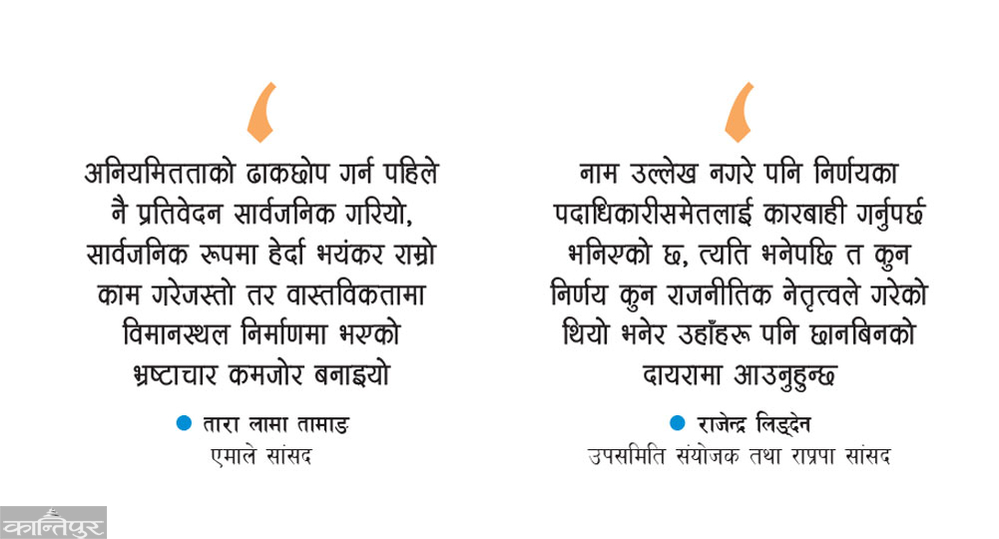
The MPs of UML are dissatisfied that the report was made public without the signatures of all the MPs and that they tried to make a political agenda without holding a meeting of all the members before reaching the conclusion. UML MP Tamang objected, "The MPs had yet to sign." If they brought it, everyone would have signed it or they would have signed it with their opinion, they would have rewritten it and given the report and they would have signed it. Why was the report brought out without maturity?'
Congress MP Giri has also criticized the behavior shown by coordinator Lingden while finalizing the report. The coordinator suddenly brought the report. Let's hold a meeting beforehand. "The meeting was held when we were not there," he said. However, he has already signed the report saying that those who commit irregularities and corruption in the construction of Pokhara Airport will not be spared.
UML MP Tamang suspects coordinator Lingden. It was already made public to cover up the irregularity of Pokhara airport. Publicly, it looks like doing a great job, but in reality, the corruption in the construction of the airport has been weakened," he said.
subcommittee coordinator Lingden is prepared to submit the report to the full committee even if the UML parliamentarians do not sign it. "No matter how many cases of corruption there are, it is only the employees below who do not involve the original leadership. But in some of our files, only the employee at the bottom is correcting and only he is visible, so only the employee appears in the beginning. But, will those employees carry corruption alone or will they also show their boss or commander? It depends on that.'
Lingden says that the involvement of the political leadership has not been confirmed, 'Even though the report given by us has not been mentioned by name, it has been said that action should be taken against the officials who made such and such decisions. After that, even if they are not named, they will also come under investigation to see which decision was made by which political leadership. It is not sure when the report of the
sub-committee will be presented to the committee. Chairman of the Audit Committee Rishikesh Pokharel said that the sub-committee is expected to submit its report within a few days. He will submit the report within a day or two. I didn't ask you to explain it, but you will explain it soon," he said.
Committee chairman Pokharel said that the report of the sub-committee is expected to come after completing parliamentary rules and procedures. The full meeting of the committee discusses the agenda made after the study. It may be less or more than what the sub-committee brought in the report from the meeting, he said. As there is a dispute among the sub-committee members on the draft of the
report, the question has been raised whether the involvement of the main decision-maker political leadership will be investigated and action taken or not. After a process of about 13 years, the airport was inaugurated two years ago, although regular international flights have not been carried out.
Although there has been a debate since the Panchayat period to build a regional level international airport in Pokhara, the process was started in May 2067 by the government led by Madhav Kumar Nepal. A meeting of Tourism Minister Sharatsingh Bhandari, Energy Minister Prakasharan Mahat and secretaries under the chairmanship of then Finance Minister Surendra Pandey of the Nepal-led government decided to proceed with the construction of the airport as a 'turn key' project through open competition. In a 'turn key' project, the investor (donor) hands over the preparation structure (key) from the feasibility study of the project to the contract itself.
The same meeting also decided to select a Chinese contractor for the construction of the airport. On 27th June 2067, the government prepared a tender document for the construction of the airport with a cost estimate of 175 million US dollars including VAT.
Following this decision, on October 6, 2067, the Board of Directors meeting of the Civil Aviation Authority decided to compete among Chinese contractors for the construction of the airport with a cost estimate of 175 million dollars. It was estimated that the cost would be $145 million for construction and $30 million for the purchase of approximately 550 ropani of additional land. That decision was made in a meeting chaired by Bhandari, the Minister of Civil Aviation of the Nepal-led Council of Ministers and Chairman of the Authority's Board of Directors.
Pokhara Airport was prepared and sent to the Ministry of Finance on October 18, 2067 to build it in Engineering Procurement Construction (EPC) format. In the EPC framework, a single company designs the project (engineering), procures the materials required for construction (procurement) and completes the construction of the project. In EPC, the cost of the project is estimated in advance and the construction has to be completed accordingly.
But the Nepal-led government collapsed without proceeding further, then when Jhalnath Khanal and Baburam Bhattarai were the prime ministers, representatives of the Chinese Exim Bank came to Pokhara and conducted an on-site inspection. On November 6, 2068, the decision of Varshman Pun, the Finance Minister of the Bhattarai-led government, decided to proceed with the process of selecting the contractor company under the EPC process. After the consent of Artha, the tender notice was published on 26 Jan 2068. Out of which the authority selected 4 companies, only 3 companies submitted tenders.
China CAMC, the company with the lowest cost, offered 305.123 million US dollars. Meanwhile, the government had set a cost of 145 million dollars for the construction apart from the land. Thus, CAMC sent a letter that it was ready to reduce the estimated cost and that it was ready to negotiate for that, when the contract process was confused due to the difference between sky and land even in the cost estimate and the minimum proposal.
In a letter sent in July 2069, CAMC had committed to do the cost estimate set by the Airport Construction Authority. However, in the construction framework, it is proposed to have Bill of Quantities (BOQ) instead of EPC. In the BOQ format, the cost should be determined based on the amount of construction materials, manpower wages and other expenses.
EPC or BOQ? The matter of which structure to build is a case before the Commission for Investigation of Abuse of Authority. However, as the process was prolonged due to complaints filed with the authority, the government led by Bhattarai collapsed along with the first Constituent Assembly. Political parties made the then Chief Justice Khilraj Regmi the Chairman of the Council of Ministers in order to break the political deadlock and hold the second election of the Constituent Assembly.
The meeting of the Authority's Board of Directors, led by Civil Aviation Minister Ram Kumar Shrestha of Regmi's government, formed a committee under the coordination of Supreme Court's former registrar Ramakrishna Timalsena to determine the cost of Pokhara Airport.
Chairman of the Council of Ministers Regmi is interested in the formation of a committee in the coordinator of Timalsena, who has no experience and qualifications related to the airport. Airport planning expert Purushottam Dangol and airport equipment expert and former director of the authority Vinodhananda Chaudhary were members of the said committee.
Timalsena has written in his book 'Adalat Bhirt, Adalat Bahir' that he succeeded in solving the Pokhara airport construction dispute. The proposed cost of the airport was also controversial. We suggested to determine the new cost based on the price increase mentioned in Nepal Rastra Bank's price index, instead of the construction discussion. That cost was not even what the Chinese company asked for, not even what was proposed before," he wrote, "The Public Procurement Act of Nepal is not so much attracted to that model. It was our suggestion that the bilateral process can be increased without the provisions of the Act since the government will do the 'negotiation'. Since China said it would be built, all the responsibilities should have been given to him.
Timalsena wrote that Pokhara International Airport was built based on the report prepared by his leadership. The same report that we submitted became the final one for the construction of the airport. The interim election cabinet led by Khilraj Regmi decided to build the airport at the cost price quoted by us," Timalsena wrote. "Not only was there a dispute in the construction process before our task force was formed, there was also a debate on whether an international airport was necessary or not. Some people were arguing that there is no need in Pokhara as Gautam Budh International Airport construction process has started in Bhairahawa. Apart from this, geopolitical interests were also connected. There was also international pressure that China should not take part in the construction of the airport.'
The committee chaired by Timalsena recommended, 'It is appropriate to finalize the contract process to operate the project based on the EPC framework while keeping the total cost of the project at 264 million US dollars (excluding VAT).' The Council of Ministers said in the decision, 'The total cost of the construction of the project will be within the limit of the cost approved by the Civil Aviation Authority and the size, number, quality and design will be approved by the Nepal Civil Aviation Authority and the agreement will be given in principle to finalize the contract process in consultation with the donor.' But according to this report, the Regmi-led government also decides to proceed with the construction work.
The Lingden-led sub-committee formed by the Accounts Committee to study Pokhara International Airport has questioned the same decision taken by the Regmi government. "Ignoring the correspondence to advance the contract process in the EPC model and also ignoring the reference that the authority has advanced the contract process in the EPC model accordingly, the consultant group with former registrar Ramakrishna Timalsena as the coordinator stated that the authority prepared the cost estimate from the BOQ model without any factual evidence to prepare a
policy basis to conclude the contract process through negotiation by increasing the cost price by a large figure, it is unfair and unfair for the government formed for the purpose of the Constituent Assembly election to agree to this kind of policy decision. is subject to action. This decision seems to be motivated by wrong intentions and intentions as well as corruption," the report prepared by the Accounts Sub-Committee states.
The authority opened the way for the contract after keeping the complaint that there were irregularities in the contract process of Pokhara airport. But in the meantime, Lokman Singh Karki had come to the authority as the chief commissioner. Similarly, the officials of the Ministry of Tourism have their opinion on the question raised about the agreement made through negotiation without competition under the Public Procurement Act.
"Regardless of what is written elsewhere in Section 67 (1) of the Public Procurement Act, as it is written that according to the agreement between the government of Nepal and the donor organization, if the purchase is made in accordance with the procurement guidelines (procurement guidelines) of that party, the procurement process does not have to be adopted according to this act, so the cost has been determined by negotiation according to the guidelines of the donor country China." is.
On the other hand, after the second election of the Constituent Assembly, Bhim Acharya, Civil Aviation Minister of the Sushil Koirala-led government, decided to enter into a contract with CAMC on 8th May, 2071. But after the dispute about the cost increase, in August 2071, when the loan agreement was being processed at the Ministry of Finance, the Secretary of Finance, the Secretary of the Ministry of Civil Aviation, the officials of both ministries and authorities sat down to analyze the cost of the project (Total Project Cost Inflation Analysis) due to the price increase. A three-member working group was formed under the coordination of Engineer Ravindra Shrestha.
The task force estimated the cost of construction of Pokhara Airport at 223.67 million US dollars excluding VAT. In this way, Prof. Dr. Timalsena's committee recommended 40 million dollars less cost. It was Shrestha's recommendation.
This dispute could not be resolved. However, when KP Sharma Oli, who became the Prime Minister after the promulgation of the constitution, went on a visit to China, an economic and technical cooperation agreement was signed between China and the Nepalese government on 8th Chait, 2072.
An agreement was reached with China's Exim Bank to take a loan of 1338.74 million Chinese Yuan to build Pokhara Airport. Finance Minister Bishnu Paudel and Civil Aviation Minister Anand Pokharel were present at the time of this agreement. In this process, the cost of Pokhara airport is fixed at 215 US dollars. Thus, the sub-committee concluded that the cost was increased to 145 million dollars (14 billion 59 million rupees according to the exchange rate of 2014) and 70 million dollars (6 billion 56 million rupees) was corruption.
Similarly, the sub-committee raised questions about the irregularity of 2 billion 22 million by making a new agreement to give tax exemptions contrary to the original agreement. According to officials of the Ministry of Finance, the sub-committee misinterpreted the issue of VAT exemption. "There is a practice of making policy decisions that no tax is charged when spending on foreign aid projects or purchasing or importing goods, and there is a legal system in Nepal as well. It is strange that the parliamentary committee does not study this matter," an official told Kantipur. According to the
act, the list of goods required for the project is called 'master list' and such a list prepared by the project is decided and sent to the Ministry of Finance, the Ministry of Finance also approves the basis of the bilateral agreement and according to the Economic Act and after sending it to the customs, the tax exemption is calculated and recorded and imported. "If the process of making the master list is considered corruption, the law in this country will have no meaning," he said.
4.435 thousand dollars more paid to fill the runway, taxi-way, apron, dam, drain has also been questioned. The sub-committee also has questions about the fact that an additional 320 million was paid for the work to be done by the same company that got the contract to cut the dikes that obstructed the landing of the ship, no environmental assessment was done before the construction of the airport and the cutting of dikes, and the additional payment of 742,000 dollars was made to the contractor company to install AC at the airport. Thus, the report of the sub-committee mentioned that there was corruption of 10 billion at a total cost of 14.59 billion. However, the name and accountability of the official who made the policy decision at that time has not been specified.
According to the agreement, the construction started on 27th December 2073, but the airport was inaugurated on 17th December 2079. Land acquisition for the construction of Pokhara Regional International Airport was started in 2032. At that time 3 thousand 106 ropani land was acquired by paying compensation and later the airport was built on 3 thousand 899 ropani by adding land.

