In the last eight months, 317,000 new and 182,000 new work permits have been obtained for foreign employment
We use Google Cloud Translation Services. Google requires we provide the following disclaimer relating to use of this service:
This service may contain translations powered by Google. Google disclaims all warranties related to the translations, expressed or implied, including any warranties of accuracy, reliability, and any implied warranties of merchantability, fitness for a particular purpose, and noninfringement.
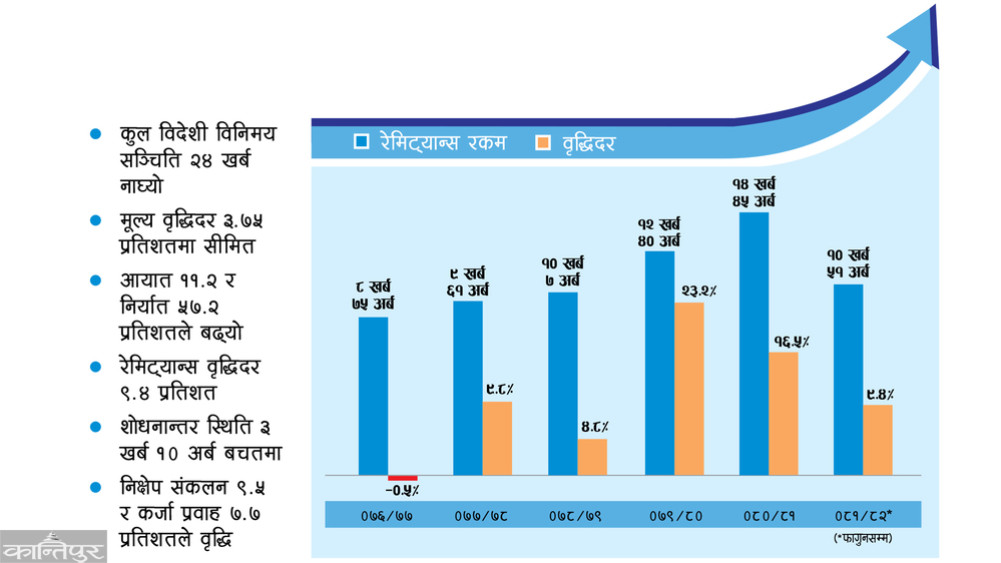
The money remittances sent by Nepalis abroad for employment has again set a record. In eight months of the current financial year, 10 trillion 51 billion 77 million rupees have entered the country through remittances. This is an increase of 9.4 percent compared to the same period last financial year.
According to the monthly report of Rashtra Bank, only 1 trillion 51 billion 20 crores of remittances have come in last February. Comparing monthly, the remittances received by Nepal in February is the highest so far. Previously, 1 trillion 44 billion remittances were received last October. Remittances increased by 18.3 percent in February last year.
In the last eight months, the number of Nepalis who took the final work permit (institutional and individual-new) for foreign employment has also increased, which has helped in the increase of remittances. In the last eight months, 3 lakh 17 thousand 68 have taken the final labor approval (institutional and individual-new) for foreign employment. In the same period, 217 thousand 403 people got work permit again, according to government data. During the same period of last year, 285 thousand 352 final labor approvals (institutional and individual-new) and 182 thousand 783 re-take labor approvals. Even if we look at the data of a decade past the
, it seems that remittances have increased continuously every year. According to which, in the financial year 071/72, 6.5 trillion remittances have reached 9 trillion 71 billion rupees in 077/78. According to Rashtra Bank's data, remittances reached 10 trillion 7 billion rupees in the financial year 2078/79 and reached 14 trillion 45 billion rupees in 080/81.
Although there is no expected improvement in the main sources of foreign exchange earnings including exports, tourism, foreign investment, the external sector of the overall economy is becoming stronger as remittances continue to increase. The Economic and Financial Report of last February published by the National Bank on Wednesday showed that external indicators including foreign exchange reserves, current account balance, etc. are getting stronger. But economists say that we should not be happy just because remittances have increased.
Economist and former executive director of Rashtra Bank Nar Bahadur Thapa says that no effort is being made to make the economy sustainable and the government is complacent because remittances have increased. The external sector of the economy has become stronger. It's not because of us. Remittances have increased because the foreign economy is good. But we are saying that remittances have increased because of us," he said. "Other than remittances, no other indicators of the economy are good. Because other countries have done well, Nepalis who have not found employment in Nepal have sent a lot of money abroad. We are happy that we have been able to increase remittances.'
As other countries are sensitive about how to make their economy sustainable, he says that even if the remittances coming into Nepal do not decrease immediately, it is not good to depend on it in the long run. With the increase in remittances, the foreign exchange reserves have increased by 3 trillion 68 billion rupees in the eight months of the current financial year. This is an increase of 18 percent compared to last June. It is mentioned in the monthly report of Rashtra Bank that the total foreign exchange reserves exceeded 24 trillion 9 billion rupees till last February.
At the end of June 2081, the total foreign exchange reserves were 20 trillion 41 billion 10 million rupees. "Such reserves in US dollars were 15 billion 27 billion at the end of June 2081, and increased by 13.1 percent to 17 billion 27 billion at the end of February," the report of the National Bank said.
National Bank claims that the foreign exchange reserves held by the banking sector will be sufficient to support 17.2 months of goods imports and 14.3 months of goods and services imports, based on the import of up to eight months of the current financial year. At the end of February 2081, the ratios of foreign exchange reserves to gross domestic product, total imports and detailed money supply were 42.2, 119.4 and 33.0 percent, respectively, according to the Rastra Bank. As of last February, the current account is 1 trillion 80 billion and the current account (balance of payments) is in surplus by 3 trillion 10 billion. During the same period of the last financial year, the current account was in surplus by 1 trillion 67 billion and the current account balance was 3 trillion 27 billion.
Despite high remittance inflows and record foreign exchange reserves, the economy as a whole is not doing well. Expected improvement in capital expenditure, revenue collection and foreign aid and grant collection has not been achieved. As of Tuesday, capital expenditure of Rs 97.85 billion has been incurred. This is only 27.77 percent of the target. During the same period, 7 trillion 91 billion 53 crores of revenue has been collected. This is only 55.77 percent of the annual target. Economists say that the economy has not become sustainable due to the failure of the expected improvement in government finances.
Thapa says that Nepal's economy has not become sustainable because the government is not spending. The government has kept nearly four billion rupees in the deposit of Rashtra Bank. The total domestic credit growth rate is only 3.9 percent till last February. In the same period of last year, this growth rate was 8 and a half percent," he said, "because the government did not spend, the balance has accumulated in the treasury. We believe that private sector credit increased by 7.7 percent. But the growth rate of aggregate internal credit expansion is critical. This means that the citizens do not have money in their hands.
The government is withdrawing money through internal debt and revenue collection. But not spent. Banks have not been able to give loans, they have kept them in Rashtra Bank saying that there is more liquidity," Thapa added, "Therefore, there is no indication that the economy will run immediately. Neither from the government nor from the private sector. Thapa said that this will be confirmed by the reduction of the total internal debt. Now the external indicators are consistently strong. At such a time, the government should send more and more money into the hands of the citizens. But the government is sitting on the bank, he said, adding that the private sector should increase spending and investment. The government should spend. And only money comes into the hands of citizens.'
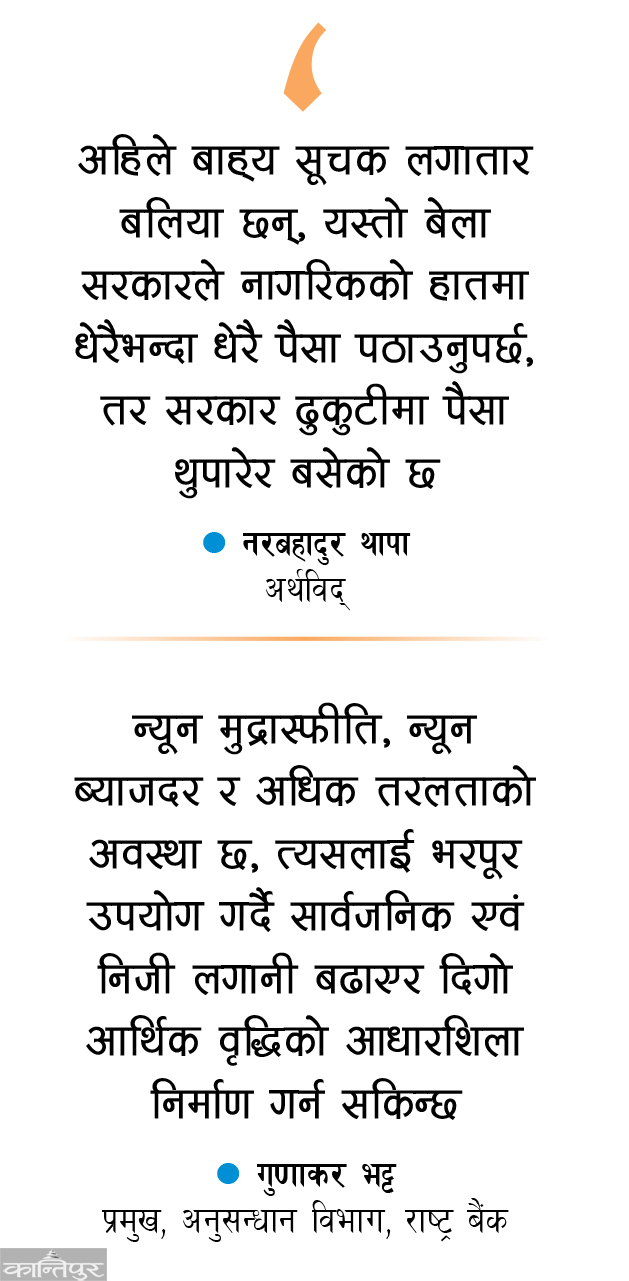
As the external sector of the economy is in a strong state, there are plenty of opportunities to increase domestic production, said Gunakar Bhatt, head of research department of Rashtra Bank. "There is a situation of low inflation, low interest rates and more liquidity," he said.
Nepal Rastra Bank said that the average price growth rate was 3.75 percent last February. In the same month of last year, the price growth rate was 4.82 percent.
In that period, the price growth rate of food and beverages group is 3.34 percent and that of non-food and services group is 3.97 percent. Rashtra Bank says that the price growth rate of these groups was 5.95 and 4.07 percent respectively during the same period last year.
In February last year, the annual point consumer price increase of ghee and oil sub-group under the food and beverage group increased by 13.74 percent, pulses and pulses by 7.80 percent, fruits by 6.82 percent and non-alcoholic beverages by 5.15 percent. However, the annual point consumer price index of maramsala sub-group decreased by 5.17, vegetable by 1.24 and fish and meat by 0.74 percent, the report said.
Under the non-food and services group, the annual point consumer price index of miscellaneous goods and services subgroup has increased by 10.14, clothing and footwear by 7.01, alcoholic beverages by 6.07, furnishings and household appliances by 5.59 and transportation by 5.07 percent.