The tension between the top leaders questions the justification of the recommendation committee
We use Google Cloud Translation Services. Google requires we provide the following disclaimer relating to use of this service:
This service may contain translations powered by Google. Google disclaims all warranties related to the translations, expressed or implied, including any warranties of accuracy, reliability, and any implied warranties of merchantability, fitness for a particular purpose, and noninfringement.
Even though there has been a lot of discussion in the economic and political market regarding the selection of the governor of Nepal Rastra Bank, the meeting of the recommendation committee has not been held even once in two weeks. According to the National Bank Act, a new governor must be appointed one month before the post of governor becomes vacant. But the government, which is delaying the appointment of a new governor even after the tenure of Mahaprasad Adhikari ended on Sunday, has entrusted Deputy Governor Neelam Dhungana Timsina as the governor.
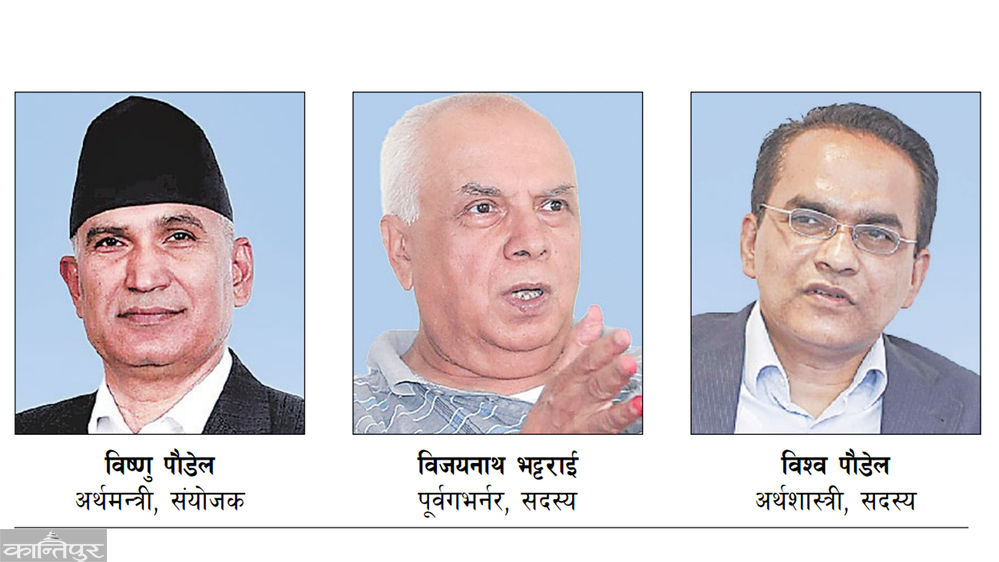
The Council of Ministers formed the Governor Recommendation Committee 16 days ago on 11 Chait under the coordination of Deputy Prime Minister and Finance Minister Bishnu Prasad Paudel. Former governor Vijayanath Bhattarai and economist Vishwa Poudel are members of the committee. It took 6 days to send the letter to the recommendation committee members. Despite receiving the letter on March 17, the meeting of the recommendation committee could not be held until Monday.
We have received the letter on Chait 17, since then the time was set twice to hold a meeting on one day, but it could not be held. Since then, there has not even been a meeting," said a member of the committee. "Discussions are going on between the top leaders of the ruling Congress-UML and it seems that the meeting of the committee has not been called because of disagreement, we are being tried to make a rubber stamp." "I have asked the top leadership, including the finance minister, to coordinate the high professional, monetary policy and finance policy and to appoint a person who can lead the financial sector as the governor," he said. Mahat says that it is natural for parties to claim important positions like the governor.
This is not the only time that the provision of the Act to appoint the governor one month before the vacancy has been violated. Previous governments also ignored the provisions of the Act. In the appointments made by the government, there are accusations of being dominated by business groups, having financial transactions, appointing their own people rather than the best.
Among the regulatory agencies in Nepal, the National Bank is relatively strong. The coordination between the Ministry of Finance, which formulates and implements the financial policy, and the National Bank, which formulates and implements the monetary policy, has always been questioned. On top of that, as the government is delaying the appointment of the governor, there is a suspicion that there will be some manipulation here as well, experts say. Former governor of Rashtra Bank Chiranjeevi Nepal says that the more the delay in the appointment of the governor, the more negative the impact on the economy. "Political parties considered Rashtra Bank as a normal company under the Ministry of Finance, they did not understand the role and sensitivity of Rashtra Bank," he said.
Even though the role of the governor is the most important in solving the problems of the economy, Nepal said that it is confirmed that the government is not sensitive to the appointment of the governor. "Nepal is on the gray list, the most important role of the governor is to get out of this situation," said Nepal, "the economy has not been made viable." Confidence in the private sector has been lost. It is difficult to solve these problems with a governor.' He suggested that the government should appoint a governor as soon as possible, being responsible for the state of the economy and the role of the National Bank.
Only 19 days after the end of the tenure of the former governor of Nepal, the then government appointed the outgoing governor officer.
Meanwhile, about three weeks ago, the Ministry of Finance also removed the age limit for officials and members of public bodies. While discussions are going on about the appointment of the Governor of Nepal Rastra Bank, the Ministry of Finance has removed the age limit for officials and members of public bodies. Along with this, it is suspected that the way has been opened so that people of the same age will be appointed to the governor and other positions.
The age limit has been removed through the 'Standards for Appointment and Nomination of Officials and Members of Public Bodies Affiliated to the Ministry of Finance 2073' (Second Amendment). According to the criteria, there are 15 institutions including the National Bank, the Securities Board, and the Insurance Authority as public bodies affiliated to the Ministry of Finance.
In the appointment and nomination criteria of officers and members of public bodies, there was a provision that the age of the executive head should be 35 years and the age of other officers and members should not exceed 65 years. Now the age limit has been removed by amendment.
According to the Ministry of Finance, the age limit has been removed for officials and members of public bodies in the revised standards. Since there is no age limit in the Act, the Ministry of Finance has accepted that it has been removed. "It was removed because it was said to go according to the provisions of the Act," said Shyam Prasad Bhandari, spokesperson of the Ministry of Finance, "The age limit was not removed targeting the new governor."
Some of the aspirants in the race for governor are over 65 years old. A former deputy governor said there is a strong suspicion that the age limit was removed to make it easier for some of them. "The fact that the criteria will be amended at the time of the appointment of the governor and that no provision other than the age limit will be amended means that they want to make a person who has reached the age of 65 as the governor," said a former deputy governor.
'The role of the Governor's Recommendation Committee formed under Section 15 of the Nepal National Bank Act 2058 seems to be important in this. Those who are controversial, represent interest groups, play games in institutional governance and have weak performance should be recommended to the entire responsible committee," said the officer. The Chairman of the National Bank Board of Directors is the Governor. The committee consists of two Deputy Governors, Finance Secretary and three persons appointed by the government. Below the Finance Secretary is the Governor, followed by the Deputy Governor and the lowest three expert members. This also means that the personality and ability of the governor should be higher than that of the finance secretary.
When the economy is unfavorable and Nepal is on FATF's 'gray-list', there is concern that the government will not be serious in selecting the governor. According to the National Bank Act, the governor must have a high moral character, have work experience in economics, monetary, banking, finance, commerce, management, public administration, statistics, mathematics or law and have a master's degree.
Kamu governor's responsibility to Neelam
Deputy Governor Neelam Dhungana Timsina has been given the responsibility of permanent governor. Deputy Prime Minister and Finance Minister Bishnu Prasad Paudel appointed Dhungana as the permanent governor on Monday. According to section 27 of the Nepal Rastra Bank Act 2058, the Ministry of Finance has stated that Timsina has been assigned the responsibility of permanent governor. Timsina is the Senior Deputy Governor of Rashtra Bank.

