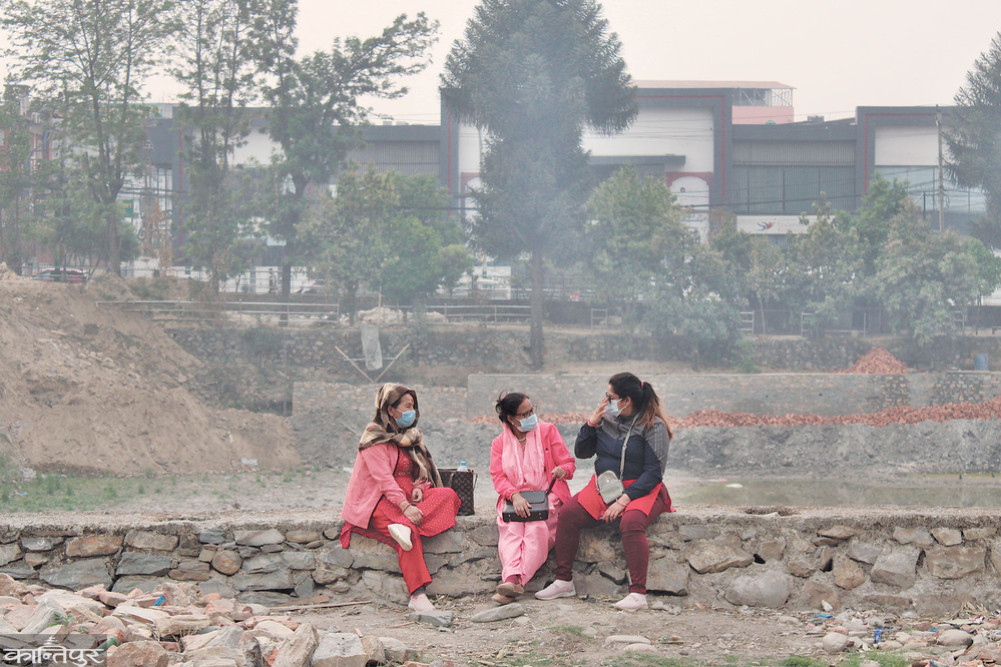
Children, elderly people with diabetes, pressure, kidney and heart disease are more prone to problems
We use Google Cloud Translation Services. Google requires we provide the following disclaimer relating to use of this service:
This service may contain translations powered by Google. Google disclaims all warranties related to the translations, expressed or implied, including any warranties of accuracy, reliability, and any implied warranties of merchantability, fitness for a particular purpose, and noninfringement.
The air in Kathmandu valley has become very polluted since last one week. With the increase in the amount of air pollution, the pressure of chest, eye, nose, ear and throat patients in the hospital has also increased by 50 percent, according to the related doctors.
For four days, air pollution in Kathmandu Valley is between 201 and 300 AQI (Air Quality Index). This is the 'very unhealthy' level of air pollution. The air quality of Kathmandu reached 300 AQI on Tuesday morning from 10:45 to 11:45.
301 and above are considered dangerous levels. On Wednesday, Kathmandu is on the first place in the list of the most polluted cities in the world. Kathmandu became the world's most polluted city when air pollution reached 287 AQI at 8 pm on Wednesday. Kathmandu's air quality reached 211 on Chait 17 (Sunday) and 232 AQI on Chait 18 (Monday).
Hams Hospital's chest specialist Dr. According to Raju Pangeni, due to pollution, the elderly, chronic patients with respiratory problems and children are now suffering from chest problems. The problem of wheezing is increasing especially in children, the elderly, and chronic diseases related to diabetes, pressure, kidneys, and heart. Pollution has caused pneumonia, difficulty breathing and asthma in patients whose ability to fight disease is low, he said, "It seems that the problem has increased in patients who come to our OPD, are admitted to the ward, and are in the ICU and ventilators because of air pollution."
Out of 20 ICU beds in Hams Hospital, 50 percent of patients have chest problems, he says. "Every day at least 15 to 20 people come with problems related to chest disease due to pollution," Dr. Pangeni said, 'There are patients who come with other problems. Some seem to be admitted with diabetes and then a chest infection. Some are admitted with symptoms of pneumonia.
Although there is no solid basis to measure whether air pollution caused the illness or not, he claims that now pollution is seen as the main factor along with viral influenza. We can't say why. But it can be claimed that air pollution has an effect on the patients who have come now," he said. Last year, after the end of winter, there were fewer asthma, heart and kidney patients during February and March.
But this year, due to increased pollution, infection in patients has increased and the pressure is also the same, he says. "During the winter season, cold, pneumonia and asthma problems were seen along with viral fever," he said. "Patients with colds, nasal congestion, sore throat, burning nose, dry nose, allergies, and sinus problems are increasing," nose, ear, and throat specialist Dr. Tulika Dubey said, "Air pollution is more likely to increase such an infection." According to her, 60-70 percent of patients out of 100 people are suffering from nose, ear and throat problems due to pollution. "Because the ears are connected to the nose, it seems that the problem of hearing loss and pain in the ears has increased now," she said.
Matrika Eye Center Ophthalmologist Dr. Shashwat Dhungel also claimed that 50 percent of the patients coming for treatment for the last one week have problems related to pollution. "Now the problem of red eyes and burning has increased. It seems that pollution has made it more difficult for those who have burning and tired eyes,'' he said, 'Now, eyes are getting tired very quickly, tears are flowing, they can't see due to dust, and headaches are happening. At this time, if the baby stays in the smoke and dust particles, it can cause infection by scratching the eyes. In complicated cases, eye sight can also go away.'
There are children and adults who come with this problem. To avoid these problems, he suggests to clean the eyes gently in the morning with clean water and apply eye drops. Now everyone works by sitting on the screen. Since we watch screens at work and at home from morning to evening, it becomes difficult for the eyes during pollution,” he said. During this time, he suggests to protect the eyes, live in a place with good ventilation, wear glasses when going out, avoid dust and smoke as much as possible, live in a house with good ventilation and an air purifier.
As the country's capital continues to be polluted, the government does not see any way to reduce it immediately. Deepak Kumar Kharal, secretary of the Ministry of Forests and Environment, said that by making a long-term plan, it can be reduced from next year. "Fires in forest areas, fires in food crops, some industries in the valley, brick kilns and transport areas, pollution has increased due to damaged roads," he said. This is a problem from the past. The wind is not blowing well and it is not raining. It increased the pollution even more. He said that the three governments of Nepal, India and Pakistan should work together to reduce air pollution. Kharal said that every year there is a problem of air pollution in South Asia, so the governments of the three countries should work together to think of a long-term solution.
After Kathmandu's air became continuously polluted, the Department of Environment released a notice on Wednesday and requested people to use mandatory masks when going out and not to go out when the pollution is high. The elderly, children, chronic patients and pregnant women have been informed to stay safe. Also, the department has mentioned in the notification not to do activities that increase pollution.