If the replacement bill is not approved by the President by 12 midnight on Monday, the law introduced through five ordinances will become inactive
We use Google Cloud Translation Services. Google requires we provide the following disclaimer relating to use of this service:
This service may contain translations powered by Google. Google disclaims all warranties related to the translations, expressed or implied, including any warranties of accuracy, reliability, and any implied warranties of merchantability, fitness for a particular purpose, and noninfringement.
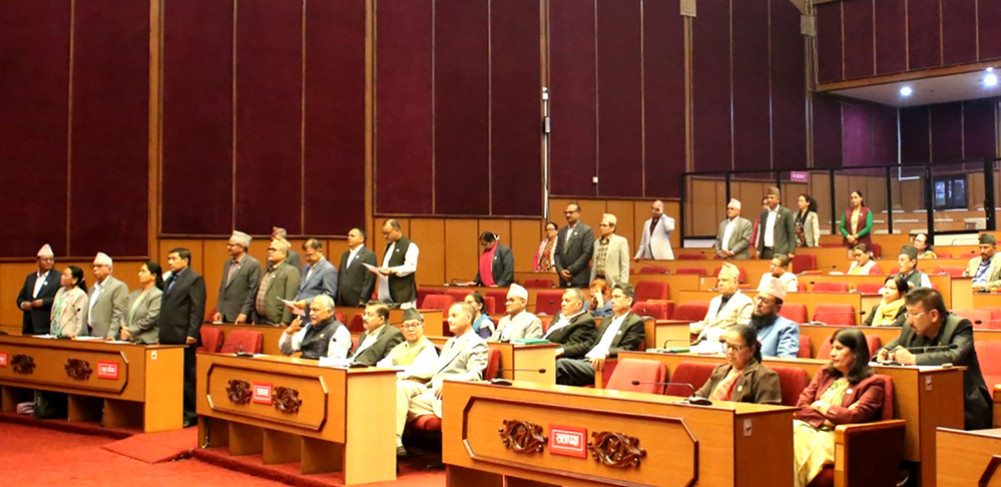
The law introduced by the government through five ordinances has increased the risk of becoming inactive from Monday. As the Ordinance Replacement Bill could not be passed due to obstruction by the opposition parties in the National Assembly, the law is in crisis.
The Ordinance Replacement Bill has to be approved by the President before 12:00 PM on Monday. There is a provision in the constitution that the replacement bill must be passed within 60 days of the beginning of the session of the federal parliament after the promulgation of the ordinance. The winter session of Parliament started from last January 18. If the bill is passed and ratified by the President by Monday, March 18, those laws will automatically become inactive.
The Bill to amend some Nepal Acts related to good governance promotion and public service delivery, the Bill to amend some Nepal Acts related to cooperatives, the Economic Procedure and Financial Responsibility (First Amendment) Bill, the Privatization (First Amendment) Bill and the Bill to amend some Nepal Acts related to the improvement of the economic and business environment and the promotion of investment have been passed by the House of Representatives and reached the National Assembly. There is still a stage to be discussed and presented for decision in the National Assembly with amendments.
Preparations were underway to discuss the amendments and clauses in these five ordinances and present them for decision. At the same time, after the government removed Kulman Ghising as the executive director of the Electricity Authority, the opposition has been blocking both houses of the Federal Parliament since March 13, demanding an answer from the Prime Minister.
Regarding the dismissal of Ghising, Prime Minister KP Sharma Oli has demanded an answer in the Parliament and the opposition parties have to accept some of the amendments they have put in the ordinance.
There is an allegation of the ruling party that the law is in crisis after Speaker Narayan Prasad Dahal took the stance of not holding the meeting of the National Assembly and not advancing the bill amidst the obstruction of the opposition. In the National Assembly, UML party leader Bhagwati Neupane said that there was a problem when Speaker Dahal refused to hold the meeting according to the rules. He said that although the prime minister was told to answer the issues raised by the opposition in the federal parliament, the meeting of the house was not postponed. "Prime Minister gave the information that the Prime Minister will address both Houses on Monday in the order of business," she said. Even though the Prime Minister was to address, the meeting was not held after a discussion between Chairman Dahal and Shrestha.
In the National Assembly, Maoist MP Maya Prasad Sharma said that the ruling party did not agree. "The problem will be solved after the prime minister answers, we said let's find a solution, but the ruling party did not want to talk." Physical Infrastructure Minister Devendra Dahal said that it is enough for the Prime Minister to speak in the House of Representatives, there is no point in addressing the National Assembly. The ruling party did more to hide the dispute than to resolve it," said Sharma. "We said that the Prime Minister should respond to the removal of Kulman and that the Finance Minister should be ready to accept some of the amendments put forward by the opposition in the Ordinance Replacement Bill and should be implemented. However, the ruling party was not serious.
Krishna Bahadur Rokaye, chief whip of the Congress in the National Assembly, said that there was a problem when the meeting was not conducted according to the constitution and regulations. "Parliament will run according to the constitution and regulations. We said that the Parliament should run according to the constitution and regulations in the meetings of the working order committee, the chairman, the ruling party and the opposition. When the government brought the bill, we said that the chairman would take it to the process, but it did not happen, Rokaye said, "If there is disagreement on some points of the bill, the opposition and ruling party MPs will make amendments. Whatever happens when they are presented for decision, that is the decision, but here the process was interrupted." The President said that he cannot advance the bill without political consensus. The regulation does not say that things that are not agreed cannot be carried forward. "The person who presides will take the process forward," she added, "even if there is no consensus, the president will conduct the meeting and whatever the majority does, that will be the decision."
Newpane also said that the speaker started seeking agreement between the government and the opposition on every matter that comes to the parliament, and why should the decision be made for the minority and the majority. The President of the National Assembly became the leader of the party. Therefore, the bill could not be carried forward. The intention of the president and the main opposition was raised after not moving forward in the process rather than fulfilling the demands of the Ordinance Replacement Bill. They agreed to fail the agenda brought by the government. The opposition has misused the fact that the president is in their favor. You are obstructing the making of the law.'
Rokaye also says that the support of the ruling party was not taken regarding the postponement of Sunday's meeting. He also said that if the government does not accept the amendment put on the bill by the opposition, then the meeting will not be allowed to proceed and it is not in accordance with the constitution for the chairman not to proceed with the process based on the same. "If the ordinance replacement bill is not passed, the president and the opposition should be responsible for it," said Rokay.
National Assembly Secretary Surendra Aryal said that according to the constitutional provisions, the Ordinance Replacement Bill should be approved by the President by 12 midnight on Monday. If passed by the National Assembly on Monday, it will be sent back to the House of Representatives. If there is an amendment, the House of Representatives should also pass it, otherwise the message should be verified and sent to the President's Office for verification," he said. He estimated that it would take at most 5 hours for the National Assembly to pass five ordinance replacement bills based on the amendments registered in the bills. He said that if all the ordinances are amended and those amendments are presented and discussed, it will take that time. He informed that if the MPs withdraw the amendment or do not propose it, it can be passed in a short time. After it is passed by the National Assembly, the House of Representatives should meet and proceed with the rest of the process.
The government brought 6 ordinances just before the start of the parliament session. Out of which, no proposal was made to accept the Land Ordinance in Parliament. Jaspa Nepal, which is the deciding factor in the National Assembly, advanced the ordinance and took the stand of not accepting other ordinances as well. The government advanced only five ordinances except the land ordinance.