The Election Commission has drafted a law to prevent party splits due to minister's greed, to make parties stronger and institutionalized.
We use Google Cloud Translation Services. Google requires we provide the following disclaimer relating to use of this service:
This service may contain translations powered by Google. Google disclaims all warranties related to the translations, expressed or implied, including any warranties of accuracy, reliability, and any implied warranties of merchantability, fitness for a particular purpose, and noninfringement.
The Election Commission has prepared a draft of the law that MPs can divide the party after reaching the number, but if they do so, their positions will be vacated. A provision has been proposed in the bill that even if an independently elected person joins a party, the position will become vacant.
In the draft of the 'Bill to amend the Political Parties Act, 2073' prepared by the commission, there is a provision that the party can be divided by reaching 40 percent in any one of the central committee and parliamentary parties. However, a provision has been proposed that if one forms a new party or joins another party, it will be deemed to have left the party. After the relevant parliamentary party gives the notice of defection to the Assembly Secretariat, the process of vacancy proceeds.
In Section 33 (2) of the Political Party Act, 2073, there is a provision that at least 40 percent of the members of the Central Committee and the Parliamentary Party of the Federal Parliament have formed a new party or joined another party, or a member of the Parliamentary Party is not considered to have left the party.
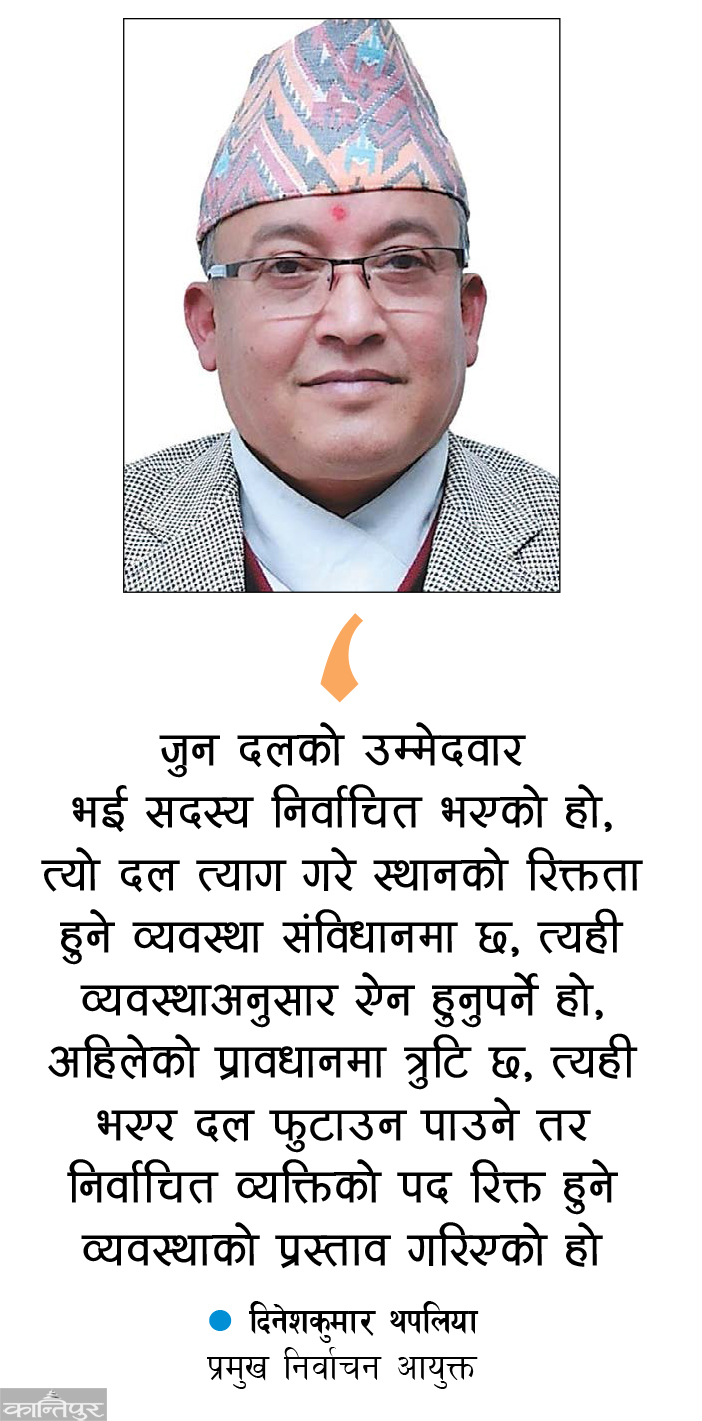
Chief Election Commissioner Dinesh Kumar Thapalia says that due to the increasing trend of splitting the party due to the greed for office, a new proposal has been made to strengthen the political party by controlling it. "There is a provision in the constitution that there will be a vacancy in the party which has been elected as a candidate and a member, if he leaves the party," he said.
'According to the provisions of the Constitution, there should be an Act. There is a flaw in the current provision. That's why a provision has been proposed to allow the party to break up, but the position of elected officials will be vacant," he said.
It is said that a person who is elected independently and not in the draft should not be a member of any party during the working period of the Assembly. A provision has been proposed that the position elected for the membership of a party shall automatically be deemed to be vacant. Section 29 of the existing Political Party Act provides that a person who is freely elected to the Federal Parliament or the Provincial Assembly, becomes a member of a party and automatically becomes a member of that party's parliamentary party. Chief Election Commissioner Thapalia said that there is a legal arrangement so that a person who has already won by voting on one symbol will not remain in office.
The Commission has proposed to cancel the current arrangement that allows two or more parties to participate in the election on a single election symbol. In the current law, there is a provision that one can take part in the election by taking a single election symbol. In a multi-party system, not individuals, but parties approach voters with their principles. Ideas compete in elections. Two or more parties went to the same symbol, whose principle will the voters understand?', Chief Election Commissioner Thapalia said, 'Parties that want to go to the election on the same symbol should unite.'
There is no clear provision in the existing Act. In the draft, it is said that 'if a member who has been elected as a candidate for a position at the local level on behalf of a party has left the party in accordance with this Act, the central committee of that party shall decide to expel him from the party and notify the relevant rural municipality or city executive.' It is mentioned in the draft that the position of the concerned member will be vacant after the executive or municipality posts the notice.
Chief Election Commissioner Thapalia said that the new proposal has been brought with the recognition that political parties should be strong in a multi-party system. The party should be made strong, not weak. "Provisions to strengthen the party have been proposed at various places," he said, "Provisions have also been proposed to institutionalize internal democracy in the party, make operations transparent, and maintain financial transparency and good governance."
There is also a provision in the draft that the government of Nepal can provide the money needed for the election expenses and party operations as a subsidy from the state fund. According to the Chief Election Commissioner, this proposal was made to maintain financial transparency in political parties. Questions have always been raised about the financial resources of the party. Political parties have also been discredited by collecting arbitrary donations.
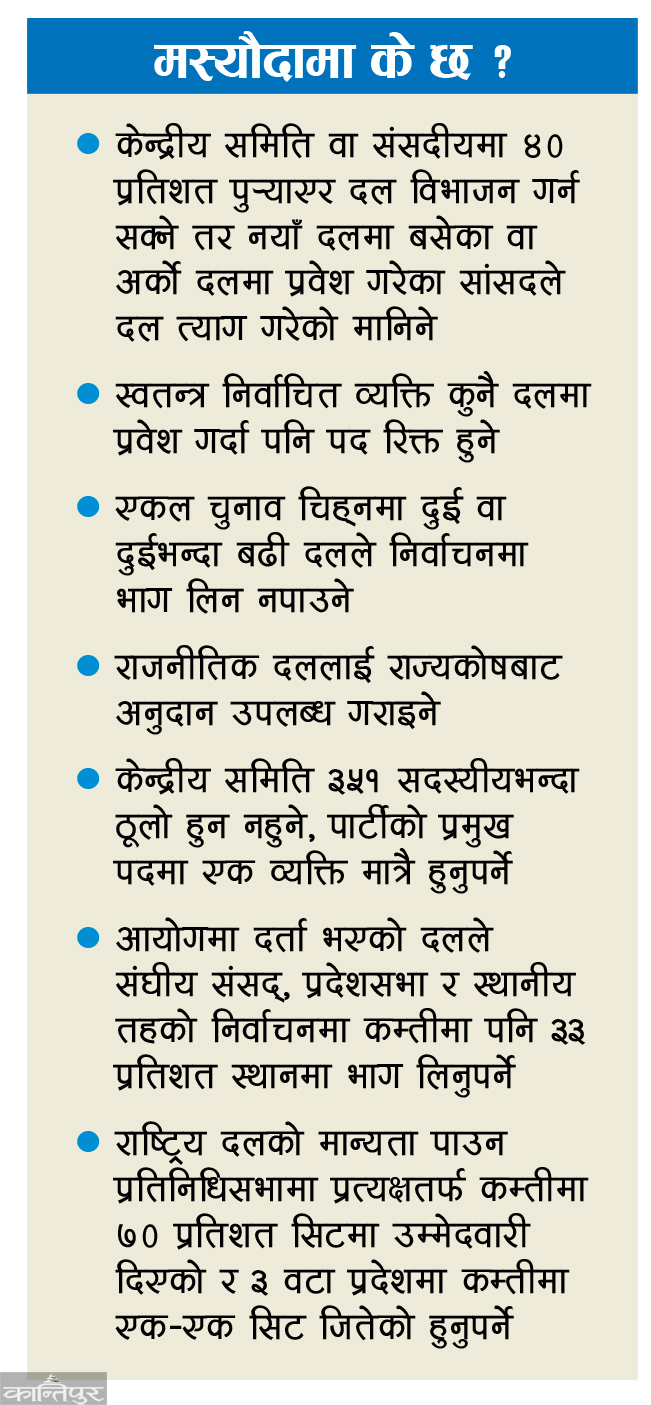
In the current provision that 500 voters must have obtained membership at the time of registration of a new political party, an amendment has been proposed that one-third of those 500 members should be women and inclusive representation of other groups. It is said that there should be at least 33 percent women in various committees and departments of the party. The Election Commission has also tried to control the tendency to keep the number of Central Committee arbitrary. The Commission has proposed that there should be a minimum of 21 and a maximum of 351 members of the Central Committee. It is also mentioned in the draft of the bill that only 10% of the elected officials can be nominated in the central committee, state committee and local committee. The structure of the
party at the center, state and local levels is also in the draft. The current law does not speak about the party structure at the local level. A legal system has been proposed that all levels of elections should be held at least once in 5 years and that only one person should be the head of the party. The Commission has tried to remove the provision of having two or more presidents when the parties merge. "There shouldn't be too many people at the head of the party, it has been proposed to remove them because it is seen as bringing distortion," said Chief Election Commissioner Thapalia.
The trend of registering a party with the Election Commission but not participating in the election is also being tried to end. It is mentioned in the draft that the party registered in the Commission should participate in the elections in at least 33 percent seats in the federal parliament, state assembly and local level elections. It is said that political parties that do not meet that standard will be disqualified.
Currently, in Section 51 of the Political Party Act, only the party that gets at least 3 percent of the votes in the proportional election system and one seat in the first-past-the-post election system will be recognized as a national party. In the draft, the provision to obtain at least 3 percent of the votes for the proportional election system has been maintained. Apart from that, it is said that only the party that has directly contested at least 70 percent of the seats in the House of Representatives election and won at least one seat each in three provinces will be recognized as a national party. Likewise, there should be a central committee with proportional inclusion of such party, a provincial committee in each province, a district committee in each district and at least 80 percent local level committees.
The commission has also proposed a new system for recognizing state-level parties. According to this, provincial level parties will be recognized if they have received 3 percent of proportional votes, directly nominated at least 70 percent of seats and won at least one seat. Such a party should have a committee in the province, all districts and at least 80 percent of the local level.
Chief Commissioner Thapalia said that after getting the theoretical consent from the government, a working group was formed and a draft of the amendment of the law related to political parties was prepared. The commission has made a public call to submit the draft opinion received from the working group. According to the suggestions received, the draft will be submitted to the government after finalization.

