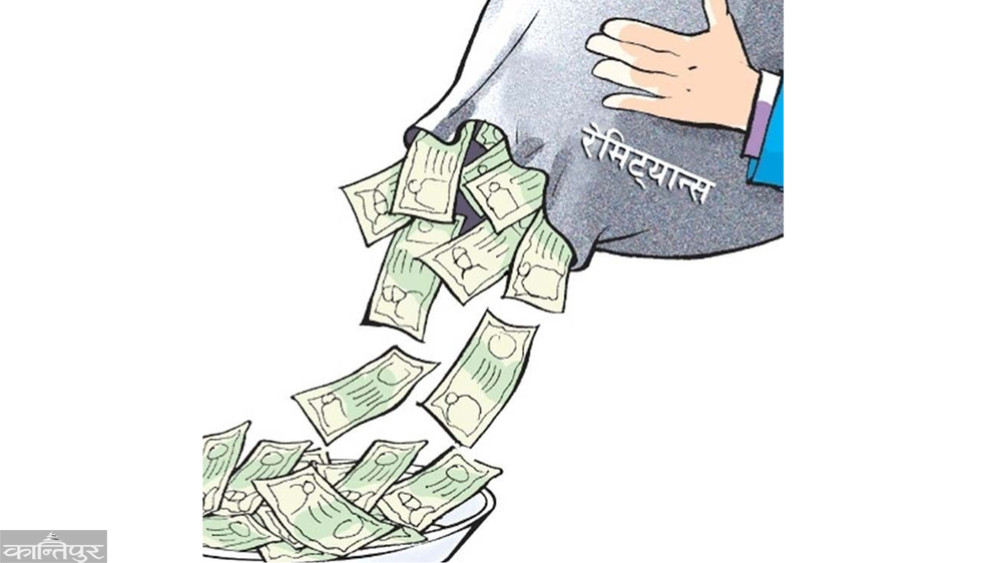
Over one billion remittances every month since one and a half years, the current foreign exchange reserves are enough to cover 14 months of goods and services imports.
We use Google Cloud Translation Services. Google requires we provide the following disclaimer relating to use of this service:
This service may contain translations powered by Google. Google disclaims all warranties related to the translations, expressed or implied, including any warranties of accuracy, reliability, and any implied warranties of merchantability, fitness for a particular purpose, and noninfringement.
Despite the lack of expected improvement in the main sources of foreign exchange earnings including exports, tourism, foreign investment, the record has been set in the external sector of the economy due to continuous increase in remittances. Foreign exchange reserves have been setting new records for 30 consecutive months, while current account balances and current account balances have also strengthened.
According to the economic and financial report of last January published by the National Bank on Monday, remittances of 9.58 billion rupees have been received in seven months. This is an increase of 7.3 percent compared to the same period last financial year.
More than one billion remittances are coming in every month for the last one and a half years. This is the reason other sources of foreign currency are exports, tourism, foreign investment, foreign subsidies and aid, even though the situation is critical, the external indicators of the economy are continuously becoming stronger.
The foreign exchange reserves reached 23 trillion 69 billion 80 million as of last January. Reserves up to last January have increased by 16.1 percent compared to June 2081. At the end of last June, the total foreign exchange reserves were 20 trillion 41 billion 10 million. Rashtra Bank claims that if the import of seven months of the current year is taken as the basis, the foreign exchange reserves of the banking sector will be enough to support 17.2 months of goods imports and 14.4 months of goods and services imports.
The contribution of remittances is more in the increase of foreign exchange reserves. In 2080/81, remittance inflows increased by 16.5 percent to 14 trillion 45 billion 32 billion. In the previous year, the flow increased by 23.2 percent. The number of people going to work abroad is also increasing.
In the seven months of the current financial year, the number of Nepalese who took the final work permit (institutional and individual-new) for foreign employment is 274 thousand 622 and the number of those who took the work permit again is 190 thousand 886. During the same period last year, such numbers were 245,432 and 157,450 respectively.
Although the amount earned abroad is continuously increasing in Nepal, the economy has not been able to pick up speed due to the lack of improvement in government income and expenditure. Economists have said that the continuously increasing remittances are not even being used in Nepal. Economist and former executive director of Nepal Rashtra Bank Nar Bahadur Thapa said that although indicators such as foreign exchange reserves, remittances, and remittances are continuously strong, the indicators of the overall economy are not satisfactory.
The government through internal borrowing and the National Bank through liquidity management are pulling money from the market. Revenue collection is not good," he said. "Despite the marginal increase in credit from banks and financial institutions to the private sector, the total internal credit expanded during that period is less than last year. This indicates that the economy is in contraction now than last year.'
He commented that the overall demand in the market has not increased due to the continuing decline in interest rates and lack of pressure on price increases and economic activity is not running. Thapa suggests that all three levels of government and the private sector should rapidly expand investment to benefit from the external sector of the economy. At the same time, he said, the mobilization of revenue and foreign aid should also be accelerated.
The average price increase (annual point consumer inflation) last January was 4.16 percent. Such inflation was 5.01 percent in the same month last year. According to Rastra Bank, the inflation of food and beverages group was 4.95 percent and the inflation of non-food and services group was 3.74 percent in seven months. Inflation for these groups was 6.59 percent and 3.98 percent respectively during the same period last year.
Last January, the annual point consumer price index of ghee and oil sub-group under the food and beverage group increased by 12.80, pulses and pulses by 9.06, vegetables by 7.56 and food and food products by 6.36 percent. However, the annual point consumer price index of Maramsala sub-group decreased by 2.98 percent.
Under the non-food and service group, the annual point consumer price index of miscellaneous goods and services sub-group has increased by 10.91 percent, clothing and shoes-shoes by 5.36 percent, alcoholic beverages by 5.08 percent, transportation by 5.01 percent, tobacco products by 4.10 percent, and furnishings and household appliances by 4.07 percent.
As of last January, the current account has a surplus of 1 trillion 66 billion 800 million. During the same period last year, the current account was in surplus by 1 trillion 62 billion 52 crores. In US dollars, the current account, which was in surplus of 1.22 billion in seven months of last year, is in surplus by 1.24 billion in the same period of this year. "Until last January, the current account balance is 2 trillion 84 billion 41 billion in surplus," the National Bank said, "Until January of last year, the current account balance was 2 billion 97 billion 72 billion in surplus." During the same period last year, deposits increased by 3 trillion 97 billion 200 million or 7 percent. According to the National Bank, deposits have increased by 9.7 percent year-on-year till January.