Congress-UML agreement to advance the process in Parliament
We use Google Cloud Translation Services. Google requires we provide the following disclaimer relating to use of this service:
This service may contain translations powered by Google. Google disclaims all warranties related to the translations, expressed or implied, including any warranties of accuracy, reliability, and any implied warranties of merchantability, fitness for a particular purpose, and noninfringement.
The government, which is unable to secure a majority in the National Assembly for the approval of the ordinance, has developed a strategy to put pressure on the smaller parties by advancing the bill on political parties. The ruling Congress-UML has decided to take the bill to Parliament to amend the Political Parties Act 2073 in order to facilitate the division of parties.
The government is doing its homework to register the bill in the parliament by Wednesday. After an informal agreement was reached between Prime Minister KP Sharma Oli and Congress President Sher Bahadur Deuba, a meeting of the political machinery comprising the second level leaders of both parties was held in Baluwatar on Friday night. The same meeting decided to advance the bill.
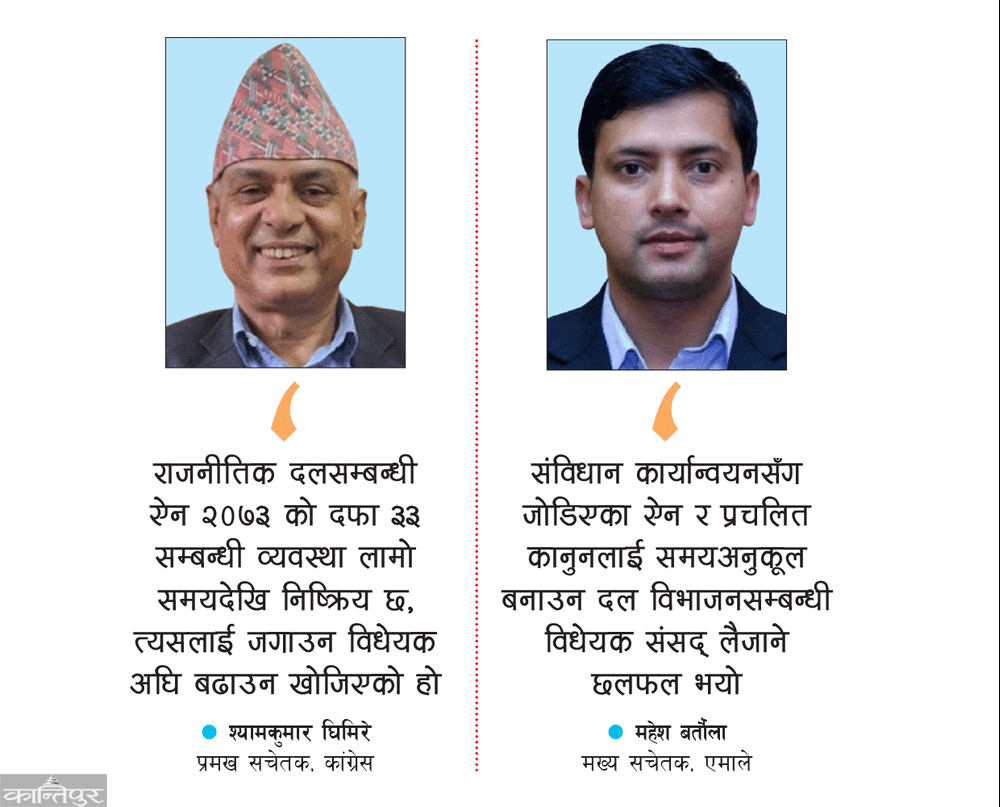
UML Secretary General Shankar Pokharel, Deputy Prime Minister and Finance Minister Vishnu Paudel, Prime Minister's Political Adviser Vishnu Rimal and UML Chief Whip Mahesh Bertaula participated in the meeting. From the Congress, Deputy Chairman Purna Bahadur Khadka, Home Minister Ramesh Ukhtar and Chief Whip Shyam Kumar Ghimire participated. Congress General Minister Gagan Thapa, who is in the
mechanism, did not participate as he was not sent back from Pokhara. According to one of the leaders who participated in the meeting, the bill to amend Section 33 of the Political Party Act 2073 is being prepared. In sub-section 2 of Section 33, there is a provision that at least 40 percent of the members of the Central Committee and the Parliamentary Party of the Federal Parliament can form a separate political party if they wish.
By amending that provision, it is being tried to make a provision that the party can be divided even if it has 40 percent in one of the parliamentary parties of the Central Committee and the Federal Parliament. The provision that a separate new party formed by dividing according to sub-section 2 cannot be divided for five years from the date of recognition by the Election Commission is in sub-section 3 of section 33.
The government is trying to open a way to divide the party at any time by revising it. But the new party that was formed after being divided in this way is trying to add a provision that it cannot merge with any other political party during the term of the same parliament. A leader of the UML said that because the leader of the ruling Congress suspected that Prime Minister Oli was trying to become the leader of a large parliamentary party by dividing the Unified Socialists and merging them into the UML.
Mahesh Bertaula, the chief whip of UML, said that there was a discussion in the meeting on Friday about bringing the bill to the parliament to make the laws and prevailing laws relevant to the implementation of the constitution. There was no discussion about what kind of bill to bring for that. It has been said that the government will bring the bill after making the necessary preparations," he said. "It has also been decided to make the parliamentarians active and hold regular committee meetings to bring the bill pending in the parliament to a conclusion in this session." The government led by Sher Bahadur Deuba brought an ordinance on political parties on August 2, 2078 with the aim of dividing the UML.
UML was split with the help of the Ordinance which was brought with the provision to divide the party if 20 percent of the party is in the Central Committee or any of the parliamentary parties of the Federal Parliament and the CPN Unified Socialist led by Madhav Nepal was born. Then, on the recommendation of the Council of Ministers, the then President Bidya Devi Bhandari revoked the ordinance on October 11, 2078.
After the repeal of the ordinance, the Pushpa Kamal Dahal-led government registered a bill in the Parliament on 18th March 2080 to keep the previous provisions in the Act. However, the said bill was withdrawn from the Parliament by the then Home Minister Ravi Lamichhane in order to open the door to bring an ordinance during the Dahal-led government. Now UML President Oli and Congress President Deuba have moved forward to amend the law with the aim of dividing the unified socialists.
Prime Minister Oli wanted to divide the Unified Socialists through an ordinance before the Parliament session started. The Ordinance was prepared and had already reached Baluwatar. However, it was stopped after Congress President Deuba protested that the introduction of an ordinance with a provision of 20 percent would increase the risk even within his own party. Now they are trying to bring a bill to revive Article 33. A Congress official said, "But now the bill will move on the fast track."
According to a source close to the Prime Minister, the government is preparing to pass the bill quickly by suspending the process of regulations. "During the approval process, there will be a delay in passing the ordinances brought by the government, so the provisions of the regulations may be suspended if they are passed by the full house (House of Representatives) at once," said the source.
Before the meeting in Baluwatar on Friday, Congress president Deuba had called a meeting of party officials and ex-officers at his residence Budhanilkanth. In the meeting, the Bill related to political parties was discussed. It is said that 20 percent cannot be kept as in the previous ordinance. It was discussed that the provision of 40% of the provisions in the Act will be made by replacing 'and' with 'or' so that the central committee or the parliamentary party will be in one of them. Then the friends went to Baluwatar," said Congress spokesperson Prakasharan Mahat.
The process of approving all the 6 ordinances registered by the government on January 18, the same day as the winter session started, has not been carried out by both houses. The government is facing a moral crisis as only the Congress and UML do not have a majority in the National Assembly and the Upendra Yadav-led Jaspa Nepal, which has supported the government, has put forward a condition that the land ordinance should be withdrawn.
Unable to reach a political consensus, the government is instead pushing the parliament meeting. At the request of the government, the next meeting of the House of Representatives has been held only on February 21. The meeting of the National Assembly has been called on Sunday.
Jaspa Nepal has 3 seats in the National Assembly. LOSPA, another party participating in the union government, has also decided not to support the government in the land ordinance. The LOSPA, which has one seat in the National Assembly, is also of the stand that the land ordinance should be withdrawn. The House of Representatives had once set the agenda for moving forward with the proposal to accept the ordinance. Speaker Devraj Ghimire abruptly removed the agenda at the request of the government when JSP was not sure of getting support from Nepal.
Even within the ruling party, there is opposition regarding the land ordinance. That is why Prime Minister Oli decided to proceed with only five other ordinances at the ruling party meeting held in Baluwatar on February 3. However, the government, which has taken the stand that JSP Nepal should withdraw the ordinance related to land, has not even advanced five other ordinances. Since the JSP Nepal is taking a stand, which does not support the other five ordinances without withdrawing the ordinance related to land, the government is on the way to divide the party by advancing the bill related to political parties. Even if the party splits after the passage of the
bill, it seems that Congress and UML will be able to get the ordinance approved by both houses. The Constitution has given the National Assembly two months to pass the bill passed by the House of Representatives or send it with amendments.
'It will be 28 days since the Ordinance came to the Parliament on Saturday, it seems impossible to pass the Bill in 32 days and get a majority by dividing the parties,' said another official of the Congress, 'now the strategy of the government is to put pressure on the small parties and pass the Ordinance after rushing the Bill.' "Probably, the ordinance will be submitted in the upcoming parliament meeting," he said, "It has been decided to call a meeting of the ruling party, including the JSP Nepal, tomorrow or the day after tomorrow." There will be a discussion on the interest of Jaspa Nepal in the ordinance related to land and an effort will be made to find a consensus with the replacement bill.'

