Madan Bahadur (Madankrishna Shrestha), who used to walk around with a lump of meat on his face. And, with the aim of making people laugh, they used to run the dallo. Does it satirize the self-esteem of a person with a fleshy face or not? Hari Bahadur (Harivansh Acharya) also used to make fun of such people by distorting his voice and making faces.
We use Google Cloud Translation Services. Google requires we provide the following disclaimer relating to use of this service:
This service may contain translations powered by Google. Google disclaims all warranties related to the translations, expressed or implied, including any warranties of accuracy, reliability, and any implied warranties of merchantability, fitness for a particular purpose, and noninfringement.
Singer Kum: How is Sagar's singing? A grand debate is going on from social media to tea shops on this issue. And, the city is divided. One has his diehard fans, basically the Genjis, who are willing to die for him. On the other hand, he is making jokes about the lyrics of the song he sang.
Does a singer become a comic character when he sings in his own style and style? Social media is also divided right now. What is the joy of blowing up other communities? Why should someone tease and bully others? And why should any community be cursed to consume khisituri?
The pinnacle of Nepali satire - writer Bhairav Aryal used to think - the purpose of satire is only to explore the truth. Aryal's idea was - 'The goal of today's comedians should be to raise comedy from the light level of farce to carry and nourish serious and profound feelings about life and the world.' He called creativity a social responsibility. ('Akshar', Bhairav Aryal Special). Aryal's satire - was in the world - attacking the anomalies seen in the political sphere and filling the voice of inspiration that the leaders should improve. But, is the current satire and literature like that? This is a matter of discussion.
Kum Sagar, a resident of Bhaktapur, sang a song in the Nepali language - 'Jane bhaye go, love ab ab nastau !...' Then what happened? Comedians Sajan Shrestha, Sujan Zimba, Utsav Sapkota and podcaster Sushant Pradhan made fun of the singing style of Kum: in an interview.
The Newa community drew the conclusion that the self-esteem of the entire Newar community was seriously hurt by the destruction of the Kumh Sagar. And, people from the Newa community filed a complaint with the police against them. They filed a petition against comedian Sajan Shrestha, singer Sujan Zimba, Utsav Sapkota and podcast host Sushant Pradhan. It was written in the complaint that the podcast used language that insults Newari culture and traditions.
Comedian Sajan Shrestha has also filed a complaint with the Cyber Bureau of the Police after a petition was registered against him. Her complaint is: 'She and her family became unsafe.' According to Sajan, her sisters were threatened with rape through a Facebook handle named Ridaya Tamrakar. Sajan informed about the application given to the police through social media. He demanded that the culprits should be prosecuted under Section-47 of the Electronic Transactions Act.
Sajan has already apologized for teasing Kum Sagar through a video and that video has also been removed from YouTube. The heritage conservation campaign also held a protest at the district police complex in Bhadrakali, saying that no action had been taken against those who had done the Khisitury.
There is a question - Why should the people of tribal-tribal community speak pure Nepali language? And why make him a subject of humor if he does not speak pure?
'Kum: On this issue of Sagar, both sides do not seem to be doing well. The subject of discrimination is coming up, but on the other hand it is also violent. Even when the wrongdoer apologizes, the crowd seems intolerant towards apologizing," says film director Deepakraj Giri. "Satire should not be targeted at individuals and communities. But trying to ban caricatures is extremism. Do not demoralize the community or individual through satire. Kum: Let's talk about Sagar, caricaturing how a Newar community can speak Nepali language is a ban on art itself.
Blasting someone on social media is new, but the story of this social 'troll' is old. Why are caste, character of the community, language, thego, poverty, love, geography, dress, physical condition always satirized through strong media such as television screen, literature or stage, stand-up comedy? When even such a serious subject has become the special 'content' of satire, the question has arisen - is satire such a cheap subject? And, it has become a satire on the very subject of satire.
In Nepali society, gossip about a community can happen anywhere on social media, playground, podcast, interview or a village-toll. Making fun of a particular community in television-serials-films or literature is considered a 'very common' act.
The first edition of the Nepal Premier League (NPL) was held in Kirtipur, Kathmandu, organized by the Cricket Association of Nepal (CAN) last November. While Janakpur Bolts were winning the title by defeating Sudurpaschim Royals by 5 wickets, a group hurled discriminatory and insulting words aimed at the Madhesi community. They treated the Janakpur Bolts supporters on the basis of race, caste and colour. It was opposed by the Madhesi Commission. Sike Raut-led Janmat Party demanded action against those who insulted Janakpur Bolts supporters.
Similarly, in the film 'Hostel Returns', a student who came to the city to study engineering lives in a hostel. Students from other parts of the country have a 'Bhaladmi' getup. However, Rameshwar Yadav (Nazir Hussain), who entered the city from Dharampur in Janakpur, has a Shiva statue, a bell in his bag and a red tattoo on his forehead.
"It's an attempt to blast other communities and cultures," film director Naveen Subba said in an interview. Another movie is 'Resham Filili'. There is a Madhesi character in it, his name is Harinarayan Mandal alias 'Hariya' (Kameshwar Chaurasia). How about Hariya in that film, he insists on having sex with a goat when he is angry. He is also the one who hits the girl, his friend Resham (Vinay Shrestha) urinates standing up, while he urinates sitting on the floor. In the opinion of
writer Tulanarayan Sah, the presentation of such content makes the weak even weaker. He says, "Such satire is the product of thinking that helpless, poor and weak people can be blown away." In
'Hari Bahadur-Madan Bahadur' there was Madan Bahadur (Madankrishna Shrestha), who used to walk with a lump of meat on his face. And, with the aim of making people laugh, they used to play the game. Does it satirize the self-esteem of a man with flesh on his face or not? There is no debate in the society. Hari Bahadur (Harivansh Acharya) also satirized such people by distorting his voice and making his face ugly.
Comedian Sitaram Kattel's 'Dhurmus' satirical teleserial 'Meri Bassai' let's see, he was - in the role of Khadkaji, she was Khadkaji - cleft palate. The Khadkas came to the streets in protest saying that the role defamed the Khadkas and the cleft palates. He protested by reaching the office of Media Hub, the program producer.
In the film 'Sunder Mero Naam' released in 2010, Deepakraj Giri made fun of people with different abilities by twisting his back and disfiguring his face. In films and teleserials, under the guise of making fun, the self-esteem of the taller and the gender minorities is hurt. And, viewers have been watching that content for decades.
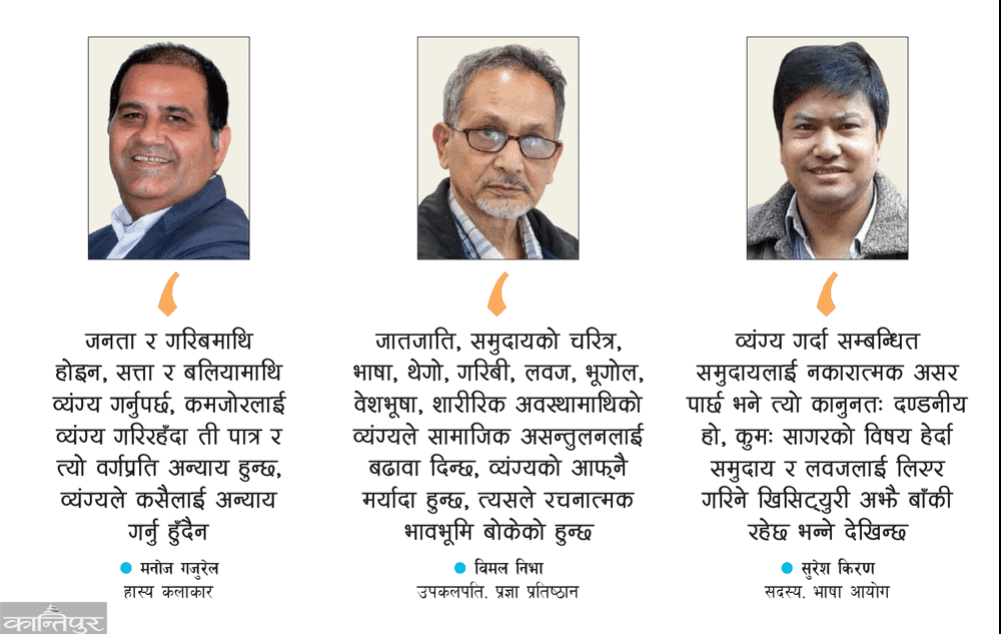
Comedian Manoj Gajurel believes that the weak and marginalized should never be made fun of. He says, "Whatever was done earlier, now humor has become responsible. We should not satirize the people and the poor, but the powerful and the powerful. Satirizing the weak is unfair to that character and that class. Now satire should not do injustice to anyone.
films, teleserials are so insensitive that those who play entitlements use their style to insult the Newa community and address 'T' as 'T' and 'T' as 'T'. Do you remember 'Muskan Paasa' from 'Meri Bassai'? With rose flowers sewn in his ears and coils in his ears, he is making others laugh by saying, ``Kati will laugh, I will die laughing.''
Poet Ujjwala Maharjan has said in a poem - My tongue did not know the difference between 't' and 'ta'
The distance between 'D' and 'D', 'Dh' and 'Dh', 'Th' and 'Th' was not considered... The door was always a deception....
is a genre of literature – satire. Everyone from kings to maharajas could be satirized. So probably started performing Gaijatra and writing cartoons. The literature and script of a strong satirist need to be strong.
Writer Bimal Niva says that no other satirist was born like Bhairav Aryal. Now the style of satire has changed, the characters have changed in the time that is rushing along with the hands of the clock. The form of satire also changed when it came to the presentation platform. Now only literature stopped working, people started satirizing acting, background music, mutilating mouths, twisting lives. As everyone's satirical style became the same, all those styles became 'cheaper'.
The satirist must know society, culture, literature, history. A satirist needs to have a study of multiple societies and cultures, which is lacking in our satirists. Satirists, who are supposed to mine the subject of satire, stand and perform before millions of intellectual audiences with very limited knowledge and poor art. Satirizing people, communities, castes and classes without targeting them is the religion of the satirist.
Only on Tuesday, 'Euta Sano Ghar Hos, Euta Duhuno Gai', the latest satirical collection by poet, satirist-writer, Vice-Chancellor of Nepal Pragya Pratishthan Bimal Nibha, has been published. His opinion is that satirizing caste, community character, language, thego, poverty, love, geography, dress, physical condition promotes social imbalance. Satire has its own dignity. Satire is not a chaotic thought, satire always carries a balanced critical consciousness.
That consciousness is always positive in totality. And, it carries a creative spirit. The common perception that sarcasm is a narrow minded, negative mood and a perverted state of mind is simply false. Earlier satirists used to satirize wives, servants and the poor," said Bimal Niva, "that is a distorted thinking, a sign of a distorted brain. Satire is a conscious mind with responsible words.'
Satirizing a community's identity as one's 'profession' is a terrible social phenomenon. In the opinion of Suresh Kiran, a member of Language Commission, poet, satirist and linguistic activist, satire cannot be done on the weak side of any person or community.
If such satire negatively affects the concerned community, it is punishable by law. We used to make jokes about the same things as before, like people with disabilities were made fun of because of their disabilities. After realizing that this is also wrong from the point of view of human rights, such sarcasm has started to decrease," Suresh said, "but looking at the issue of Kum: Sagar, it seems that the cynicism about the community and the people still remains. The practice of sarcasm and asking for forgiveness should be stopped and punished according to law.' Clarifying that provision, clauses 'a' and 'c' of sub-section 2 of Article 306 explain that 'deemed to be insulting' is not only insulting.
films-serials communicate with the society and imagine a beautiful society. But in comedy films or teleserials, the poor-Dalits who are the backbone of the society are shown in the role of thugs or badass, why? Does satire on them keep society healthy? Or is it just a product of the selfish thinking of making your supremacy great? The country is multi-coloured, multi-lingual and multi-cultural. What kind of country can we envisage by making them humorous-content, making them humorous?