It is not easy for the Constitutional Council to recommend the appointment of the President of the National Assembly, the Leader of the Opposition and the Deputy Speaker, as the political background of the three people is different from that of Prime Minister Oli.
We use Google Cloud Translation Services. Google requires we provide the following disclaimer relating to use of this service:
This service may contain translations powered by Google. Google disclaims all warranties related to the translations, expressed or implied, including any warranties of accuracy, reliability, and any implied warranties of merchantability, fitness for a particular purpose, and noninfringement.
The Supreme Court on Wednesday started the final hearing on the petition filed four years ago against the appointment of officials in the constitutional commissions. On the recommendation of the Constitutional Council chaired by the then Prime Minister KP Sharma Oli, 15 writs filed against the appointments made in various commissions in January 2077 and June 2078 were heard in the constitutional bench led by Chief Justice Prakashmansingh Raut.
The hearing started only after the tenure of the officials appointed for 6 years exceeded four years. Earlier, when there were 5 Chief Justices, including Kamu, the petition was not sent to hear the writ even though it was fixed 11 times.
If the appointment is annulled by the constitutional bench, a new process of appointment has to be started for all posts. Currently, the Constitutional Council is chaired by Prime Minister KP Sharma Oli and its members include Chief Justice Prakashmansingh Raut, Speaker Devraj Ghimire, National Assembly Speaker Narayan Prasad Dahal, Chief Opposition Leader Pushpa Kamal Dahal and Deputy Speaker Indira Rana.
The political background of the National Assembly Speaker, Leader of the Opposition and Deputy Speaker is different from that of Prime Minister Oli, so it is not easy for the Constitutional Council to recommend their appointment. Even if the Chief Justice supports the Prime Minister's proposal, only three votes (50 percent) will be enough.
In such a situation, if the appointment to the constitutional commission is strong, then the commission will remain vacant for a long time. In this case, there is a risk of party division in the name of national consensus. If that does not happen, a new political chapter may be initiated to fill the constitutional chaos.
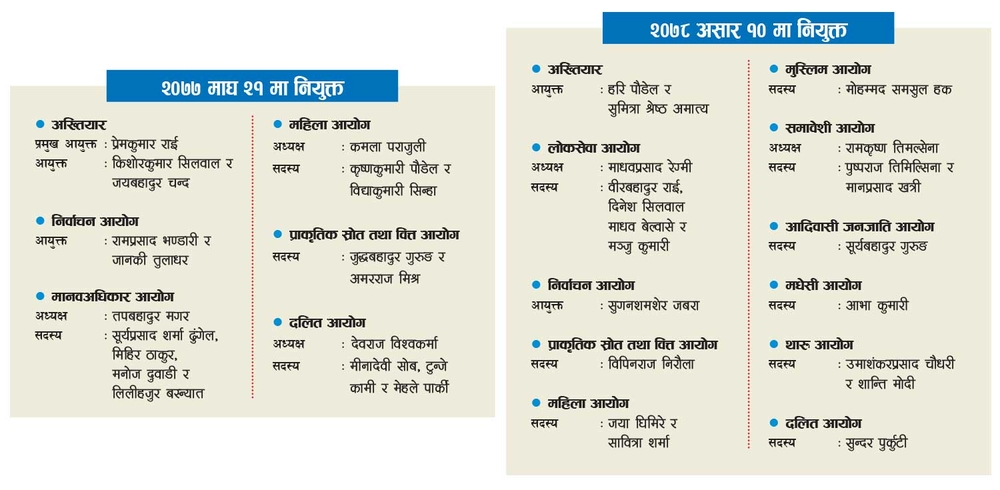
Prime Minister Oli of the then CPN-led government brought an ordinance on the Constitutional Council in November 2077 and recommended 32 names for appointment to the Constitutional Commission. Then in May 2078, 20 more people were recommended for appointment in various commissions. Both times the House of Representatives was dissolved and the session of the National Assembly was terminated after recommending the appointment to the Constitutional Commission on the basis of the Ordinance.
The government of the time amended the provision that if five people attended the meeting of the Constitutional Council, it was considered a quorum. The ordinance also made a legal provision that a majority of members including the chairman can take decisions from the meeting held in that manner.
The names were sent to the Parliament for hearing after the recommendation of the Constitutional Council sitting according to the revised legal provisions. When the recommendation was decided, the then Speaker Agni Prasad Sapkota and the leader of the main opposition party Sher Bahadur Deuba boycotted the council meeting. But the officials were recommended by the decision of Prime Minister Oli, the then Chief Justice Cholendra Shamsher Jabra and the then Speaker of the National Assembly Ganesh Prasad Timilsina. In the name of
recommendations, the House of Representatives was dissolved on December 5, 2077 and June 8, 2078 without the hearing committee starting its work. The then President Bidya Devi Bhandari appointed her after 45 days without a hearing on the name recommended to the Constitutional Commission.
15 writs were filed in the Supreme Court from December 1, 2077 to July 10, 2079 demanding the cancellation of the ordinance and cancellation of appointments with the argument that the constitution was falsified. The then Speaker and Constitutional Council member Agni Prasad Sapkota, Senior Advocate Dinesh Tripathi, Advocate Omprakash Aryal filed the writ. 4 years after the
writ was filed, the hearing has started in the bench. Besides Chief Justice Raut, the constitutional bench for the hearing consists of Justices Sapna Pradhan Malla, Manoj Kumar Sharma, Kumar Chudal and Nahkul Subedi.
The Constitutional Council chaired by the Prime Minister consists of the Chief Justice, the Speaker, the Speaker of the National Assembly, the leader of the main opposition parties and the Deputy Speaker. Cholendrashamsher Jabara was the Chief Justice when the recommendation was made to the Constitutional Commission. It was alleged that he supported the recommendation by asking to participate in the Constitutional Commission and did not hear the writ against the appointment. During Jabara's tenure, the writs were kept in 'not to be seen' even though they were brought up for hearing three times.
When Deepak Karki became the permanent Chief Justice after Jabara, Pesi went up for hearing four times. At that time, show cause, interim order not to be issued and other orders were issued. After that, during the time of Harikrishna Karki, who became the leader of the constitutional bench, the writ was filed for hearing once, but it was not heard. Even when Vishwambhar Prasad Shrestha was the Chief Justice, the writ was not heard four times. During the tenure of the current Chief Justice Raut, the petition for the final hearing has been started after the third time of hearing. The next hearing of the writ, which started on Wednesday, is scheduled for February 21.
Petitioner Advocate Omprakash Aryal has argued in the constitutional bench on the first day of the hearing. He put before the bench the demand for canceling the constitutional council ordinance and the appointment of 52 people. Aryal said that there were various reasons behind the
writ not being heard for four years. The delay in the hearing is due to the internal court. Cholendrashamsher had appointed some people after taking the share. He blocked the hearing and delayed it for 8 months. Then there was a dispute whether he should sit on the bench or not. Through that, the hearing was stopped by the order of Judge Hari Phuyal,' said Aryal, 'The Chief Justices after that did not look at the writ because of the bargaining in the Constitutional Council.'
Aryal's guess as to why the hearing was started now, 'The credibility of the court fell by not looking at this case. The present Chief Justice had said in the parliamentary hearing committee and in public statements that the general message that the judge is under the influence of the political power center, that the court is under the influence, and that he will return that credit has gone. That's the reason why the hearing has been started.' Aryal said that he did not understand the reason why the next payee was brought to February 21 and expected to have a regular hearing after that.
Senior advocate Chandrakant Gyawali, who debated on Wednesday, mentioned that after the House rejected the ordinance, 52 people were appointed after the House of Representatives was dissolved. He said that ordinances that should be brought to do something immediately have been brought repeatedly with the same content and purpose and the right of the legislature to make laws has been violated.
Parliament rejected the ordinance that was brought once. Due to the need to bring the bill, the session was closed again and an ordinance was brought. After that, Parliament was dissolved and appointed to constitutional positions according to the ordinance," he said. "The House of Representatives was dissolved to evade the provision of the constitution that officials appointed to the Constitutional Commission must undergo a parliamentary hearing." It is the responsibility of the court to review the constitutional dispute. He should have prioritized the hearing. "If there is no judicial review, the government will end the legitimacy of the parliament," he said. He says that politics should be guided by constitutionalism, because at that time constitutionalism was guided by politics, so the court should conduct a judicial review. "Those ordinances and recommendations made in the Constitutional Commission should be annulled as they fall within the ambit of judicial review," he said.
Anand Prasad Dhungana, who is currently a member of the parliamentary hearing committee, said that since the writ against the appointed official is being heard in the Constitutional Commission, there is no need to comment on it. At that time, the people recommended in the Constitutional Commission were not heard because there was no Parliament. Appointed by Ordinance. If there was a parliament, there would have been a system to go to the hearing," said Congress MP Dhungana.

