The government does not need reform, it has been able to exploit the state by sharing, it is just a show of good governance. - Padmini Pradhanang, Past President, Transparency Nepal
We use Google Cloud Translation Services. Google requires we provide the following disclaimer relating to use of this service:
This service may contain translations powered by Google. Google disclaims all warranties related to the translations, expressed or implied, including any warranties of accuracy, reliability, and any implied warranties of merchantability, fitness for a particular purpose, and noninfringement.
Nepal's international image is continuously declining as all the three organs of the state, executive, judiciary and legislature seem indifferent to control corruption and maintain good governance. According to the Corruption Perceptions Index (CPI), conducted by Transparency International, an international organization that monitors corruption and good governance, Nepal has not been able to come out of the list of highly corrupt countries.
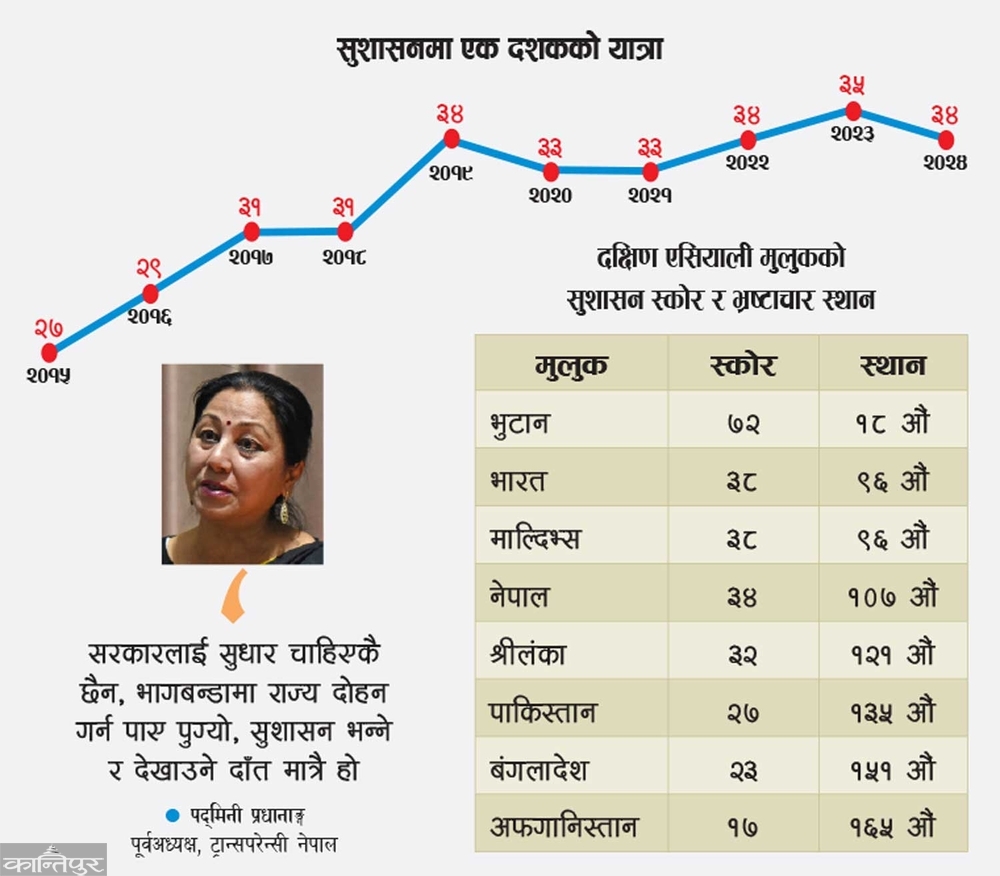
In the 2023 report of Transparency, Nepal scored 35 out of 100 points in governance. According to the report of 2024, Nepal's level dropped and got only 34 points. Transparency ranks countries with scores below 50 out of 100 as highly corrupt. Nepal is ranked 107th among 180 countries included in the survey. Last year it was at number 108.
CPI has stated that the state has not achieved any concrete achievement in improving the governance level of Nepal. Madankrishna Sharma, the president of Transparency Nepal, said that even though the country has moved to a federal democratic republic, the constitution has been promulgated accordingly, and governance has been operated by a three-level government, but there has been no improvement in good governance.
"Even though the Constitution of the Republic of Nepal came into effect in 2072 and the three-level government has been in operation for about 8 years, no success has been achieved in reducing corruption in Nepal," Sharma said while releasing a report on Nepal on Tuesday. Lagla, who runs the country - whether it is officials, employees or anyone from making laws to delivering justice, the truth is, the state system is in the hands of middlemen,' says a former secretary, 'they don't need reform, even if the revenue is low, even if there is no development expenditure, even if the procurement is not transparent, it doesn't matter, the exploiters have been able to do it, they have been appointed for self-interest, does it matter? The only thing that will affect the country's reputation is the country's reputation.
The implementation of measures taken by the state to maintain good governance, action against political and administrative persons involved in corruption, prevention and control of conflict of interest, transparency in import-export, etc. Transparency has maintained the level of the country based on the measurements made by 6 different international organizations World Bank, World Economic Forum, Global Insight, Bertelsmann Foundation, World Justice Project and Varieties of Democracy Project.
Nepal is included in the list of high corruption in the assessment of all 6 organizations involved in regional level measurement. The World Bank conducted a survey on issues such as government decisions, use of resources, and accountability of employees and citizens, access to government information, and the control of limited individuals with vested interests in government operations. The World Bank has given Nepal 39 points out of 100.
World Economic Forum conducted a survey on corruption in import-export, public services, tax payment, public contracts and judicial decisions, and Nepal got only 30 points. According to the index, Denmark has scored 90 points continuously for 7 years and is stuck at the first number of countries maintaining good governance. Denmark is the least corrupt country by this measure. The most corrupt country is South Sudan. South Sudan scored only 8 out of 100.
This country has been in the grip of civil war for a long time. The United Nations has been deploying peacekeeping forces and police from various countries there to maintain peace. According to the 2024 report, two-thirds of the countries participating in the measurement have scored less than 50 points and are included in the list of highly corrupt countries.
This time, Bhutan is stuck in the country with the most governance in the 8 countries of South Asia. Bhutan got 72 out of 100, India and Maldives got 38 points, Sri Lanka 32, Pakistan 27, Bangladesh 23 and Afghanistan 17.
Denmark 90, Finland 88, Singapore 84, New Zealand 83, Luxembourg, Norway and Switzerland with the same 81 and Sweden 80 in the list of countries with good governance are included in the list of countries with good governance.
Nepal ranks third in South Asia. Neighboring country China got 43 points out of 100. Global Insight's survey on the risk of bribery and corruption in trade/business, public contracting, import-export and day-to-day work has pointed out that the situation in Nepal is critical. Global Insight has given only 32 points to Nepal. The Bertelsmann Foundation gave a score of 34, the World Justice Project 32 and the Varieties of Democracy Project 34.
Bertelsmann conducted a survey on the extent to which public officials involved in abuse of office are prosecuted and the government's level of corruption control, while World Justice conducted a survey on the abuse of office for private interests by representatives of the government, parliament, courts, and security agencies, and Varieties of Democracy conducted a survey on corruption in the parliament, government, judiciary, and public sector under political corruption.
Although Nepal's level in the World Bank's scale shows some improvement from last year, it is not enough to get out of the list of highly corrupt countries. In 2023, the World Bank gave Nepal 35 out of 100 points, this time it increased by 4 points to 39. In the scale of World Economic Forum, Nepal got 38 points last year, this year it has decreased by 8 points. Global Insight has reduced 3 points from last year, while Bertelsmann has given 1 point more than last year. World Justice gave 1 point more than last year and Varieties of Democracy gave 1 point less than last year.
In this way, Transparency has kept Nepal in the list of countries with the most corruption with a total of 34 points in 2024 by measuring the average of the evaluations received from separate organizations. In the 10 years since the constitution was promulgated, Nepal got the highest score in 2023. However, this time it fell from that and got only 34. Out of 100 points, Nepal scored 34 in 2022, 33 in 2021 and 2020, 34 in 2019, 31 in 2018 and 2017, 29 in 2016 and 27 in 2015. 27 points in 2012, 31 in 2013 and 29 in 2014.
Nepal was ranked 122th in 2017, 124th in 2018, 113th in 2019, 117th in 2020 and 21, 110th in 2023 and 108th in 2023 last year among 180 countries included in the transparency scale.
Due to political bargains, the main challenge for good governance is from always making bargains in the prevention and control of corruption, interfering with the agencies that investigate crimes, and even those who are brought under investigation are under pressure and influence, weakening the case and appearing with impunity.
It seems that there is an increasing trend of accepting bribe money abroad and keeping it there, setting it up in Nepal for big purchases. Recently, during some large-scale corruption investigations conducted by the authority, it was confirmed that people at the political and administrative levels accept bribes abroad for giving large purchases made to the plans of businessmen and middlemen. Transparency has also pointed out that bribery does not work.
The government has not shown caution in creating laws related to conflict of interest. Interference has not been stopped in the activities of agencies investigating and prosecuting cases such as the Abuse of Authority Investigation Commission, the Police, the Asset Laundering Investigation Department, and the Revenue Investigation Department. Attempts to block cases connected with large-scale scams from the public prosecutor's office to the court have also been ongoing.
Attempts are being made to weaken the provisions of both the Commission for Investigation of Abuse of Authority and the Prevention of Corruption Act pending in Parliament. Another reason for Nepal's downfall is the tendency to obstruct the cases being investigated by the authority. From giving ministerial or other public appointments to political persons related to conflicts of interest, to returning persons convicted of crimes to the law-making body by court orders, it has also been seen as a factor in the increase in misgovernance.
The suggestions and instructions given by the authority and the Auditor General's office have not been followed. Even though the authority sent many employees for departmental action before the trial, the government did not act accordingly. Although the Accountant General has repeatedly instructed to recover the amount of such irregularity from the officials/employees who commit financial irregularities and to take action against corruption, the government has been refusing to do so.
The authority has been repeatedly reminding the government to control corruption through the annual report. President Ramchandra Poudel on Monday drew the attention of the government to take effective measures to prevent corruption in the program organized on the 34th foundation day of the Authority. Prem Kumar Rai, the chief commissioner of the authority, expressed his displeasure with the government in the round about the government saying that the government should take the lead to maintain good governance.
Due to the state's lackluster initiatives in financial discipline, the country is at risk of being on the bad list of the Financial Action Task Force (FATF), which monitors money laundering globally. This organization has prepared to put Nepal on the 'negative list' (grey-list) saying that proper steps have not been taken to control money laundering and that the steps taken have not been implemented.
Nepal had asked for one year time for reform after being warned to put it on this list last year, but as no signs of reform were seen within the requested time, FATF has prepared to put it on the list of bad countries in money laundering control, which will further negatively affect the image of Nepal.
The former president of Transparency Nepal, Padmini Pradhanang, says that even though state exploitation has crossed the border, no initiative has been taken to prevent and control it. "Government does not need reform, they have been able to exploit the state in divisiveness. Good governance is just a show of teeth," Pradhanang told Kantipur.
Question in Parliament for not publishing the property details
Even after 7 months of the KP Sharma Oli led government, the property details of the prime minister and ministers have not been made public. The coalition government, which includes the two largest parties in Parliament, the Congress and the UML, has broken the practice of disclosing the assets of the cabinet members.
It is mentioned in the first point of the 7-point agreement between the two parties for government formation that corruption control and good governance will be maintained. Property details of Prime Minister and Ministers were being made public to strengthen good governance. But after the prime minister and the minister hid the property details, the Oli government's governance has started to be questioned.
The opposition party has also raised this issue in the parliament. In the House of Representatives on Tuesday, MP Asim Shah raised a question as to when the minister's property details will be made public. "Why are those who raise slogans of transparency and accountability silent?," he said, "how can we expect corruption files to be opened from a government that does not disclose the property details of ministers?" He said that we cannot even expect good governance from the government.
There is a 25-member cabinet led by Oli. The website of the Office of the Prime Minister and Council of Ministers claims to have received the property details of all the ministers including the Prime Minister. But the property details are hidden on the website, access is not given. Asset details do not open.
The previous government led by Maoist Chairman Pushpa Kamal Dahal had released the property details of the cabinet members last May. After the election of 2079, after he ran the government for 16 months, the property details were made public. At that time he was the Prime Minister in an alliance with UML and RSVP.
Before that, when the government was running in alliance with the Congress, the government led by him was not paying attention to publicizing the property details. The cabinet meeting decided to make the property details public after the pressure was increased by the people who became ministers from the RSVP. The decision of the Council of Ministers meeting on May 3 was as follows, 'The statement of assets submitted by the members of the current Council of Ministers to the Office of the Prime Minister and Council of Ministers in accordance with Section 50 of the Prevention of Corruption Act 2059.' In section 50 (4) of the same Act, there is a provision that the details submitted in that way will be kept confidential.
Similarly, Section 31 of the Abuse of Authority Investigation Commission Act, 2048 also has a provision to submit property details. There is also a provision that a person holding a public position must submit the property details within 60 days. It is said that the Government of Nepal should publish a notice in the Gazette and submit such details to the designated agency or authority.
Oli became the Prime Minister on June 31 after the agreement reached between Congress and UML on the night of June 17. Since then, no interest has been shown in publicizing the property details of members of the Council of Ministers. Since 2048, the minister's property details have been made public.
The former president of anti-corruption activist Transparency International Nepal, Padmini Pradhanang, says that since she is in charge of running the government, her property details should be made public. "When a good practice is stopped, many questions start to arise in people's minds. In order to win the trust of the people, the property details should also be brought out," she said.
On June 29, 2078, the property details of the ministers were not made public during the tenure of the Congress President Sher Bahadur Deuba-led government that replaced the Oli government. In 2048, when he was the home minister, a rule was made that the minister should make his property details public within 15 days of assuming office. The government was formed after the people's movement. At that time, the practice was started with a good heart and a desire to maintain good governance," Pradhanang said. The practice was kept alive. By hiding the reality, the minister started to give details of assets.'
Publicizing how much assets he had while he was a minister, and how much assets he got when he left, is considered a good 'indicator' of the country's good governance. He says that at least political persons who have reached positions and those who have political appointments should disclose their assets. "It is dangerous for good governance and the country not to publicize the property details under this or that excuse," she told Kantipur. People should know that.
government spokesperson Prithvi Subba Gurung, the government's spokesperson, said that all the ministers have submitted their property details to the Prime Minister's Office. "I don't think there is any reason why the property details should not be made public," he said, "In this context, the Prime Minister's Office should understand." But during the Oli-led government that was formed after the 2074 election, the issue of publicizing the minister's property details stopped getting priority. 2 months after becoming the prime minister after the election, his government released the minister's property details. But after the changes in the Council of Ministers, the property details of the ministers have been kept secret. At that time, some ministers left their posts without disclosing their assets.
Article 28 of the Constitution enshrines the right to privacy of individuals and property. Section 10 of the Personal Privacy Act, 2075 has given every person the right to keep his property and details about it confidential. Section 34 of the same Act states that the provisions of the Act shall not prevent the disclosure of the property of a person holding a public position.
Madhav Paudel, the former chairman of the Law Commission, says that the intention of the law is to make public the property details of people holding public office. According to him, even though the constitution and laws give the right to the privacy of an individual's property, it is understood to be the right of ordinary citizens.
The law has not forced anyone to disclose property details. However, it has not stopped them from doing so," he says. "The property details of people holding public positions should be made public. It is also a matter that should be determined by a person's morality, conscience and conscience.'' In the absence of such a clear provision in the law, in the past, the government has been publishing members' property details by putting it in the code of conduct or making a decision.

